
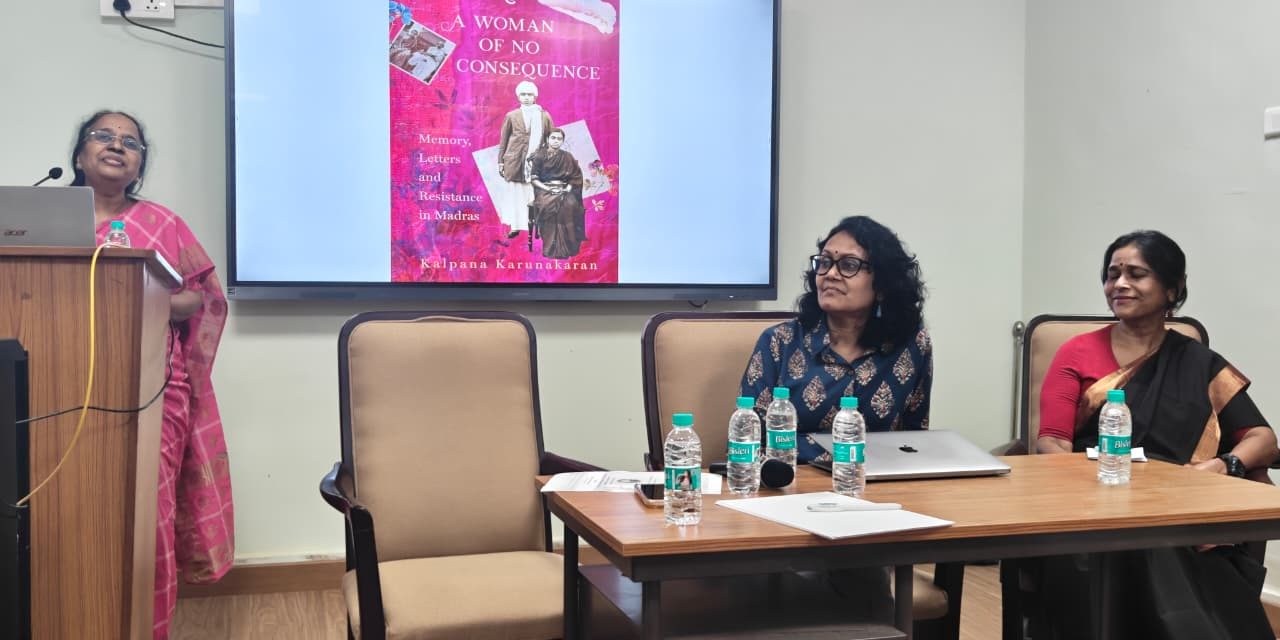
The Centre for Women’s Studies, University of Hyderabad, organized a talk titled “Grandmother, Mother, Daughter: Writing Women’s Lives” by Dr. Kalpana Karunakaran, President of the Indian Association for Women’s Studies (IAWS) and faculty at IIT Madras. The session, held on January 27, 2026, at the New Seminar Hall of Social Sciences, was based on her book A Woman of No Consequence: Memory, Letters and Resistance in Madras.
The program began with a welcome address by Prof. Deepa Sreenivas, Head of the Centre for Women’s Studies, who spoke on the significance of examining women’s lives across generations. Prof. K. Suneetha Rani, Dean of the School of Social Sciences, chaired the session. Ms. Anjalee Kumari, a research scholar at CWS, anchored the event, while Ms. Alice Abraham, also a research scholar, introduced the speaker.
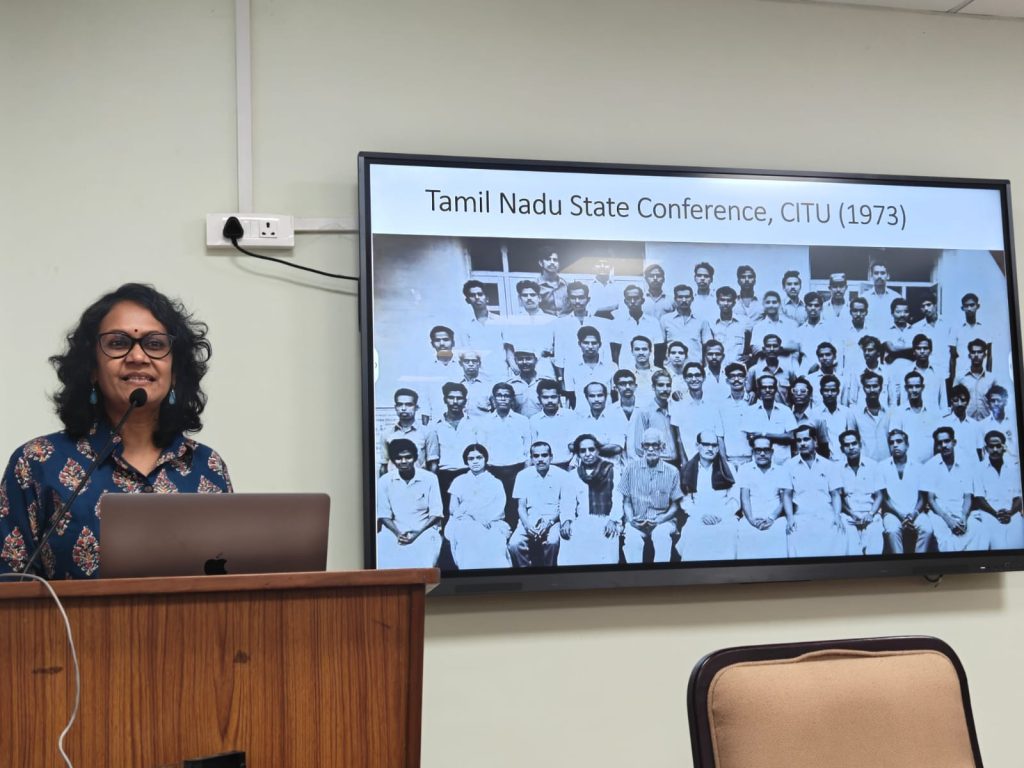
Dr. Karunakaran began the talk by mentioning how touched she was by Prof. Suneetha Rani’s recollection of her mother, Mythili Sivaraman, during the introduction. She framed the ensuing conversation around the celebration of women’s lives. Her initial presentation focused on Mythili Sivaraman-highlighting her writing, her struggles against oppression, her activism, and the profound impact she and her own mother had on the speaker. The narrative then shifted to the lives of Dr. Karunakaran’s grandmother and great-grandmother, illustrating their distinct approaches to life. She highlighted how her grandmother, Pankajam-a housewife who described herself as a Sarvasadharana kudumba penmani (ordinary family woman)-documented her lived experiences through autobiography. Dr. Karunakaran noted that Pankajam occasionally turned to fiction, using pseudonyms to tell her story. Throughout the talk, the speaker’s effort to centre her grandmother as an individual, by referring to her by name rather than defining her solely by relationships, was deeply appreciated. A particularly moving moment occurred when someone in the audience realized that one of the letters discussed was actually written by her own grandmother. This revelation surprised the room and served as a cherished memory for the speaker as well.
Pankajam’s writings covered diverse topics, including anti-colonialism, the transformation of Madras during the 19th and early 20th centuries, and shifting educational patterns. Although she described herself as “A Woman of No Consequence” in her 80th birthday reflections, Dr. Karunakaran’s work to compile these writings into a book opens out the many dimensions and complexities that underlie such a self-description.
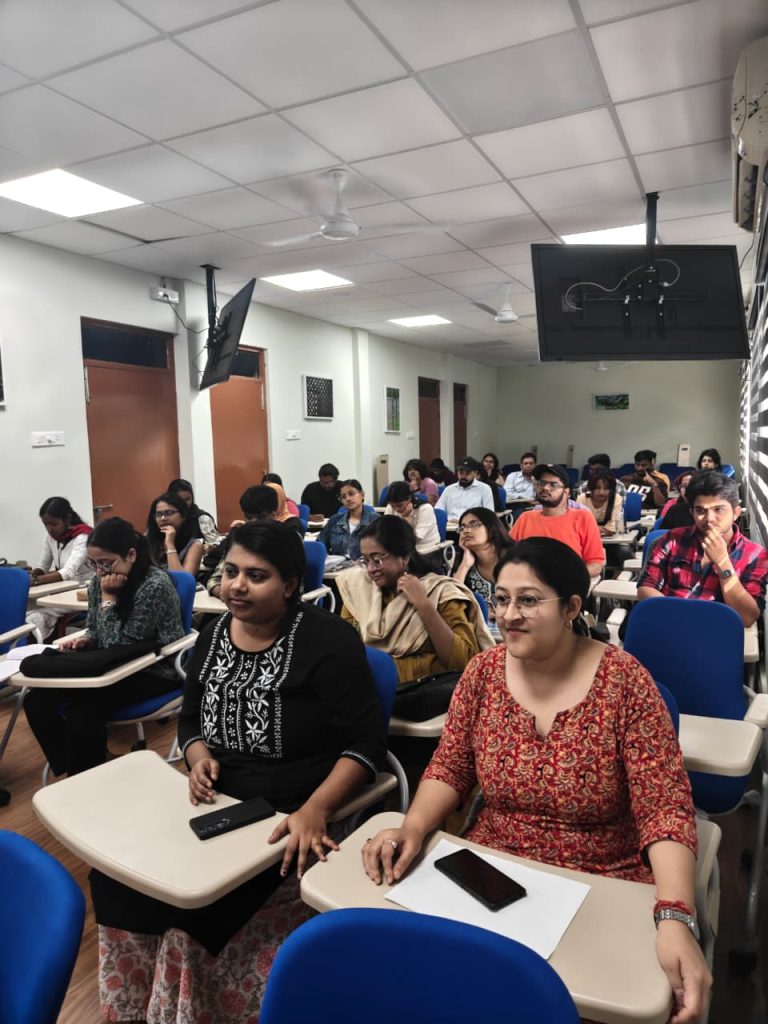
The event drew an enthusiastic audience of faculty, students, and university community members. The presentation was followed by an interactive session where faculty and students posed inquiries, exchanging both appreciation and critical perspectives. Abhiruchi Chatterjee delivered the vote of thanks. The event not only celebrated the speaker’s contributions but also fostered a strong sense of community. It highlighted the importance of dialogue in academia, leaving the audience with a renewed appreciation for storytelling and the power of individual narratives. This gathering served as a reminder that every voice matters and that even those who view themselves as “a woman of no consequence” can leave a lasting legacy through their words and experiences. The successful culmination of the event underscores the value of such initiatives in promoting intellectual engagement and inspiring future generations.
Report by: Silpa B Das (Research Scholar, CWS)