
The Centre for the Study of Indian Diaspora (CSID), School of Social Sciences, University of Hyderabad, organised the XIV Lusophone Film Festival 2026 on Saturday, 14 February 2026, at the New Seminar Hall, School of Social Sciences.
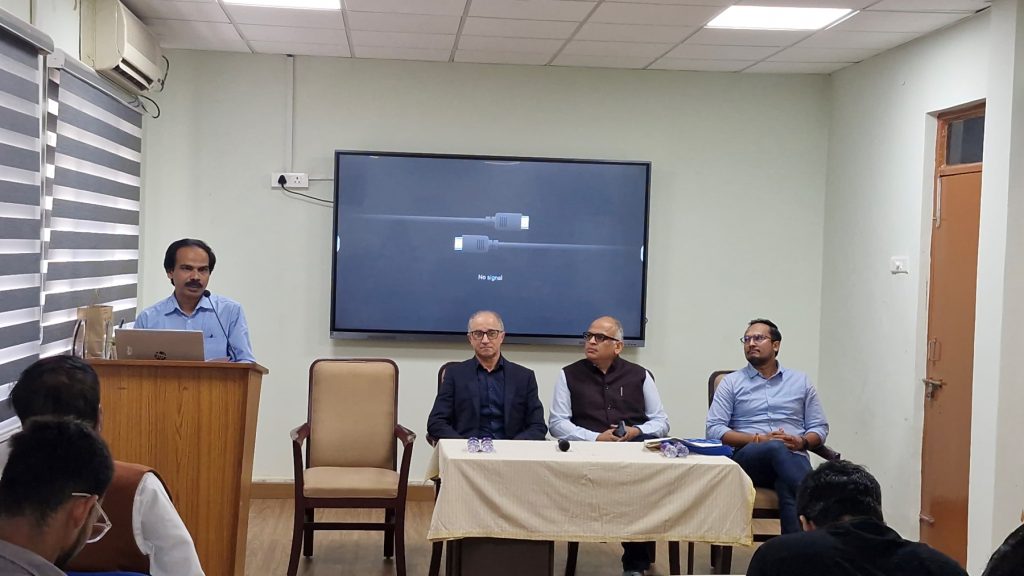
The festival was conducted in collaboration with Camões – Centro de Língua Portuguesa and the Consulate-General of Portugal in Goa, with support from FESTIN – Festival de Cinema Itinerante da Língua Portuguesa and Cinemateca Portuguesa – Museu do Cinema. Designed as a one-day academic and cultural programme (10:30 AM – 6:30 PM), the festival combined keynote lectures, scholarly dialogue, academic discussions, and curated film screenings to promote engagement with Lusophone cinema, language, and culture.
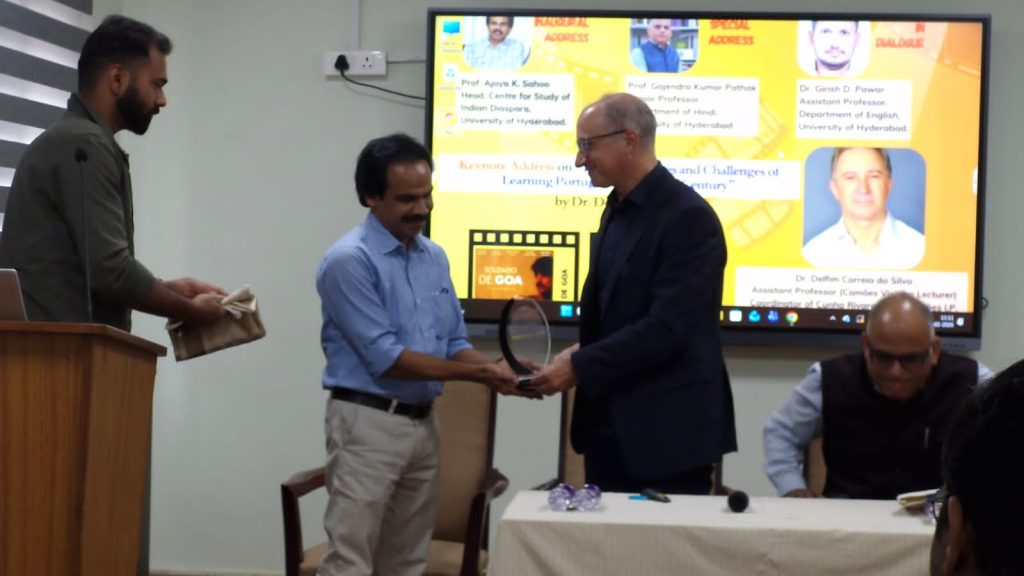
The programme began with an inaugural address by Prof. Ajaya K. Sahoo, Head, CSID. He highlighted the long-standing historical and cultural connections between India and the Portuguese-speaking world. He emphasised that cinema provides an important platform to understand shared colonial histories, migration experiences, and evolving diasporic identities.
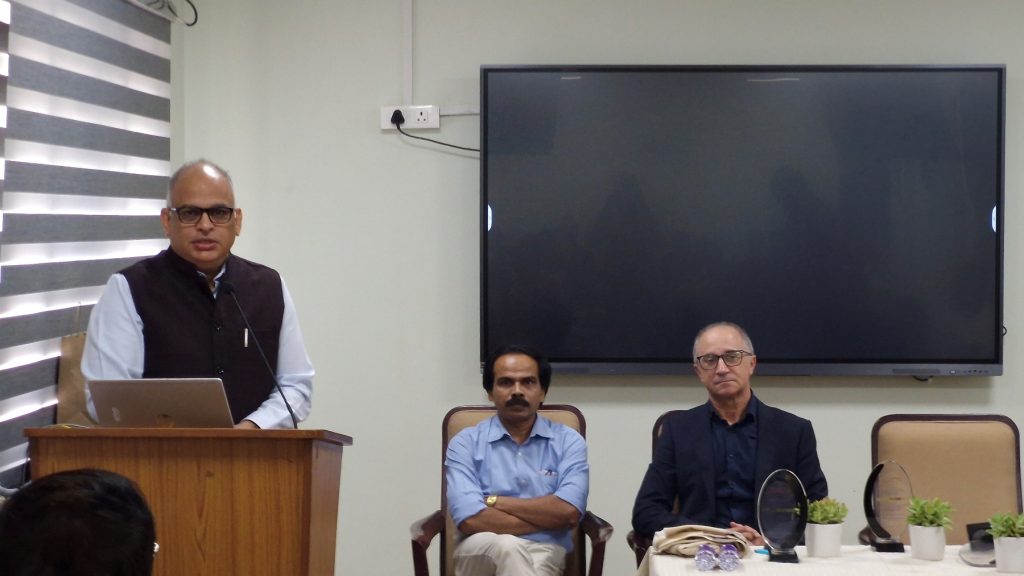
The Special Address was delivered by Prof. Gajendra Kumar Pathak, Senior Professor, Department of Hindi, University of Hyderabad. He offered a comparative perspective on Indian and Portuguese literary traditions and explained how diaspora communities negotiate identity and cultural memory across languages and regions.
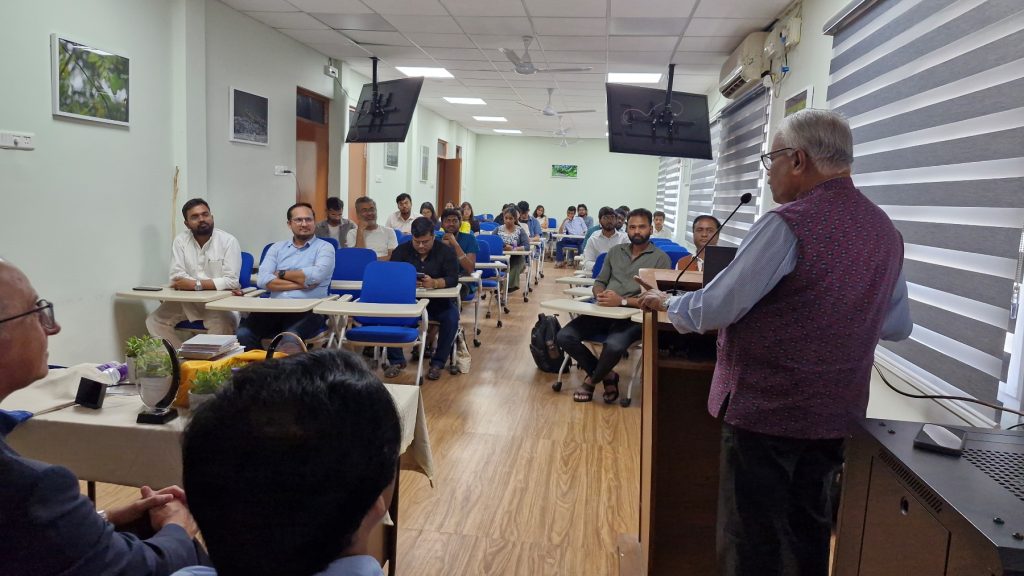
The programme had the presence of the Hon’ble Vice-Chancellor, Prof. Basuthkar Jagadeeshwar Rao, of the University of Hyderabad. His participation reflected the University’s strong commitment to intercultural dialogue and global language learning. In his address, he explained the academic and strategic importance of the Portuguese language in contemporary higher education, diplomacy, and international collaboration. He noted that proficiency in Portuguese can open new avenues for research partnerships, comparative cultural studies, and stronger academic ties with Lusophone countries in Europe, Africa, Asia, and South America.
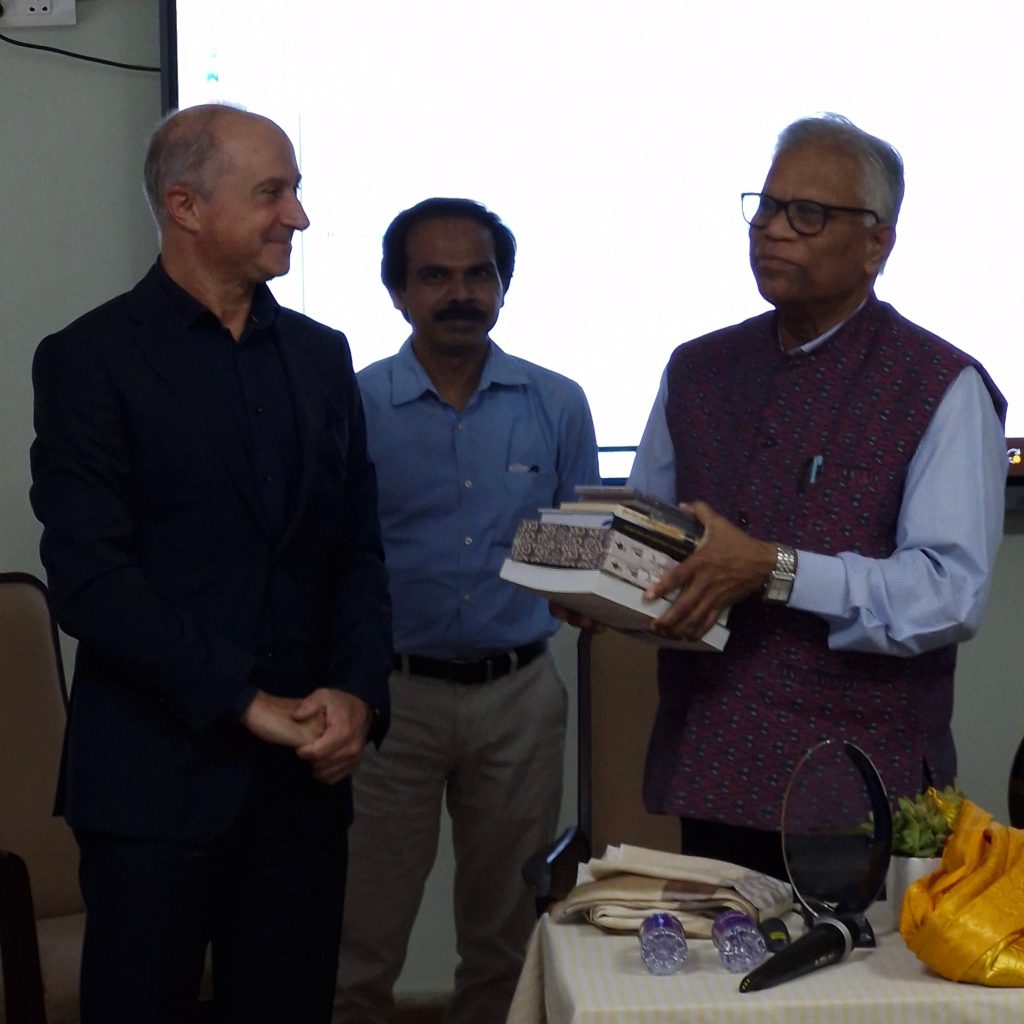
The Vice-Chancellor also expressed interest in developing formal academic collaboration with Dr. Delfim Correia da Silva. He suggested that if Dr. Delfim is willing, the University of Hyderabad would explore the possibility of signing a Memorandum of Understanding (MoU) to promote faculty exchange, joint research projects, co-organised seminars, and curriculum development in Portuguese and Lusophone studies. He further discussed the possibility of starting a Portuguese language course at the University in collaboration with the Camões Centre, provided a resource person is made available. As Coordinator for Foreign Languages Courses, Dr. Girish D. Pawar also discussed the potential for initiating such a programme at the University.
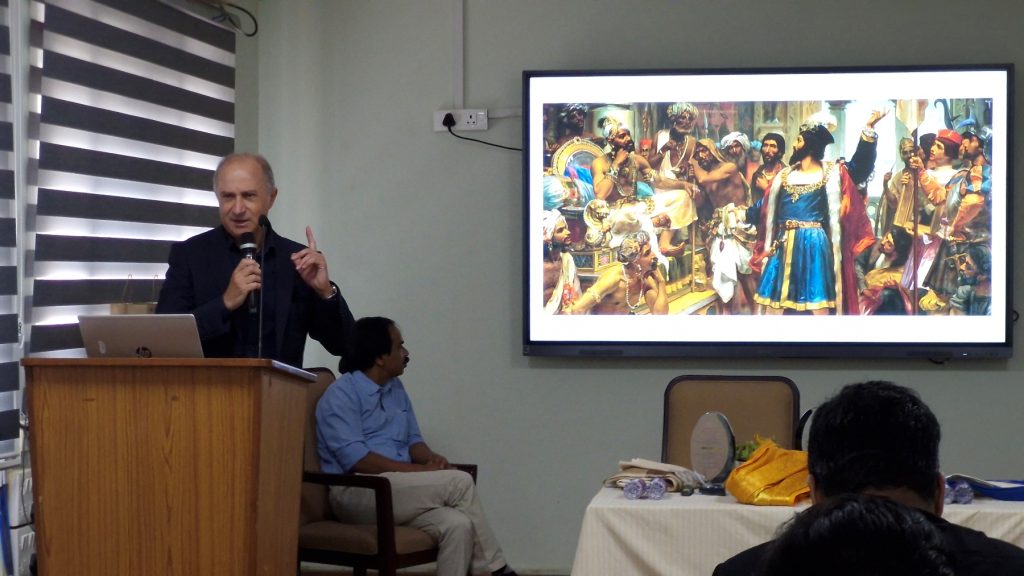
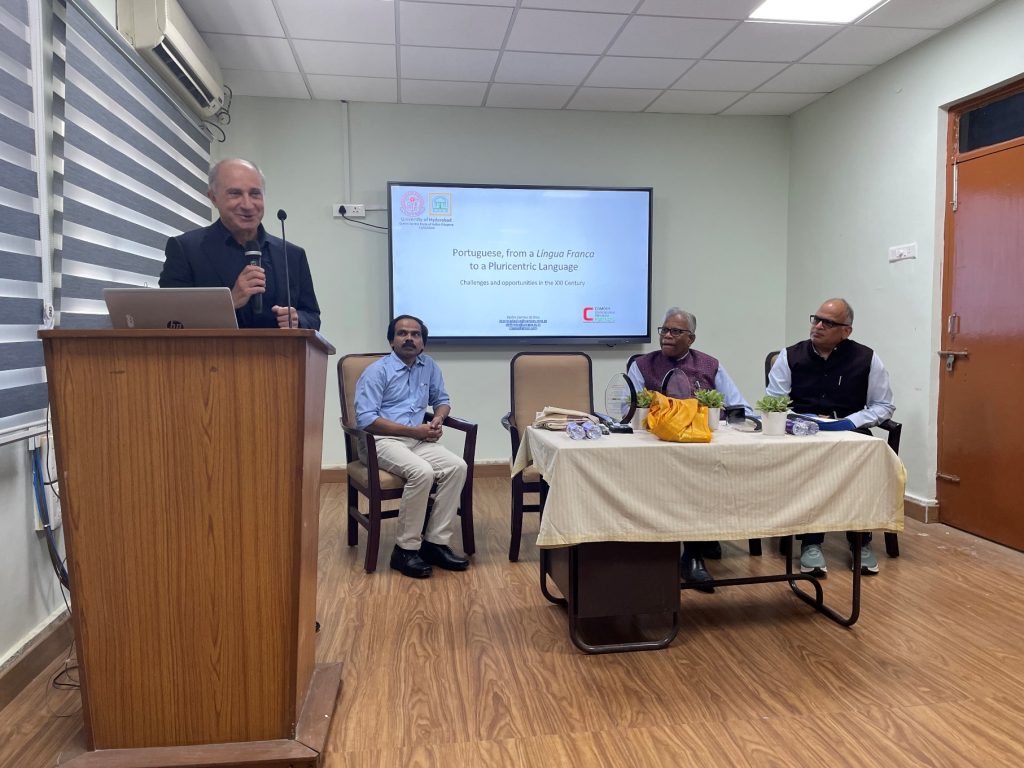
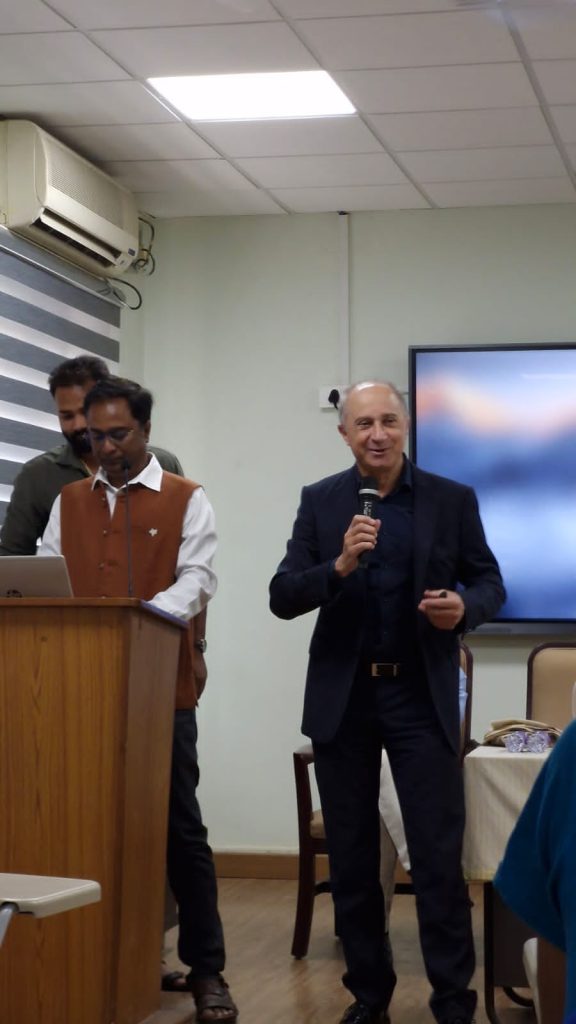
The keynote lecture was delivered by Dr. Delfim Correia da Silva, Assistant Professor (Camões Visiting Lecturer) and Coordinator of the Cunha Rivara Chair, Camões – Centro de Língua Portuguesa, Goa University. Speaking on “The Perspectives and Challenges of Learning Portuguese in the 21st Century,” he highlighted the global importance of Portuguese as one of the most widely spoken languages in the world.
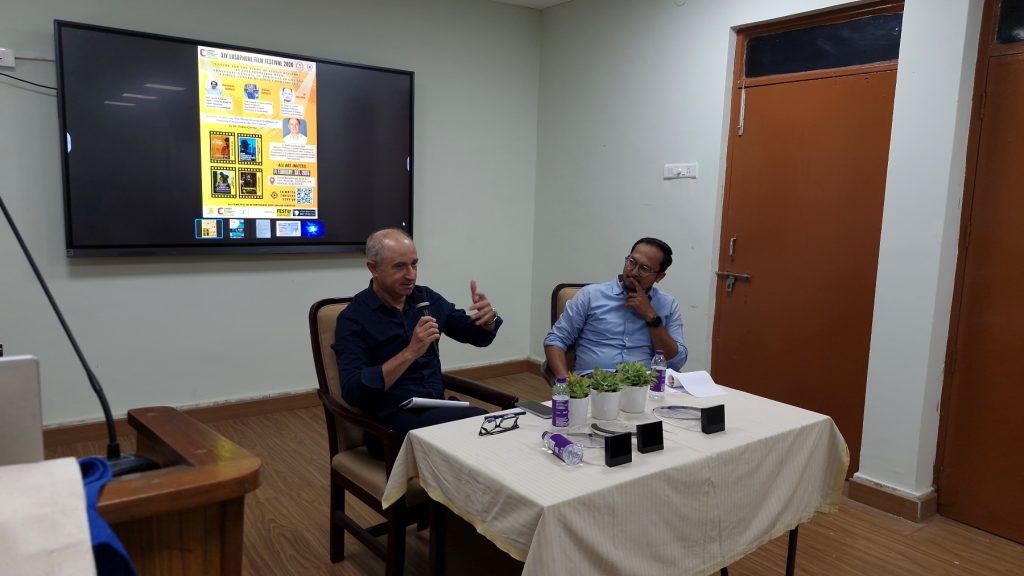
He explained that learning Portuguese connects students not only to Portugal but also to Brazil and several African nations, thereby creating opportunities in higher education, research collaboration, trade, tourism, and international relations. He also noted that Portuguese shares linguistic similarities with Spanish, making it easier for learners to understand and acquire other Romance languages. In this way, learning Portuguese can open access to a broader linguistic and cultural world. Dr. Delfim emphasised that in an era of global mobility and academic exchange, language skills enhance employability and cross-cultural understanding. He called for innovative teaching methods, digital learning tools, and stronger institutional partnerships to make Portuguese learning more accessible in India. He concluded by stating that language is not only a tool for communication but also a bridge to shared histories, literature, and global opportunities.
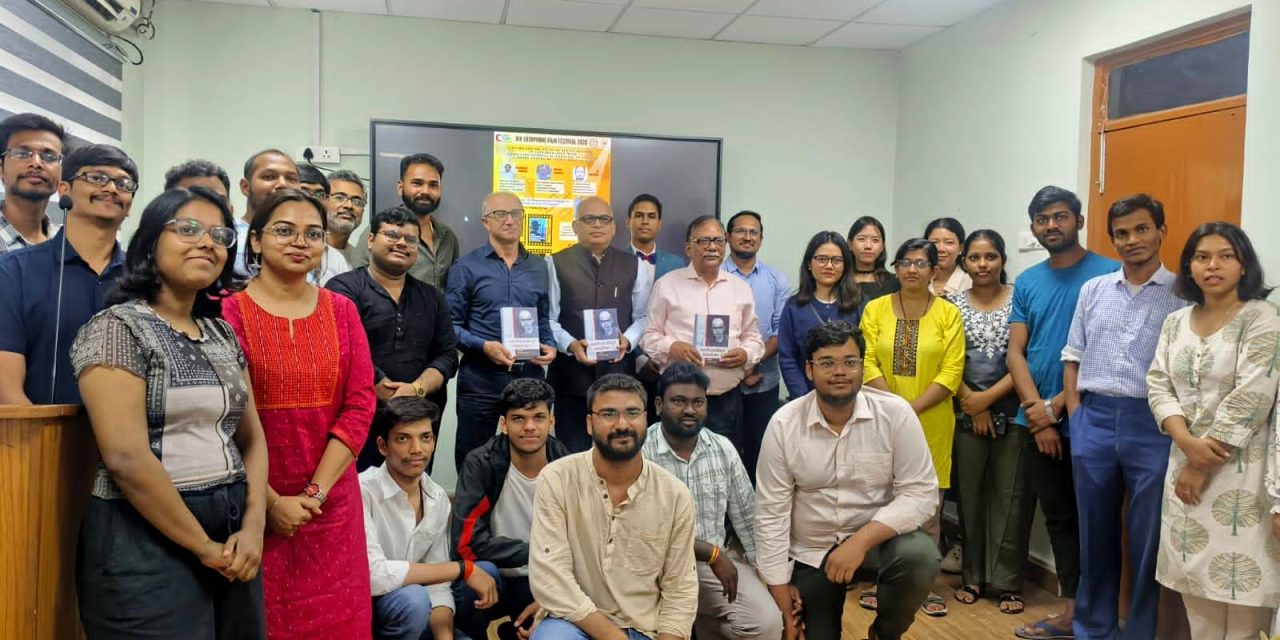
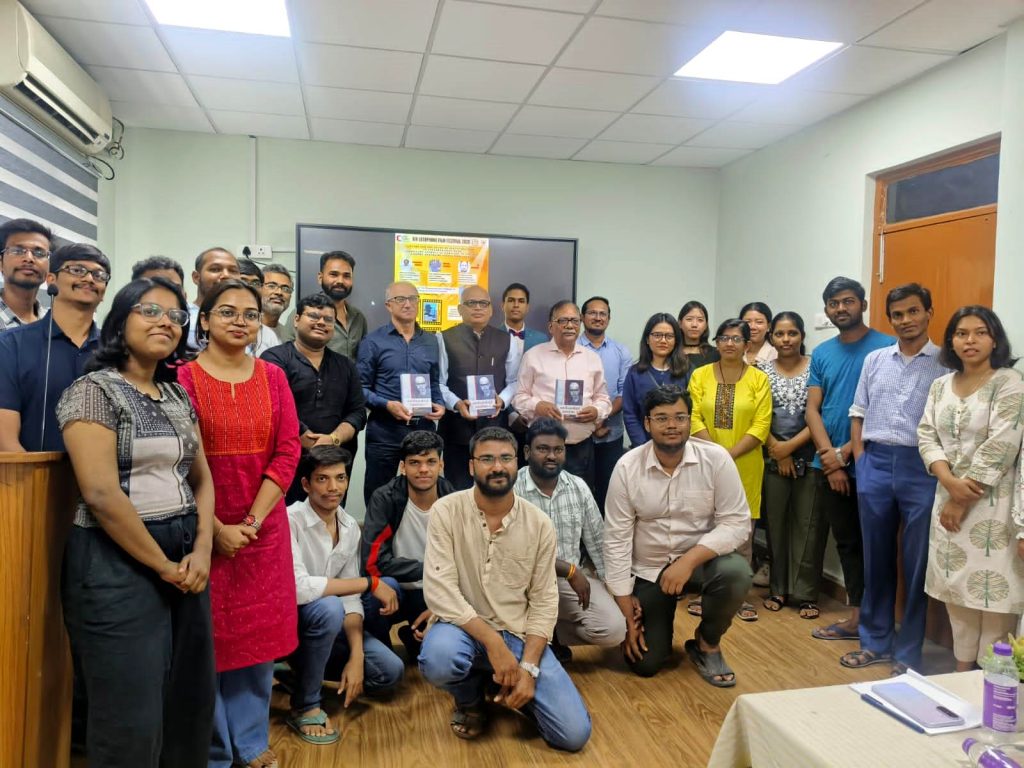
A notable scholarly highlight of the festival was the formal book release of “Banarasi Prasad Bhojpuri, Rachnavali, Khand-3”, edited by Professor Arvind Kumar. Professor Kumar, born in Ara, Bhojpur, completed his MA and PhD in Hindi from Patna University and currently serves in the Department of Hindi at Tilka Manjhi Bhagalpur University, Bihar.
The book was released in the presence of Prof. Gajendra Kumar Pathak, Dr. Girish D. Pawar, Dr. Delfim Correia da Silva, research scholar & several students. The publication was appreciated for its contribution to linguistic and cultural scholarship.
The festival featured a curated selection of Lusophone films, all screened in Portuguese with English subtitles. The morning session opened with the short film Soldado de Goa (2024). This was followed by an academic dialogue led by Dr. Girish D. Pawar on “Postcolonial Encounters: India, Portugal, and Literary Memory,” which encouraged critical reflection on colonial history and literary-cultural exchanges.
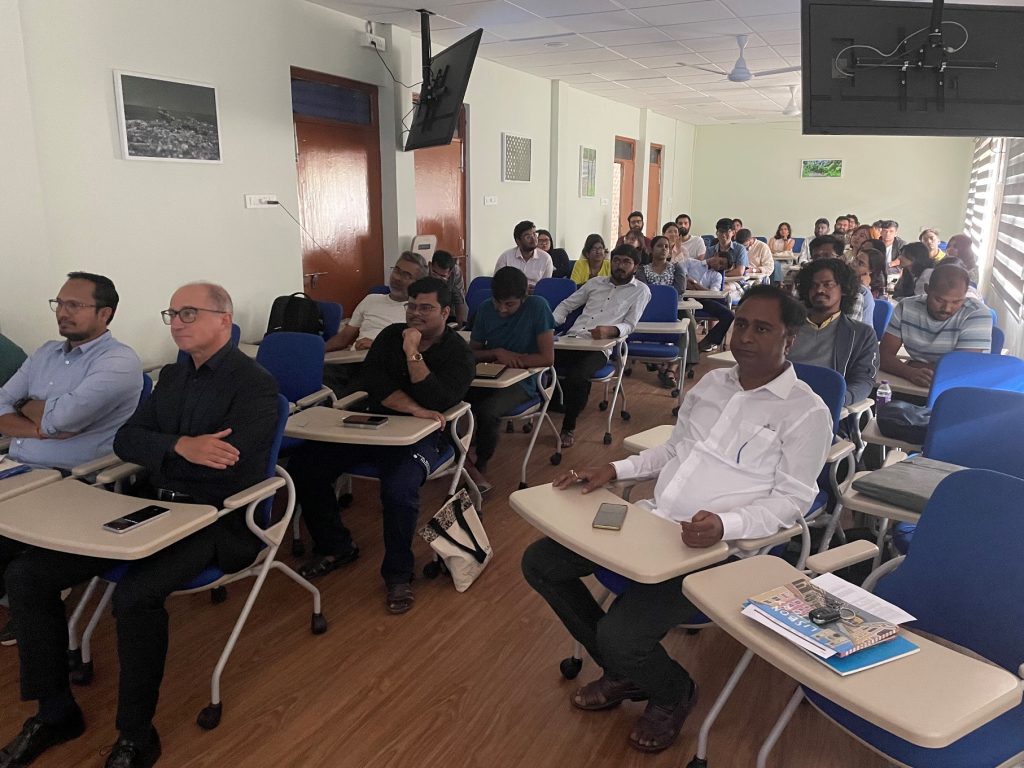
The screening of Como Fernando Pessoa Salvou Portugal (2021) was followed by an interactive discussion where students and faculty engaged in conversations on nationalism, literary imagination, and cultural symbolism.
The afternoon session included remarks on Lusophone cinema and the 30th anniversary of the Community of Portuguese Language Countries (CPLP). The festival concluded with screenings of two feature films — Memória do Cheiro das Coisas (2025) and Os Portugueses (2025). These films explored themes of memory, belonging, migration, and social transformation.
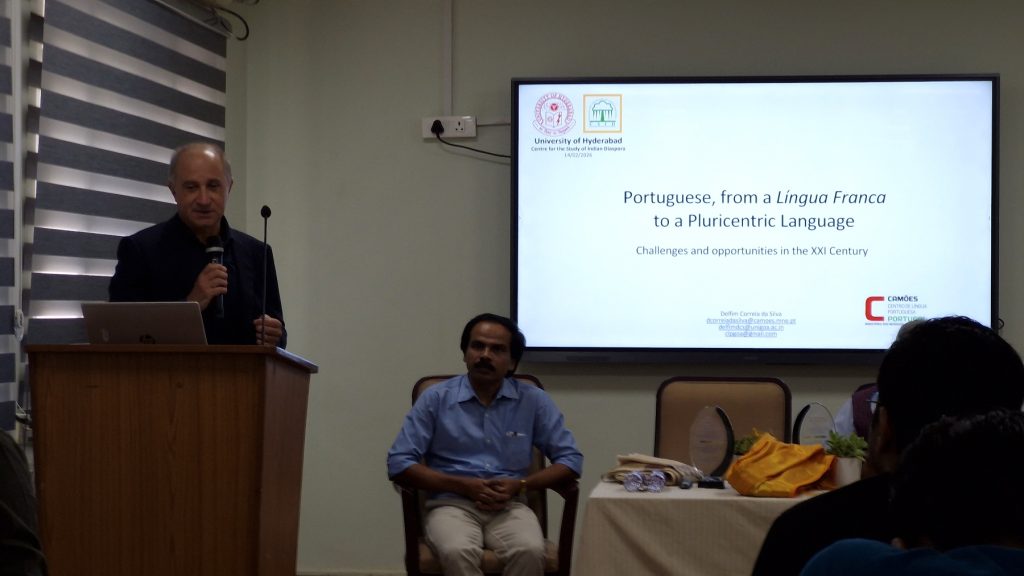
Throughout the Film festival, meaningful discussions were held among faculty members, scholars and postgraduate students regarding the future of Lusophone studies. Conversations focused on pedagogical frameworks for Portuguese language instruction, comparative film studies, and interdisciplinary research linking cinema, language, and diaspora studies.
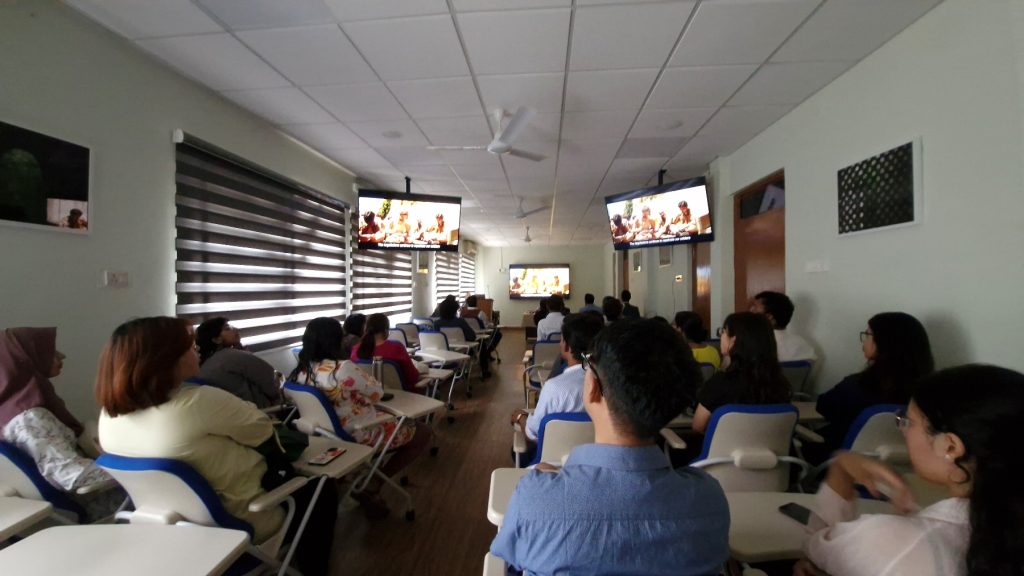
The XIV Lusophone Film Festival went beyond being a cultural event and emerged as a serious academic platform. The Vice-Chancellor’s engagement and discussions on potential institutional collaboration signal promising opportunities for international academic partnerships.
The festival was organised and coordinated by Akash Bhati, PhD Scholar, Centre for the Study of Indian Diaspora (CSID), and Vidhu Shekhar, PhD Scholar, Department of Hindi, University of Hyderabad. Their planning and coordination brought together diverse academic and cultural perspectives successfully.
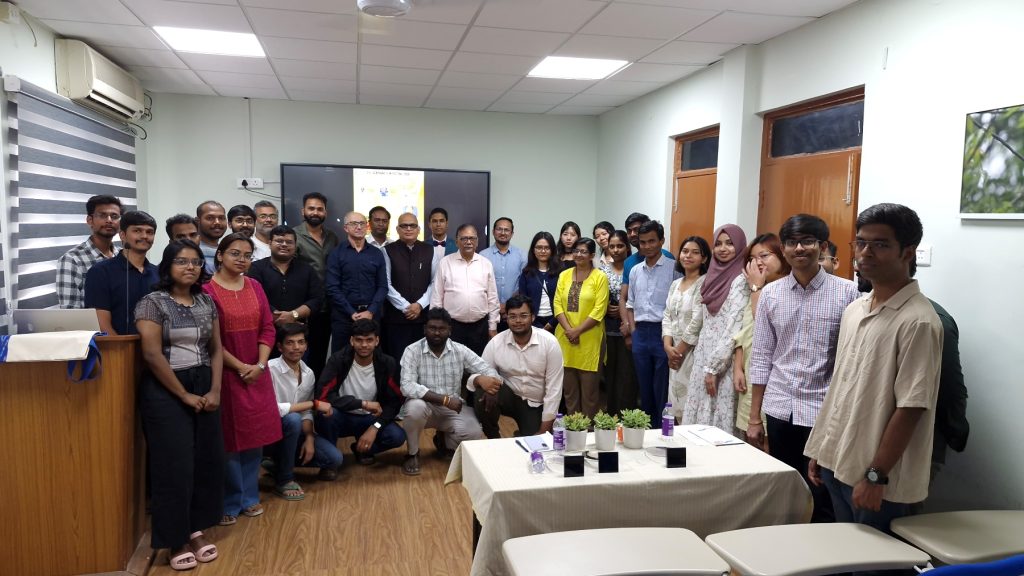
The XIV Lusophone Film Festival 2026 reinforced the academic importance of the Portuguese language and Lusophone cultural studies at the University of Hyderabad. It promoted interdisciplinary engagement, strengthened institutional dialogue, and opened avenues for future collaborations at both scholarly and institutional levels. The enthusiastic participation of students, faculty, and researchers reflected the growing interest in Lusophone studies and its relevance in today’s global academic landscape.
Report by Akash Bhati, Research Scholar, Centre for the Study of Indian Diaspora (CSID), School of Social Sciences