
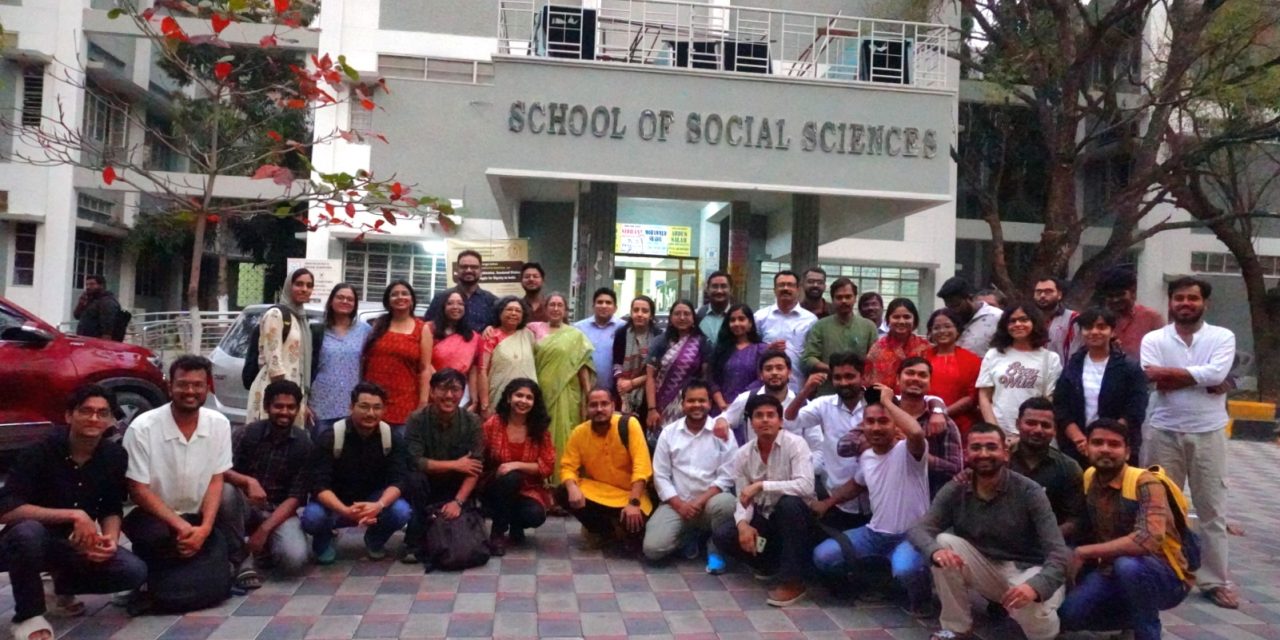
The Department of History, School of Social Sciences, University of Hyderabad (UoH), organised a felicitation seminar on January 28, 2026 in honour of Prof. Anindita Mukhopadhyay, celebrating her distinguished academic career and her contributions to the histories of gender, law, and society. The convenor of the seminar was convened by Prof. Suchandra Ghosh, Head, Department of History. Titled “Between Norm and Experience: Critical Histories of Gender, Law, Sovereignty, and Mobility in South Asia,” the seminar brought together faculty members, students, doctoral scholars, and academicians to engage with themes central to Prof. Mukhopadhyay’s scholarship.
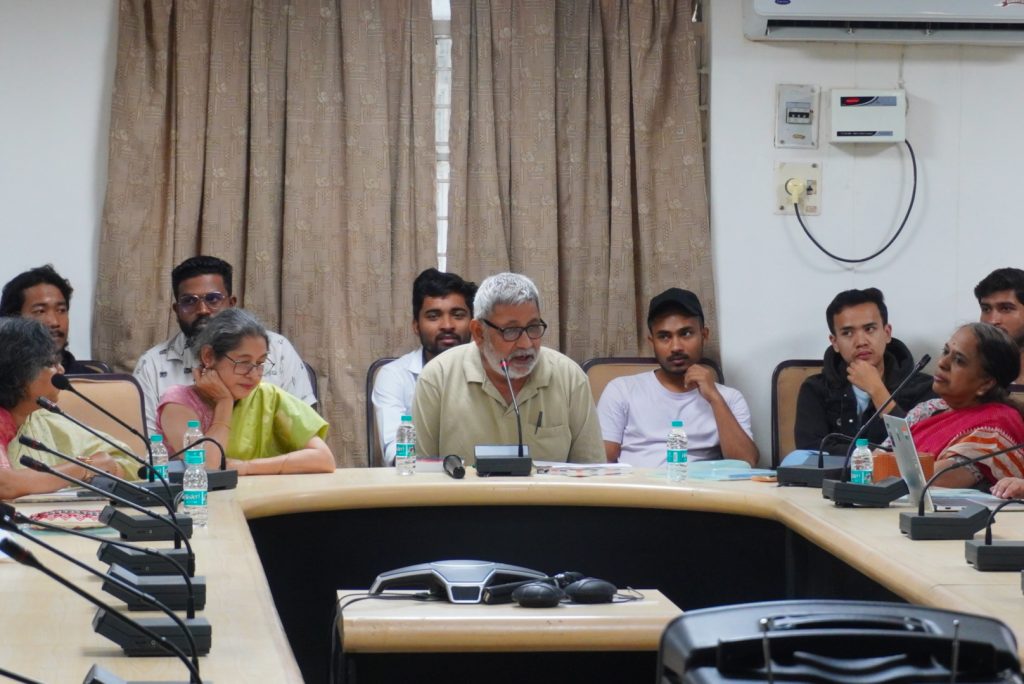
The inaugural session was chaired by Dr. Rajagopal Vakulabharanam, a long-term colleague of Prof. Mukhopadhyay, who recalled their years of working together in the department. He described her as a scholar who always needed a book to live with and admired her rare ability to remain both a committed teacher and a constant learner. Professor Ghosh in her welcome address provided an idea about the structure of the seminar. Dr. Suneeta Rani, Dean of the School of Social Sciences, also reflected on her interactions with Prof. Mukhopadhyay, noting their shared interest in translation and literature. She highlighted Prof. Mukhopadhyay’s warmth, intellectual generosity, and her well-known fondness for animals, which endeared her to colleagues and students alike.
The inaugural address, titled “Sovereignty in Motion: Mobility, Gender, and the Reconstitution of Authority in the Himalayan World,” was delivered by Dr. Aniket Alam (IIIT Hyderabad), who also spoke of his intellectual friendship with Prof. Mukhopadhyay. His lecture examined everyday meanings of sovereignty, arguing that in the Himalayan region authority has historically been shaped more by mobility than by fixity. Challenging mainstream, state-centric frameworks, he emphasized sovereignty as relational and provisional rather than territorially bounded. He further highlighted how Himalayan societies have often been framed as marginal within dominant historical narratives, despite possessing complex social stratifications and political arrangements. Introducing the concept of circulatory sovereignty, he discussed the family as a seemingly stable sedentary unit and examined the roles of religion, borders, and frontiers as delegated mechanisms that demarcated jurisdiction.
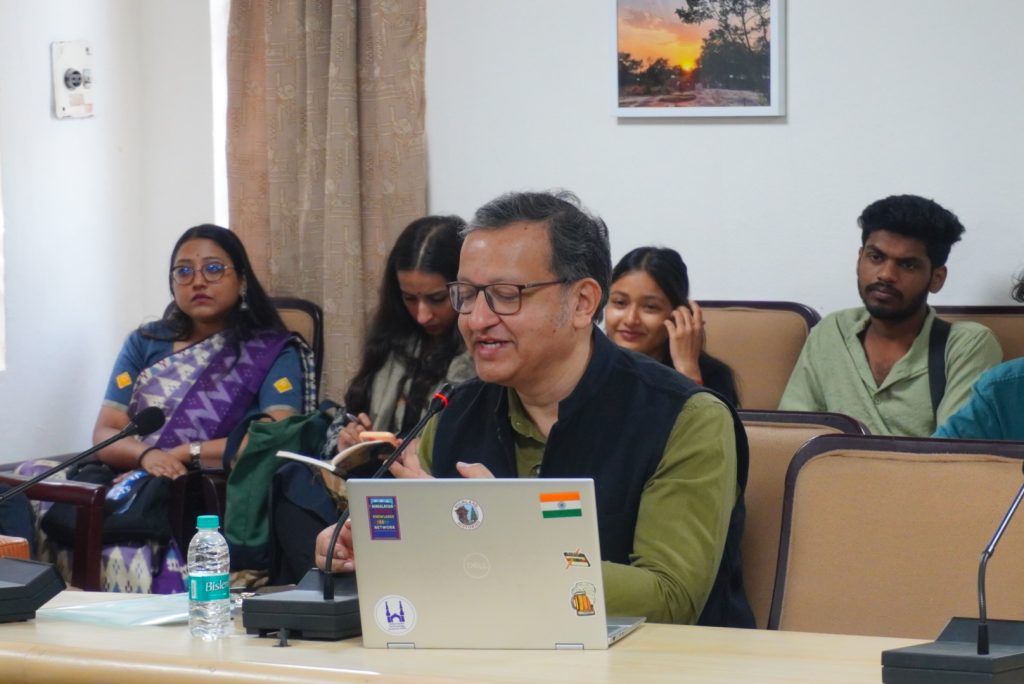
The next session chaired by Prof. Bhangya Bhukya featured Prof. Charu Gupta (University of Delhi). Prof. Gupta presented a paper titled “Unruly Archives: Gender, Sexuality, and Everyday Vernacular Histories.” She argued that archives are never neutral and that the vernacular is a contested and expansive category with gender centrally located within it. Critiquing the dominant notion of Indian sexuality as backward, she demonstrated how colonialism, modernity, print culture, and nationalist discourse collectively shaped sexual regulation. Drawing on visual and textual sources, she highlighted how erotics were rendered scandalous and how Dalit women’s resistance to caste norms became visible through sartorial practices and visual culture. She emphasized that the vernacular should be understood not as a site of reproduction but of rupture.
The latter part of the session commenced with presentations by the doctoral scholars of the department, beginning with a paper presentation by Ms. Anjana M. Nair, titled “Life in an Ancient Indian Prison: Locating Gendered Incarceration in Normative and Narrative Sanskrit Sources (2nd Century BCE–7th Century CE).” She contrasted idealized depictions of prisons in normative legal texts with dystopian representations in Sanskrit kāvyas, while also identifying informal and circumstance-specific carceral spaces for both men and women within broader socio-political contexts.
The post-lunch session, chaired by Prof. Sujith Kumar Parayil, began with Ms. Titas Sarkar’s paper, “Debt, Power, and Social Hierarchies: A Legal Analysis of Lekhapaddhati in Early Medieval Western India.” Through a reading of a vyavahāra patra from the Lekhapaddhati (12th–15th centuries), she showed how everyday legal practices surrounding debt increasingly relied on written documentation, reinforcing hierarchical relations between creditors and debtors.
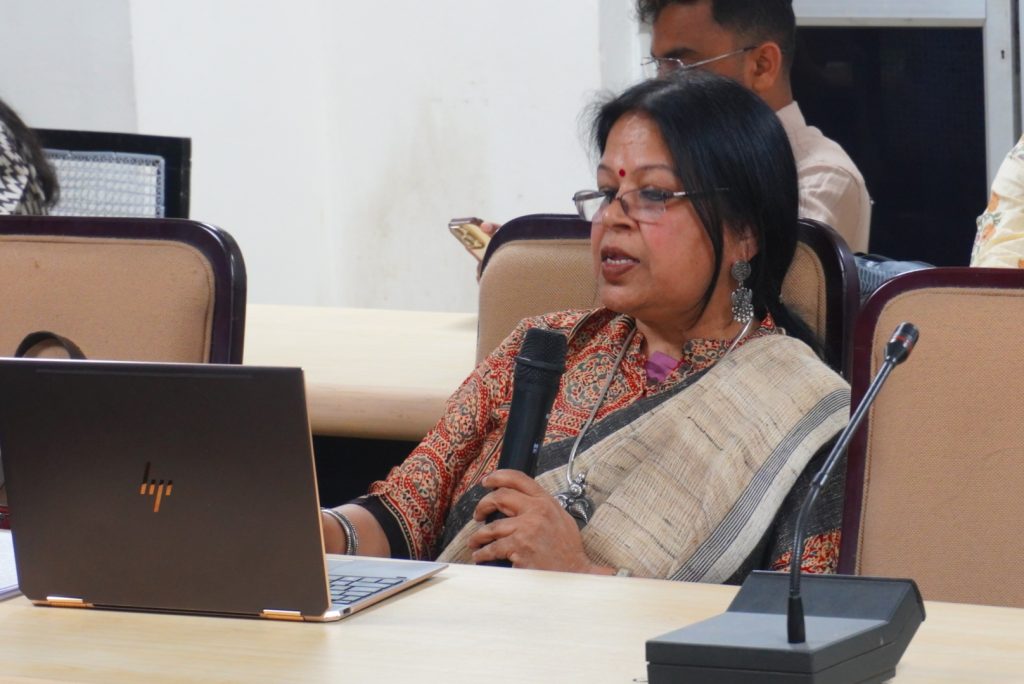
This was followed by Ms. Noushida K. K.’s presentation, “Memory and Measurement: A Re-reading of Nazhikamani in Travancore.” She reinterpreted the Nazhikamani as a social institution that shaped ritual practices, temporal discipline, and political authority, particularly during moments of political consolidation and crisis.
The subsequent session included Ms. Devi P. J.’s paper, “The Interiority of Displacement: Emotional Landscapes in Malayali Women’s Travel Writings to Europe (1930s–1950s).” Analysing early travel narratives, she argued that women’s travel writings framed displacement as an interior, affective, and gendered experience rather than mere geographic movement.
The final academic session, chaired by Dr. V. J. Varghese, featured Mr. Vikramaditya Awasthy’s paper, “Legal Strategies in Imperial Preference: Fluid Sovereignty and Trade Exceptionalism in the Interwar British Empire.” He examined how Britain used legal interpretation and diplomatic manoeuvring to sustain imperial trade preferences while navigating multilateral trade norms in the 1930s.This was followed by Mr. Arun Thomas’s paper, “Jurisdictional Smugglers: Legal Pluralism, Fiscal Borders, and Illicit Movements of Intoxicants in the Madras Presidency (1886–1930),” which analysed how smuggling operated as economic arbitrage within rigid colonial fiscal regimes and shifting definitions of legality.The session concluded with Ms. Neha Gautam’s presentation, “Images against Empire: Visual Revolution in Colonial India (1900–1950),” which showed how posters, lithographs, and bazaar prints shaped nationalist consciousness by reaching both literate and non-literate publics.
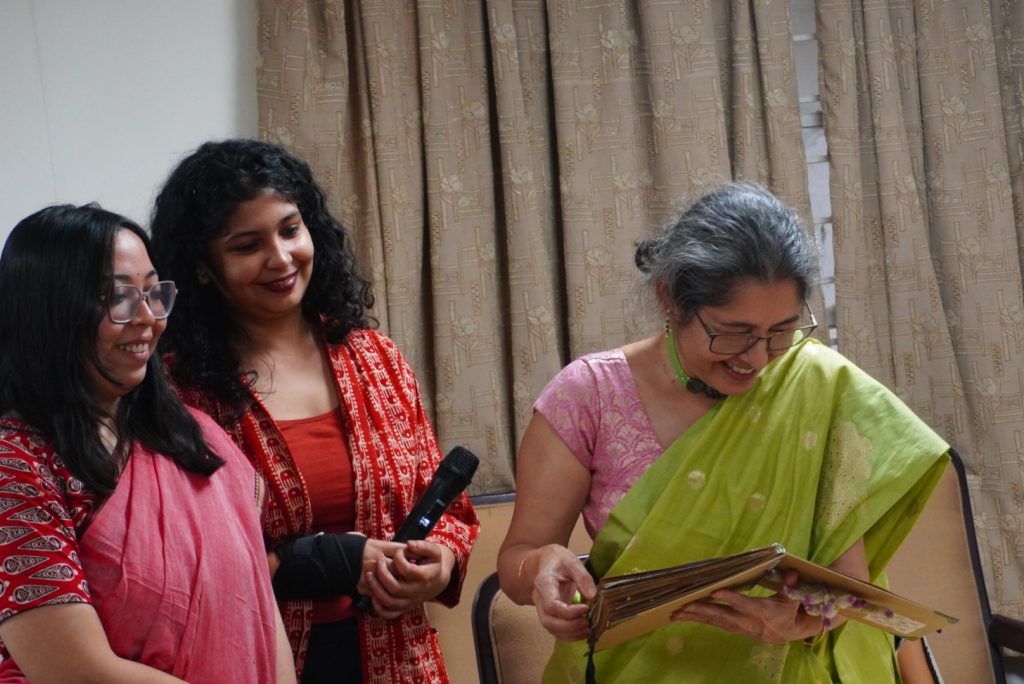
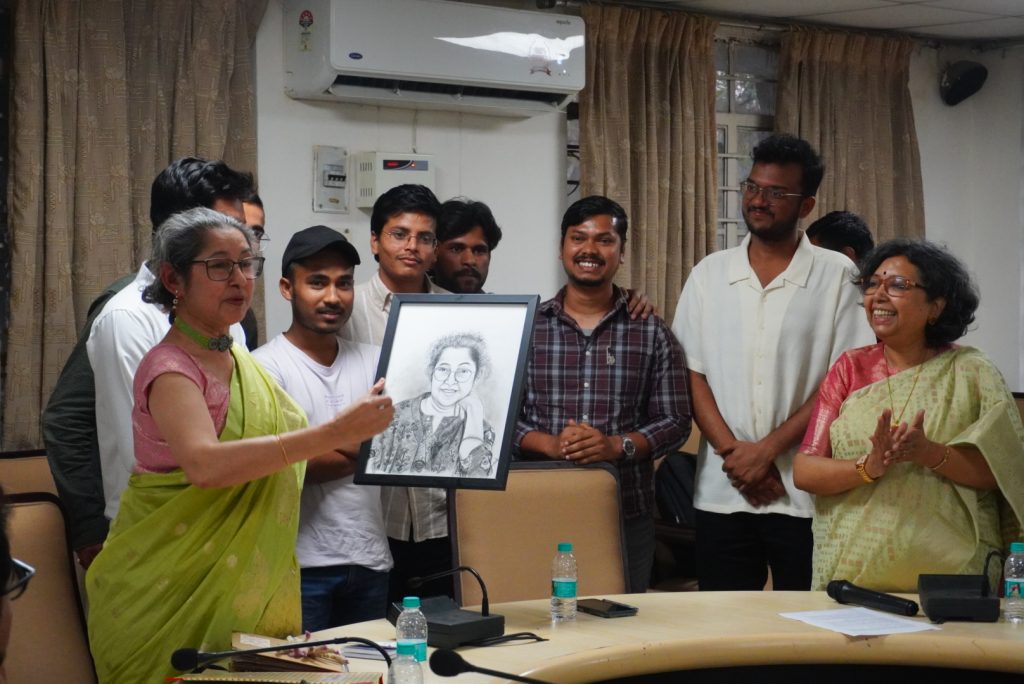
The felicitation ceremony, chaired by Dr. Vijay Ramdas Mandala, formed the emotional culmination of the seminar. As a gesture of gratitude doctoral scholars presented her with a memory scrapbook, while Masters students gifted her a hand-drawn sketch portrait, reflecting their admiration and affection for her as a teacher and mentor. Faculty members and colleagues shared personal reflections on her role as a scholar, administrator, and colleague. Dr. Suchandra Ghosh, Head of the Department, recalled Prof. Mukhopadhyay’s tenure as Head and her lasting institutional contributions. Faculty members including Prof. Sujith Kumar Parayil, Dr. Vijay Ramdas Mandala, Dr. V. J. Varghese, Prof. Bhangya Bhukya, and Dr. Eswar Rao fondly recollected their experiences with her and applauded her intellectual curiosity, critical rigour, and the warmth she consistently extended to students and colleagues.
The seminar concluded with a thoughtful response by Prof. Anindita Mukhopadhyay. Marked by active participation from students, doctoral scholars, faculty members, and fellow academicians, the event stood as a living tribute to her almost twenty-five years of dedicated service at the University of Hyderabad. The seminar reaffirmed the university’s commitment to rigorous scholarly engagement with questions of gender, law, sovereignty, and mobility in South Asia, while celebrating the enduring legacy of a deeply respected academician.
Contributed by Aparna, Lawmi and Pragati (Ph.D Scholars Department of History, UoH)