
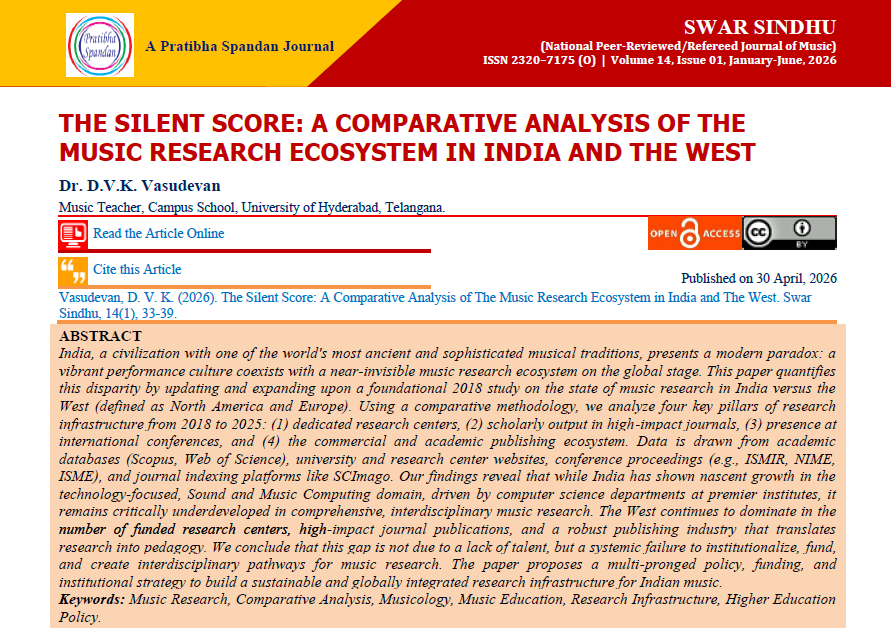
Dr. D.V.K. Vasudevan, a faculty member at the Campus School, University of Hyderabad (UoH), has published a groundbreaking research paper titled “The Silent Score: A Comparative Analysis of the Music Research Ecosystem in India and the West”. Published in the peer-reviewed national journal Swar Sindhu (Volume 14, Issue 01), the comprehensive study quantifies a modern paradox: India’s ancient, sophisticated, and vibrant musical performance culture stands in stark contrast to its near-invisible music research footprint on the global stage.
Expanding upon his foundational 2018 doctoral thesis, Dr. Vasudevan’s latest study tracks four critical pillars of research infrastructure from 2018 to 2025: dedicated research centres, scholarly output in high-impact journals, presence at international conferences, and the pedagogical publishing ecosystem. Drawing quantitative data from leading academic databases like Scopus and Web of Science, the findings reveal severe global structural imbalances. For instance, despite India accounting for over 17% of the global population, data from the Sound and Music Computing (SMC) network highlights that India possesses only one specialized research centre compared to Europe’s 72 and the USA’s 11. Furthermore, India does not house a single internationally recognized, high-impact music journal indexed in Scopus, causing significant local research to remain completely invisible to the international scholarly community.
The paper emphasizes that this global gap is not due to a lack of talent, but rather a systemic failure to institutionalize, fund, and create interdisciplinary pathways. Dr. Vasudevan notes a persistent “Two-Culture Chasm” in India, where premier engineering institutes (such as IIT Madras and IIT Bombay) treat music strictly as a tech-centric data or signal processing problem, while traditional musicology remains siloed within humanity-focused music departments. This fragmental approach prevents the rise of comprehensive, large-scale interdisciplinary hubs like Stanford University’s Centre for Computer Research in Music and Acoustics (CCRMA). Additionally, the study points to a severely underdeveloped pedagogical publishing industry that fails to translate research findings into standardized, accessible “method books” for the public.
To bridge these structural gaps, the study proposes a multi-pronged policy roadmap. Key recommendations include establishing a “National Mission for Music Research & Technology” under a joint ministerial framework, earmarking dedicated funding to establish 3–5 standalone National Centres for Music Research (NCMRs), and launching Global-Caliber, peer-reviewed journals. Dr. Vasudevan concludes that India does not need to choose between its ancient oral guru-shishya traditions and modern academic research, but rather build the necessary institutional bridges to let them inform each other and resonate globally.
The paper can be downloaded from https://swarsindhu.pratibha-spandan.org/v14i01/