
School of Life Sciences team to build India’s first single-cell atlas of PCOS and a low-cost test to guide fertility treatment
A team of researchers from the University of Hyderabad has received a research grant of ₹4.98 crore from the Indian Council of Medical Research (ICMR). The grant was awarded under the ICMR Intermediate Extramural Grants (ICMR Nischayak Anveshan Extramural Grants) 2026 call and is among the largest extramural grants the University has received. The four-year project will use artificial intelligence and advanced genomics to develop a simple blood test for Polycystic Ovary Syndrome (PCOS), one of the most common causes of infertility among Indian women.
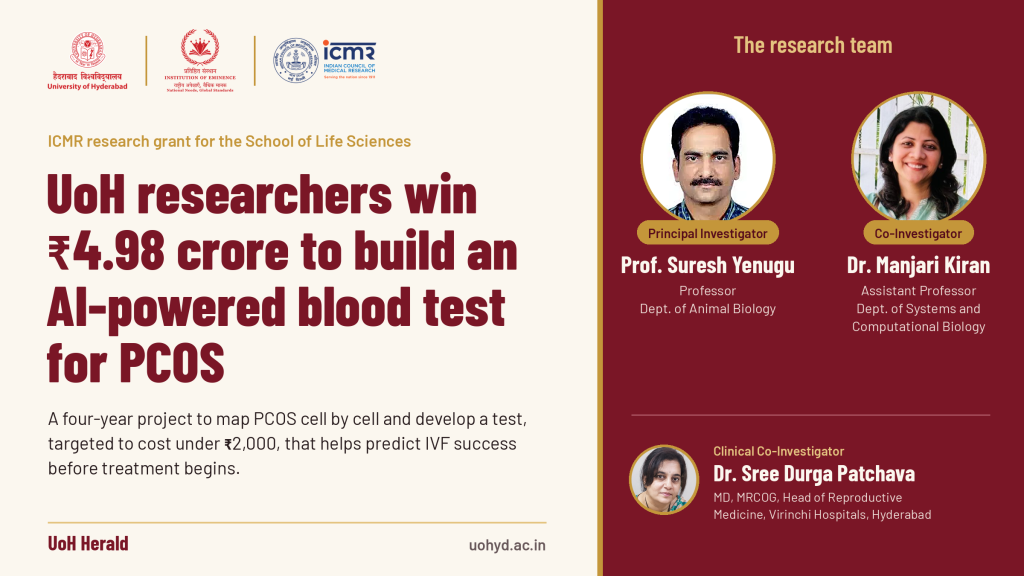
The project is titled “Multi-Modal Artificial Intelligence Integration of Systemic and Follicular Single-Cell Transcriptomics for Non-Invasive PCOS Theranostics, Molecular Endotyping, and Early Discovery.” Prof. Suresh Yenugu of the Department of Animal Biology, School of Life Sciences, leads it as Principal Investigator. Dr. Manjari Kiran, Assistant Professor in the Department of Systems and Computational Biology, School of Life Sciences, is Co-Investigator. Dr. Sree Durga Patchava, MD, MRCOG, Head of Reproductive Medicine at Virinchi Hospitals, Hyderabad, joins as Clinical Co-Investigator.
ICMR sanctioned the project on 1 September 2026, and work began on 16 September 2026. A first-year instalment of about ₹1.52 crore has been released.
A condition in need of better answers
PCOS is a hormonal condition that affects a large number of women of reproductive age in India. Some estimates suggest it is considerably more common here than the global average. It can cause irregular periods, weight gain, excess hair growth and difficulty in conceiving. Higher rates of insulin resistance mean Indian women often experience a more severe form of the condition.
PCOS is currently diagnosed using broad, symptom-based criteria. Clinicians have no simple way to see what is happening inside a woman’s ovaries or to know which treatment will work best for her. Many couples therefore undergo repeated, expensive and emotionally draining rounds of fertility treatment, including IVF, largely by trial and error.
Reading the ovary through the blood
The team starts from the idea that immune cells circulating in the blood carry signals reflecting the environment around a woman’s eggs. If those signals can be read accurately, a routine blood sample could reveal what currently requires an invasive procedure to find out.
The goal is a test, targeted to cost under ₹2,000, that sorts women into distinct PCOS sub-types. It would also help predict their chances of IVF success before costly treatment begins.
Most existing genetic reference data on PCOS comes from Western populations and does not fully reflect the biology of Indian women. By building a population-specific single-cell atlas, the project will create a lasting national data resource for researchers and clinicians.
If successful, the work could:
– help doctors move from trial-and-error to personalised fertility care
– reduce the financial and emotional burden of failed IVF cycles
– enable earlier detection of PCOS
– identify new biological targets for future medicines
– lead to a patented, made-in-India diagnostic kit that can reach fertility clinics across the country, including in smaller towns
Strengthening research at UoH
The grant reflects the University’s growing ability to bring life sciences, computational biology and clinical medicine together. Each investigator brings a different strength:
– Prof. Yenugu has 25 years of experience in reproductive biology.
– Dr. Kiran has expertise in high-throughput data analysis and computational biology.
– Dr. Patchava has clinical experience in reproductive medicine and IVF.
The project will add a high-performance GPU computing workstation for AI modelling and a real-time PCR system to the University’s research infrastructure. It will also create research positions for young scientists and technical staff. The work is expected to produce high-impact publications and intellectual property, strengthening UoH’s standing in translational health research.
The University of Hyderabad congratulates Prof. Suresh Yenugu, Dr. Manjari Kiran and Dr. Sree Durga Patchava on securing this prestigious ICMR grant.