
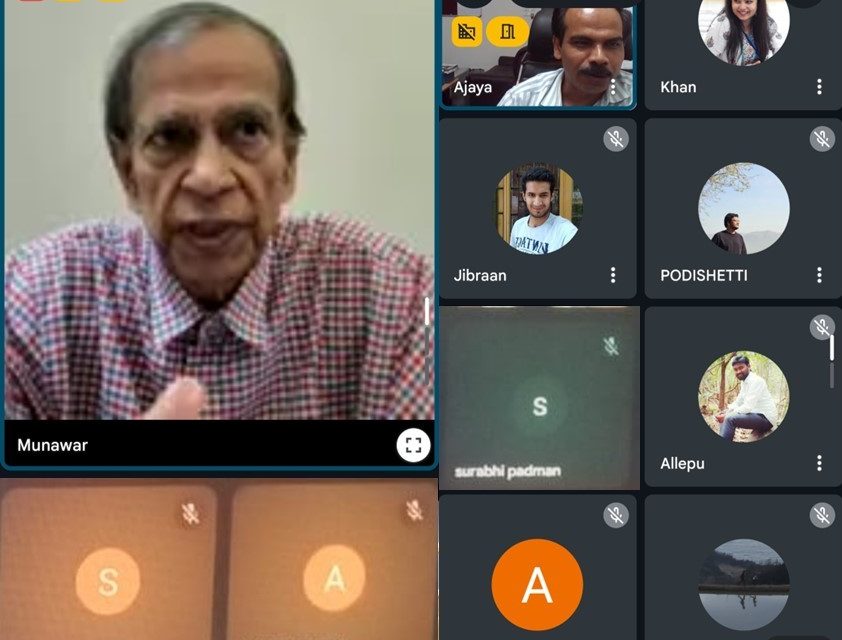
The Centre for the Study of Indian Diaspora, School of Social Sciences, University of Hyderabad, organized a special lecture on “An Ethnographic Study of Indian Diaspora in the United States of America” on Tuesday, 28th October 2025, at 11:00 AM.
The session was held online and delivered by Dr. Muhammad Badrul Alam, former Director of Research and Head, Department of Political Science, Jamia Millia Islamia University, New Delhi. The session was chaired by Prof. Ajaya K. Sahoo, Head of the Centre for the Study of Indian Diaspora, who formally introduced the distinguished speaker.
Dr. Alam, in his talk, offered an insightful exploration of the complex realities of the Indian diaspora in the United States through an ethnographic lens. He began by tracing the historical trajectory of Indian migration, followed by an in-depth analysis of the social and demographic diversity within the diasporic community. Drawing on data and field-based observations, Dr. Alam highlighted variations in region of origin, faith, caste, and immigration status, emphasizing how these factors shape the heterogeneous fabric of Indian American life. This diversity, he noted, both enriches the community and occasionally challenges its sense of solidarity and collective identity.
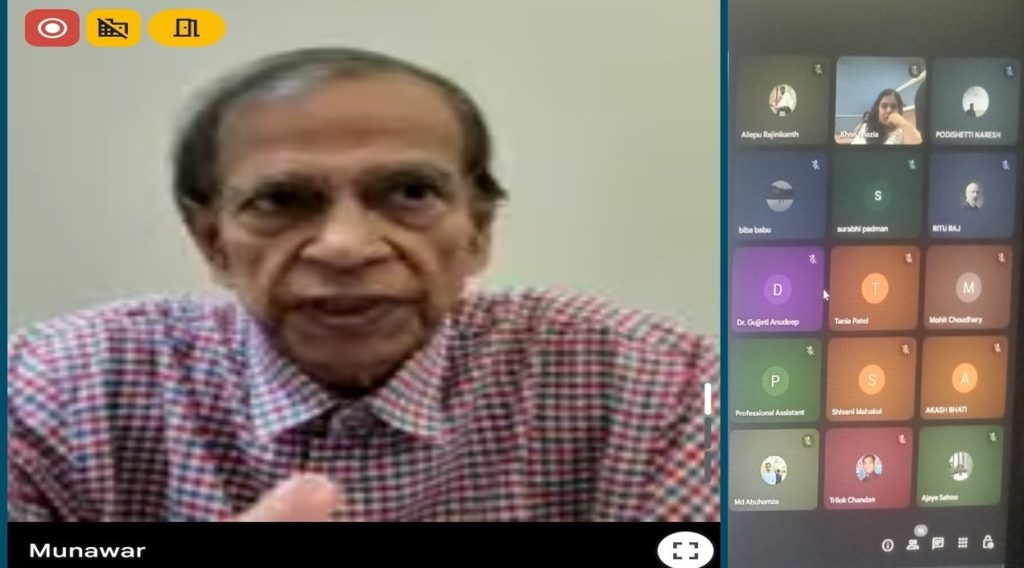
Further Dr. Alam focussed on identity, assimilation and acculturation, Dr. Alam discussed how Indian Americans navigate their ethnic, cultural, and national identities in a multicultural American setting. He reflected on how the first generation strives to preserve linguistic and cultural traditions, while the second and third generations reinterpret “Indianness” in ways that blend nostalgia with contemporary global identities. He also elaborated on the transnational bonds that sustain emotional and cultural connections with India, through media, festivals, remittances, and digital engagement.
On the theme of civic and political engagement, Dr. Alam examined the evolving participation of Indian Americans in U.S. civic life. He drew attention to the growing presence of Indian-origin individuals in American politics, contrasting the experiences of foreign-born immigrants with those of U.S.-born citizens. He also discussed the community’s dual political consciousness—its active role in American democratic processes and its continuing interest in political developments in India.
In the end Dr. Alam addressed experiences of discrimination and exclusion, Dr. Alam critically analysed how identity markers such as religion, caste, skin colour, and nationality affect the everyday lives of Indian Americans. He noted that while the community enjoys a relatively high socioeconomic status, underlying prejudices and internal divisions persist, revealing complex intersections of privilege and marginalization.
In his concluding section on economic and social mobility, Dr. Alam presented comparative insights into the educational and occupational attainments of Indian Americans vis-à-vis the wider U.S. population. While acknowledging their remarkable success in sectors such as technology, medicine, and academia, he also pointed to hidden disparities, particularly among unauthorized immigrants and lower-income groups, whose stories often remain untold in mainstream narratives.
The lecture provided a comprehensive and nuanced understanding of the Indian American experience, balancing empirical depth with theoretical reflection. The session concluded with an engaging question-and-answer round, where participants from diverse academic backgrounds interacted with Dr. Alam on issues of identity, transnationalism, and diasporic belonging.
The event was well attended by faculty members, research scholars, and students, and was highly appreciated for its interdisciplinary scope and ethnographic insight into one of the most influential diasporic communities in the world, contributing to a rich and engaging academic exchange.
Report Prepared by Akash Bhati, Ph.D. Research Scholar, Centre for the Study of Indian Diaspora, School of Social Sciences, University of Hyderabad.