
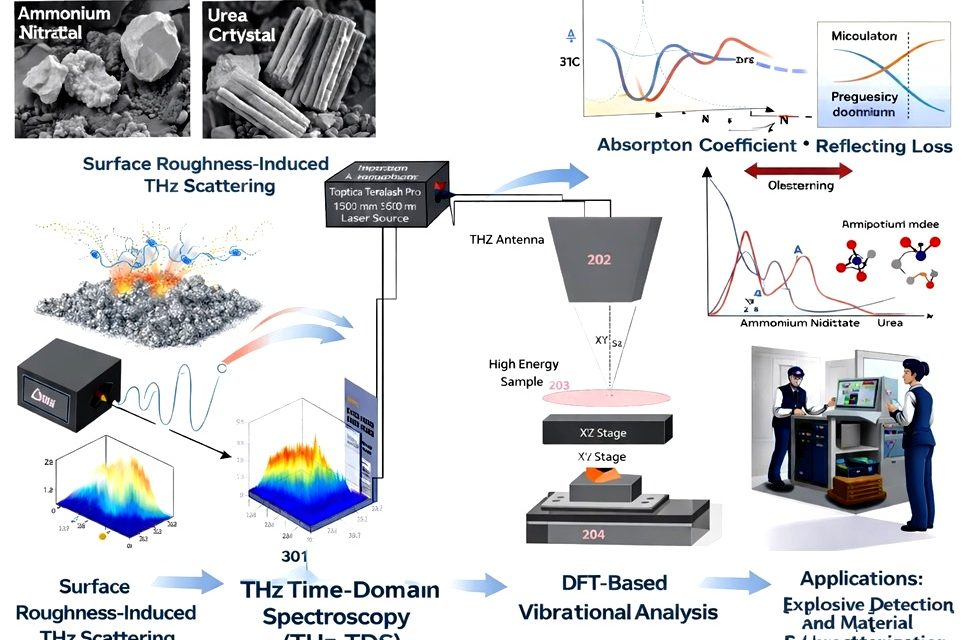
Researchers from the DRDO Industry Academia Centre of Excellence (DIA-CoE), School of Physics, University of Hyderabad, led by Sr. Prof. A. K. Chaudhary, along with team members Dr. Chandan Ghorui and Mr. Periketi Naveen Kumar, have developed an indigenous terahertz (THz) profilometer for the non-contact and non-destructive measurement of surface roughness in metallic and explosive materials.

The developed system has significant potential for applications such as evaluating paint quality in naval vessels, assessing the surface smoothness of warheads and missiles, and inspecting stealth/composite-coated surfaces.
The THz profilometer successfully measured surface roughness in explosives and metallic samples within the ranges of 0.05–0.15 μm and 15–100 μm, respectively. A major advantage of the developed technology is its capability to penetrate painted coatings and detect hidden corrosion beneath metallic surfaces, which is difficult to achieve using conventional visible-light-based techniques.
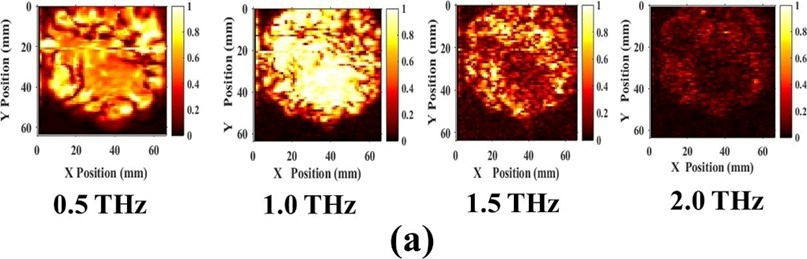
Figure 1: (a) 2D-THz images of painted old metallic object at f= 0.5, 1.0, 1.5 & 2 THz range, respectively.
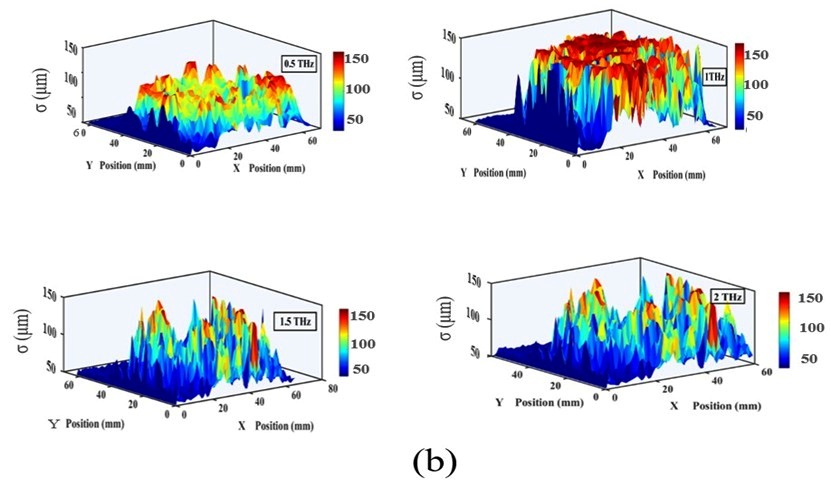
3D surface roughness images of same object
The designed THz profilometer operates in a tilted-reflection geometry and is an extension of the previously developed real-time 2D THz imaging system. The system provides real-time 2D and 3D profile imaging of painted and unpainted metallic objects, as well as hazardous materials. The measured surface roughness values showed excellent agreement with results obtained using Atomic Force Microscopy (AFM) and conventional optical profilometry techniques.
The part of the developed work is published in Journal of Infrared, Millimeter and Terahertz Waves, 47 :36, 1-14, 2026, DOI: 10.1007/s10762-026-01142-3 .
The second part of the same technique with DFT calculation done by Dr. Prathap Kr. Jharapala, used to measure the such as ammonium nitrate and urea is published in the Spectrochimica Acta Part A Molecular and Biomolecular Spectroscopy, 359:127911, 2026, DOI: 10.1016/j.saa.2026.127911.
According to Prof. A. K. Chaudhary, the technology has strong potential for homeland security, defence inspection, industrial quality control, corrosion monitoring, and stand-off detection applications. The innovation has also received Indian patent recognition and published on 28 November 2025 in Patent Journal No. 48/2025 with Patent Application No. 202441040603 and Patent No. 11536.
Dr. Chandan Ghorui expressed his gratitude to the Prime Minister’s Research Fellowship (PMRF), Government of India, for financial support. Prof. A. K. Chaudhary, Dr. Chandan Ghorui, and P. Naveen Kumar also thanked Dr. S. C. Bhattacharya, Director of DIA-CoE, University of Hyderabad, for his continuous encouragement and support toward advancement of THz research based indigenous technology development.