

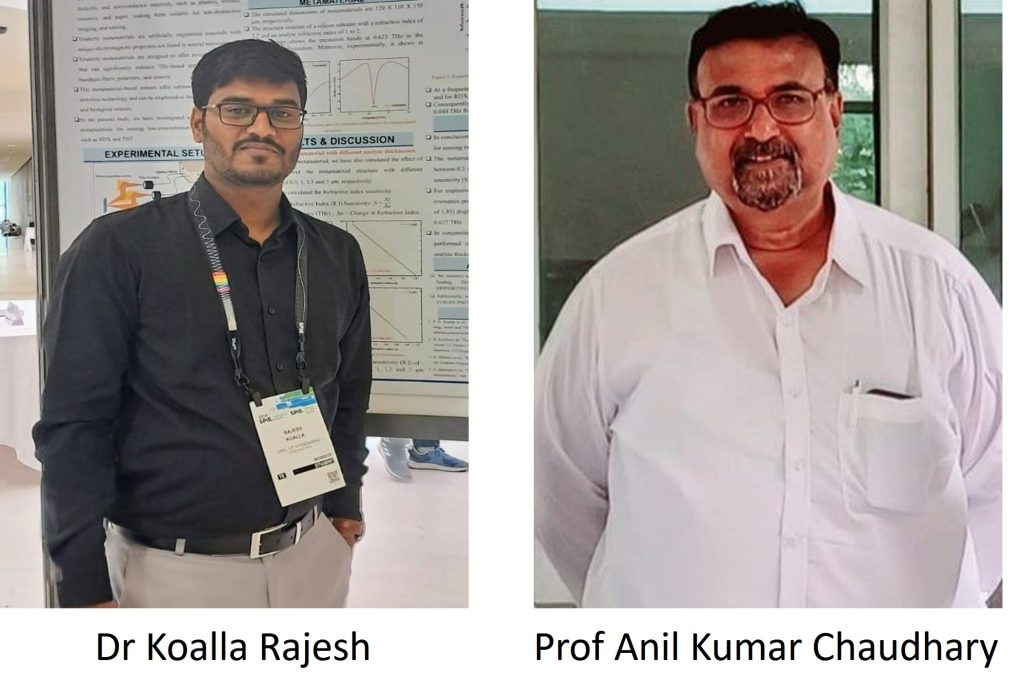
The Terahertz research group at the University of Hyderabad, researcher Dr. Koalla Rajesh ( R.A.) and Senior Professor Anil Kumar Chaudhary of DIA-CoE, School of Physics, UoH, Hyderabad have developed a safer and highly effective method to characterize highly sensitive explosives in the terahertz spectral region using Effective Medium Theory.
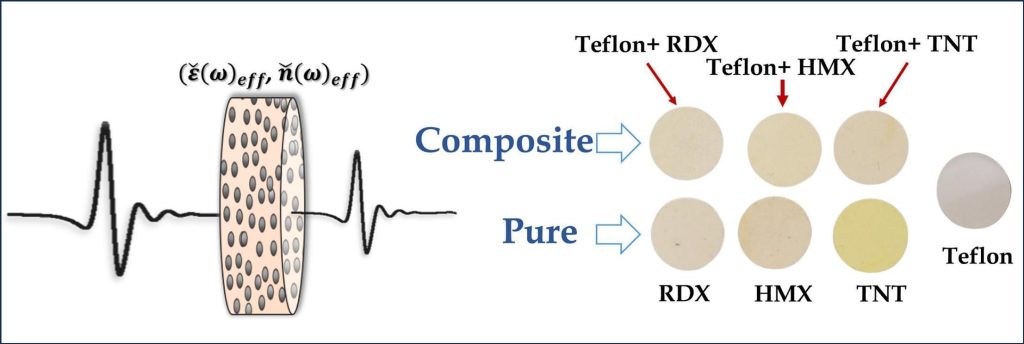
Terahertz Time-Domain Spectroscopy (THz-TDS) is a powerful spectroscopic technique used to study the optical and electronic properties of materials in the frequency range of 0.1–10 THz. In spite of its numerous advantages, the characterisation of sensitive high-energy materials, particularly primary explosives, remains a challenging task due to the hazards involved in handling such materials and the difficulty of preparing pure pellets. Since THz-TDS of powdered samples requires in pellet form. However, the direct pellet preparation of these sensitive explosives is risky task because of their high sensitivity towards shock , grinding and compression. To overcome this limitation, we have mixed these sensitive explosives with a low-absorption binding matrix, which enabled safe pellet preparation. Furthermore, Effective Medium Theory (EMT) models were employed to extract the intrinsic optical and dielectric properties of the pure sensitive explosives from these composite pellets.
Our results show that EMT models can reliably reproduce the high quality optical signatures of sensitive explosives, even when studied in a safer composite form in THz domain . This provides a practical pathway for studying highly sensitive energetic materials without compromising safety,” said Prof. Chaudhary.
This work has been published in the peer-reviewed journal Infrared Physics & Technology. Use of effective medium theory for characterization of optical and dielectric properties of explosive composites in terahertz spectral range – ScienceDirect
The authors express their sincere thanks to the Defence Research and Development Organization (DRDO), Ministry of Defence, Government of India for financial support and to the Director Dr. S C Bhattacharya, DIA-CoE, University of Hyderabad for their excellent support.
For any further details on this research please email to: akcsp@uohyd.ac.in