
The Centre for Women’s Studies, School of Social Sciences, University of Hyderabad, participated in a collaborative initiative led by the Centre for Women’s Development Studies (CWDS), New Delhi, to commemorate the “International Day for Elimination of Violence against Women – 2025” on December 7, 2025. The online session focused on the theme “UNITE to End Digital Violence against All Women and Girls,” aligning with the 2025 UN focus on addressing online gender-based violence. This event was part of the broader 16 Days of Activism campaign (November 25 – December 10, 2025), which saw collaboration across 18 universities in India by organizing online talks, interactive sessions and skits.
The program began with opening remarks by Prof. Manimekalai, Director of CWDS, who emphasized the significance of this nationwide initiative in fostering awareness and action. Prof. Deepa Sreenivas, Head, Centre for Women’s Studies at the University of Hyderabad, formally welcomed the audience and the speakers. Ms. Lekshmi Heeran, Ph.D. Scholar, CWS, University of Hyderabad, introduced the speakers.
Speaker Presentations
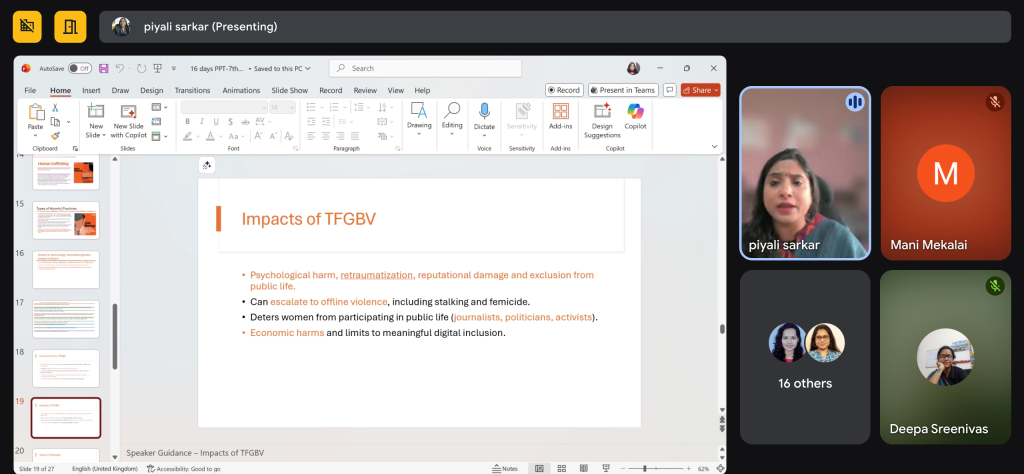
- Ms. Piyali Sarkar Debnath
Programme Manager, UN Women
Ms. Debnath, a development practitioner with over a decade of experience in gender equality, youth empowerment, and safety, discussed the intricate connections between offline and online violence. Drawing on her work at UN Women leading programs on gender-based violence prevention, she highlighted:
- The Continuum of Violence: The prevalence of various forms of cyberviolence—such as doxing, morphing, trolling, and cyberstalking—and how these threats often translate into physical danger.
- Targeted Harassment: She detailed the rise of the “manosphere” and organized campaigns targeting high-profile women, including politicians, journalists, and human rights defenders.
- Systemic Challenges: Debnath discussed the psychosocial trauma faced by victims and their subsequent withdrawal from digital spaces. She pointed to the apathy of tech platforms regarding response times and emphasized the need for stronger legal provisions, platform accountability, and enhanced digital literacy for women and girls.
- Dr. Sneha Banerjee
Assistant Professor, Department of Political Science, University of Hyderabad
Dr. Banerjee, whose research interests lie in gender and law, the politics of reproduction, and feminist International Relations, provided a critical perspective on regulating digital spaces. Her presentation focused on:
- Redefining Harm: She urged the audience to expand their understanding of “harm” with regard to Technology facilitated Gender Based Violence, beyond the narrow definitions often found in criminal justice systems.
- Beyond Punitive Measures: Banerjee argued that a purely punitive “cyber crime” approach is limited. She advocated for feminist advocacy to address structural patriarchal power dynamics holistically rather than relying solely on legal remedies.
- Regulatory Risks: Both speakers noted the precarious nature of regulating the cybersphere, cautioning that unchecked regulation could inadvertently slide into censorship.
The presentations converged on a critical insight: the need to recognize the intertwined relationship between the offline and the online, and between technology and social structures. The discussion highlighted that we often forget this connection, treating the digital as separate, whereas digital violence is deeply embedded in existing social hierarchies.

The session concluded with an interactive segment where the audience engaged with the speakers on the complexities of digital safety. The event closed with a formal vote of thanks from Prof. Manimekalai, acknowledging the speakers’ contributions and the attendees’ participation.