
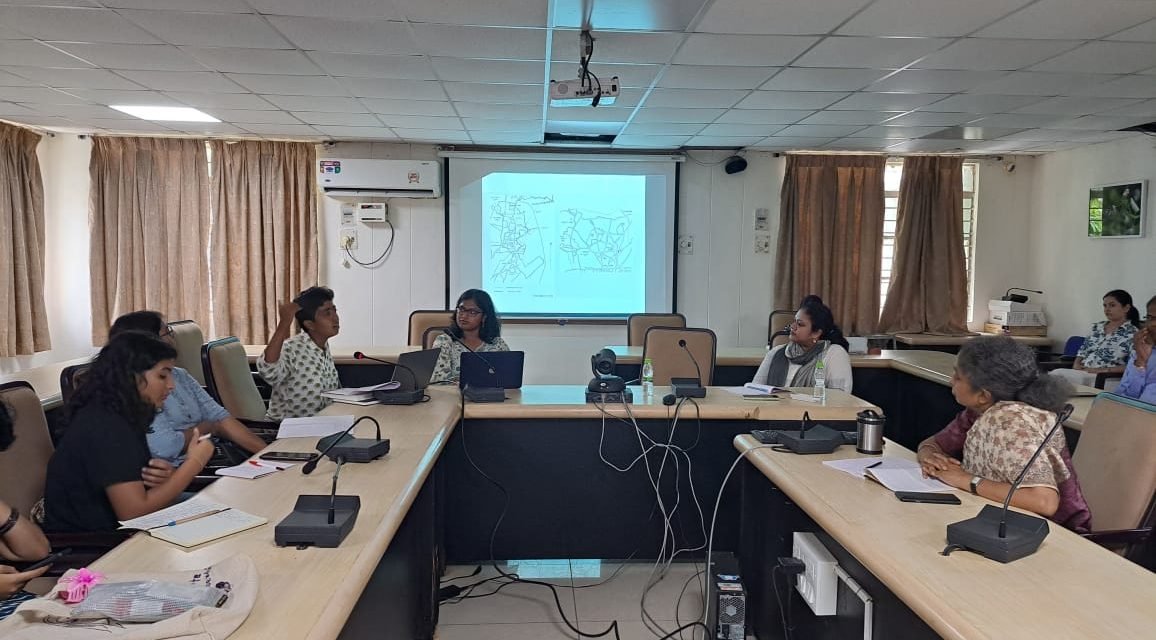
The Department of Sociology, School of Social Sciences, University of Hyderabad (UoH) conducted a discussion of the book titled, ‘Film City Urbanism in India: Hyderabad from Princely City to Global City, 1890-2000’, written by Dr. C. Yamini Krishna, published by the Cambridge University Press in 2025 on August 11, 2025, at 2.30 PM in the Social Sciences Conference Hall, SSB.
The session was chaired by Prof Aparna Rayaprol, Department of Sociology and Minu Anna Philipose, a research scholar in the Department of Sociology, was the discussant. This event was organised by Prof Anurekha Chari Wagh and Firdaus Soni, research scholar of the department and Jaya Sinha, MA student of the department of sociology introduced the speaker.
The author works in the areas of Film, Urban and Deccan History and Cultural Studies, and is an Assistant Professor in FLAME University, Pune. She has been the recipient of the India Foundation for the Arts (IFA) Arts Research Grant (2022), Asia Art Archive – Shergil Sundaram Foundation archival grant (2022), Satyajit Ray Film and Television Institute Independent Research Grant (2022), Philip M Taylor Award for Best Article by a new researcher (2021), and the Charles Wallace India Trust fellowship (2017). She is the Founding Member of the Khidki Collective, and curated the Zor Project Digital Archive, and a multicity exhibition titled Chitramahal: Princely Encounters with Photography and Film
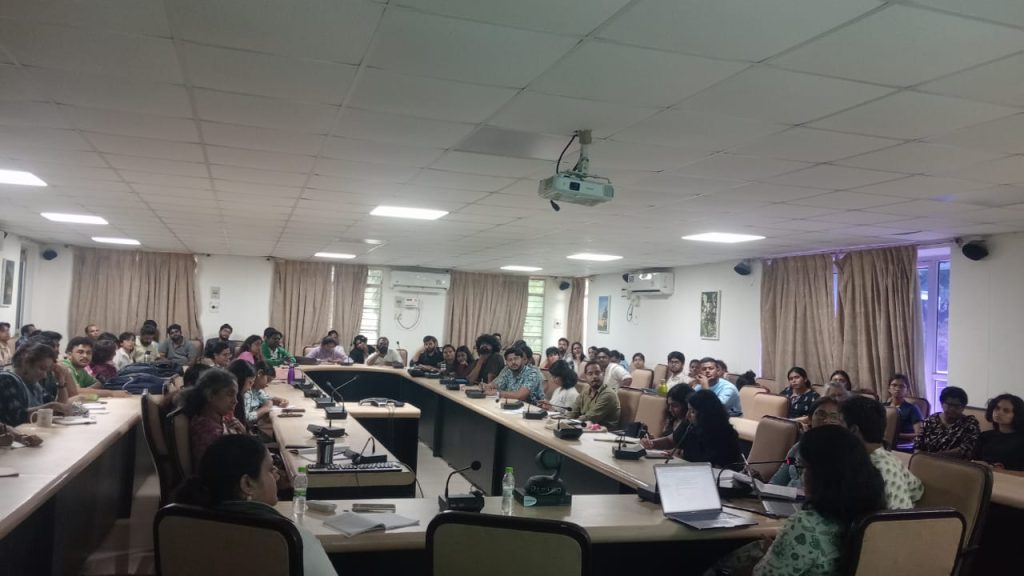
In the book discussion, the author highlighted the various sections of the book in detail, which takes on the ‘film’ as the lens of an insignificant geography that has been shaping the city of Hyderabad from its inception in the princely state of the Asaf Jahis till the millennium. The author argues that the state was characterised by princely urbanism, taking on different roles in the film industry, first as patrons, then as regulators and investors, whether it is in the production of cinema with clear propagandas, or inside cinema halls as a consumer. Spaces of movie consumption within the British cantonment came with restrictions and competed with those in Hyderabad city. Silent movies were identified as Urdu cinema during the Nizami era, and with the decline in Urdu film industry as a whole, as Telugu cinema in later decades. Policies and regulations only come into the picture following years of petitions, and even a tragedy in the twentieth century, and further, with the demands of the industry in competition with their counterparts in Bombay, Madras, Delhi and Lahore. The book also highlights in detail the years of transition of the city from a princely state to that of a postcolonial, reorganised linguistic capital, the later resettlement of the capital and labour networks from Madras to Hyderabad, and finally, the development of the various urban nodes associated with the cinema industry, and real estate properties, over several decades.
Minu Anna Philipose, the discussant engaged more with the sociological aspects of the book. She raised questions about the integration of mall culture with the consumption of cinemas, and the conflicts between provincial and outside capital within it. The open Q&A session followed the discussion with questions on Hyderabadi Urdu cinemas, the frameworks employed in the book, as well as the methodologies that were employed for the research undertaken for the book. Upamanyu Basu, MA student of the department proposed the vote of thanks.