
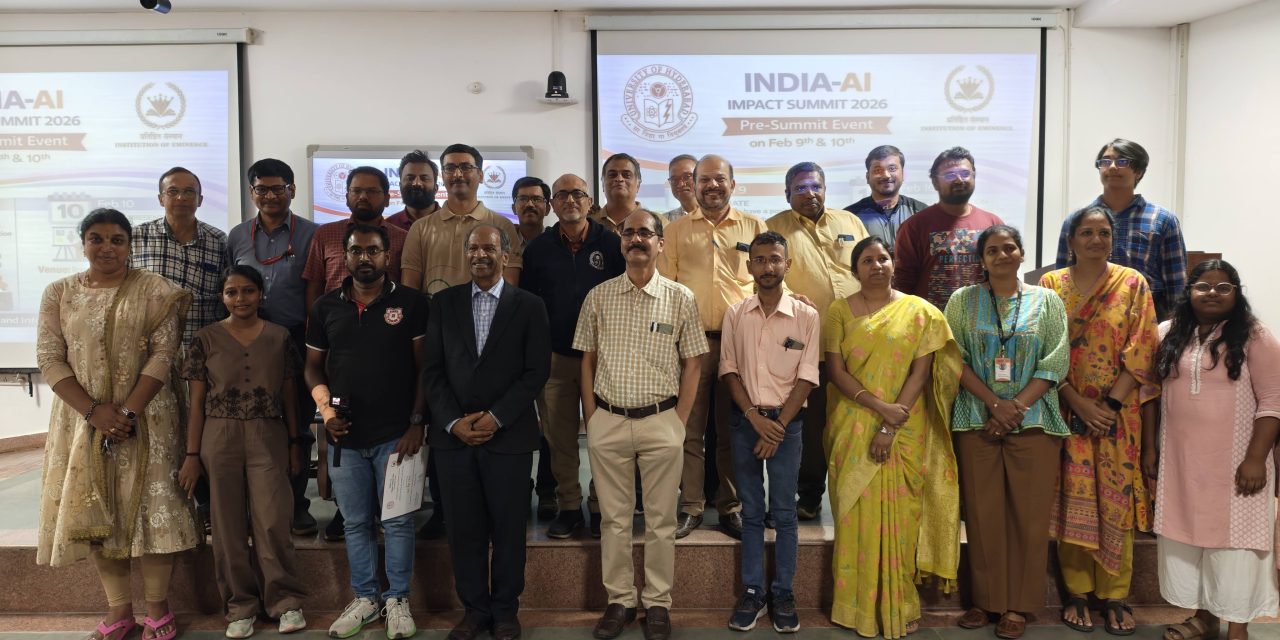
The School of Computer and Information Sciences (SCIS), University of Hyderabad, successfully organized the India AI Impact Pre-Summit Event on 9th and 10th February 2026. The event brought together students, academicians, and industry experts to discuss and debate contemporary developments in Artificial Intelligence while critically examining its ethical, social, and technological implications. The event also addressed concerns around the responsible use of AI and its misuse. The event served as a meaningful precursor to the India AI Impact Summit 2026, reinforcing its vision of responsible, inclusive, and people-centric AI. This is one of the nationwide events contributing to the national dialogue ahead of the global summit in New Delhi. AI Summit in India 2026 aims to position India as a leader in leveraging AI for sustainable development, innovation, and societal good through collaboration among policymakers, researchers, industry leaders, and civil society.
Event Overview
The two-day event provided a platform for insightful discussions, creative exhibits, and interaction between students and leading AI professionals. It encouraged critical thinking, innovation, and dialogue on both foundational and emerging AI topics.
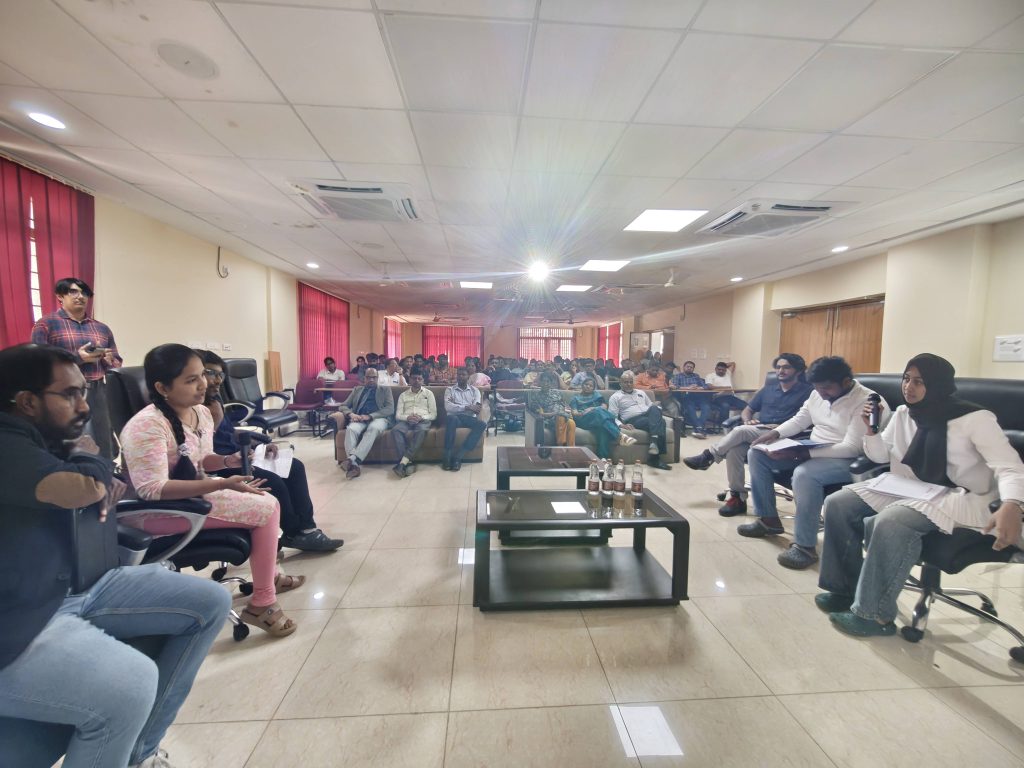
Day 1 began with a spirited Debate involving six student participants, moderated by Prof. Vineet C P Nair on the topic “AI Tools have a positive impact on Higher Education”. Students presented their views on key contemporary issues in AI, demonstrating analytical skills and subject knowledge. The student arguments centred on ethics and what must be taught to the students to make efficient use of AI tools. The large audience found the discussion on the balance between AI tools and human thinking interesting. Students debated how AI could bridge the learning gap and make learning easier for everyone. Three faculty members of the SCIS, Prof. Salman Abdul Moiz, Dr. T. Sobha Rani, and Dr. Anupama Potluri were the jury for the Debate Event.
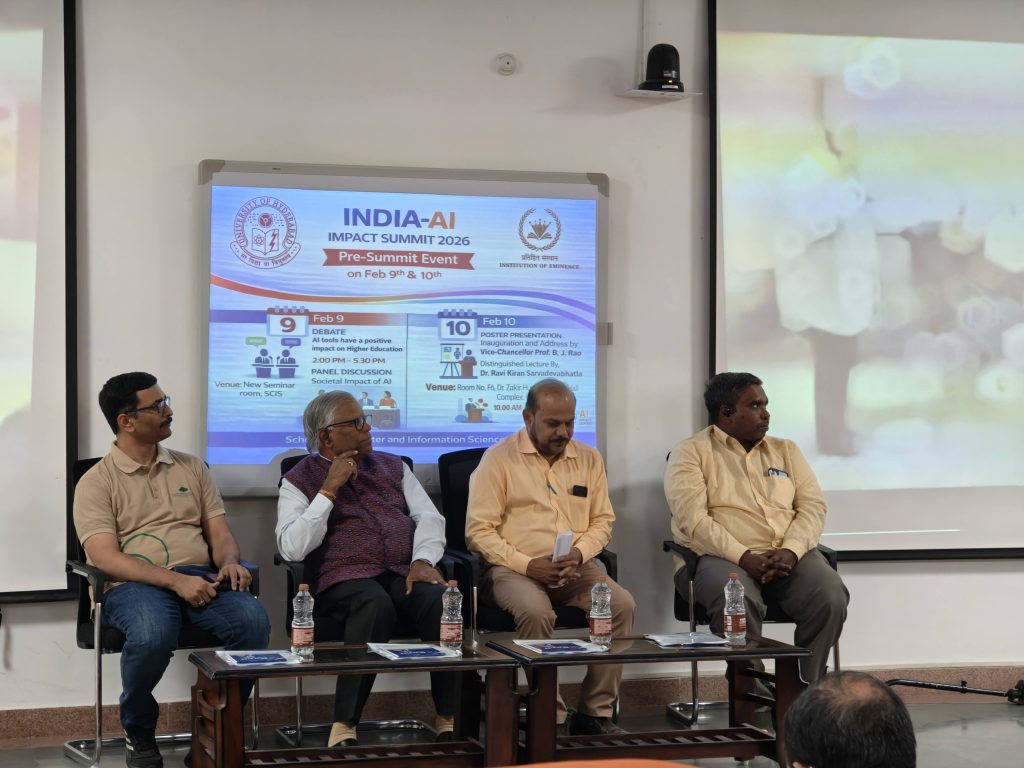
This was followed by a Panel Discussion moderated by Prof. Chakravarthy Bhagvati. The panel comprised distinguished experts from academia and industry who deliberated on the future of Artificial Intelligence, ethical considerations, societal impact, and career pathways.
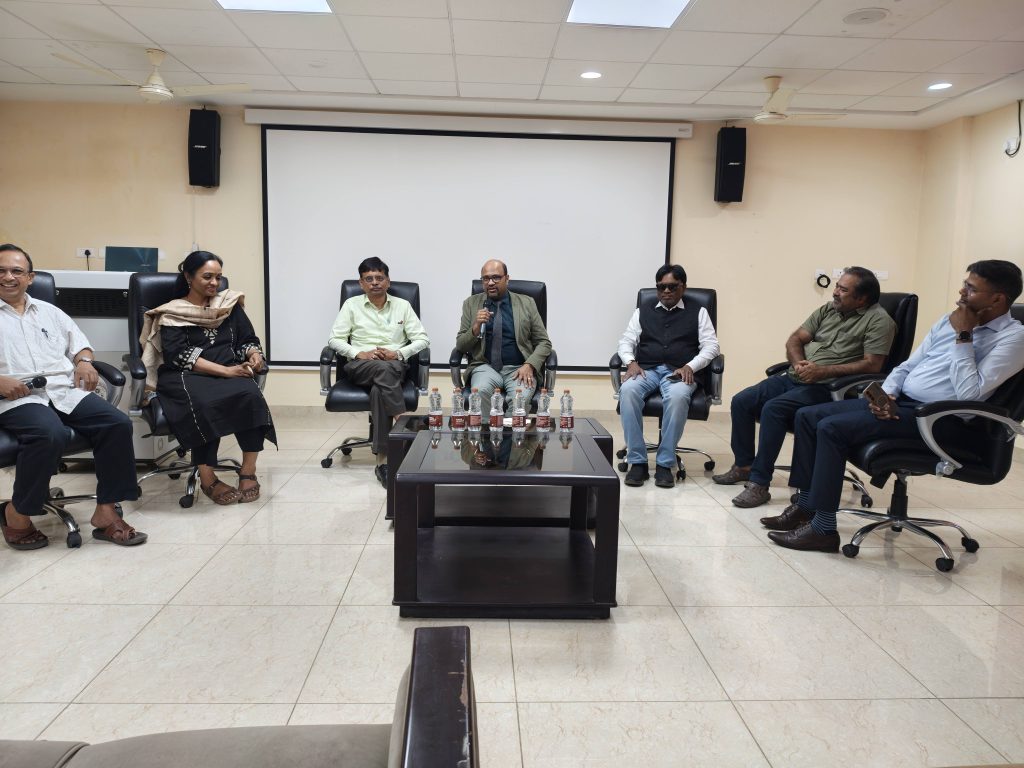
🎓 Panel Members:
- Arun Tripathy, NVIDIA
- JVR. Sagar, DRDO
- Srikanth Appasani, Gastroenterologist, KIMS Secunderabad
- Sri Neredimalli Annavaram, Dept of Sociology, UoH
- Madhavi Ravikumar, Dept of Communications, UoH
- Samrat L. Sabat, CASEST, UoH
Prof. Chakravarthy Bhagvati, SCIS, UoH: He is an early contributor to the AI domain with his efforts on Telugu OCR, which aims to make the Telugu script machine-readable. As the moderator, he posed questions to the panelists. Prof. Chakravarthy made the event engaging for the audience and brought out the issues raised by the panel.
Dr. Arun Tripathy, NVIDIA: A technocrat from NVIDIA, X-Googler, and Ex-Qualcomm. His direct work experience with NVIDIA, the tech giant behind the AI Revolution. Dr. Tripathy brought with him the thoughts of Jensen Huang, CEO of NVIDIA, advocating that students think in first principles and focus on a strong understanding of Maths and Physics. Asserting the student dilemma of whether to use AI in research, the motto given was: “don’t do blunt work, offload it to AI, and focus on the actual problems to be solved.” He also dwelt on how AI is used day in and day out with Alexa and Siri, long before ChatGPT.
Dr. J V R Sagar, DRDO: Brought his experience as a scientist who had directly worked on solutions using drones and UAVs, which are crucial for modern battlefields. He opened our minds to how AI is actually keeping a constant eye on the border lines without putting our soldiers at risk.
Dr. A. Sreekanth, KIMS, Secunderabad: Coming from the medical domain and being a practising gastro-entrologist, Dr. Sreekanth demonstrated AI being effectively used in a Human-in-the-Loop manner for detecting Polyps. A doctor does a faster examination and reviews with AI Assistance. Dr. Sreekanth was directly associated with Google in developing these solutions. His narration provided us with firsthand information on the advancement in AI and its impact on medical analysis.
Sri N. Annavaram, Dept. of Sociology, UoH: Is a visually-challenged person who has been an extensive user of AI day-in, day-out, of various tools from AI, GenAI, ChatGPT, etc. He has firsthand experience testing many of the AI technologies for assisted living in society. He highlighted how multimodal technologies such as Text-to-Speech, Speech-to-Text, etc., were essential to his education and appreciated the contributions of SCIS in these areas for the native Telugu Language. In particular, he explained how Meta-RayBan glasses help with understanding the surroundings.
Dr. Madhavi Ravi Kumar, Department of Communication, UoH: She has both journalism and academic experience. She mentioned how AI has helped make sense of large volumes of information, rendering it into compact, readable news that people could trust. She also raised concerns about DeepFakes and misinformation with the advent of GenAI. From an academic point of view, she discussed her students, for whom AI bridged the knowledge gap and made learning easier.
Prof. Samrat Sabat, CASEST, School of Physics, UoH: He highlighted that AI is not just about Generative AI. AI has long been there; with algorithms and the heuristics we employ in research across many domains. He expressed concern about efforts to remove the human in the loop. Prof. Sabat cautioned about how power- or energy-hungry AI is, warning us about the conscious use of AI. He asked all the panelists for their opinions on how the convenience of LLMs is taking away the joy of learning, getting their hands dirty, and building something on their own.
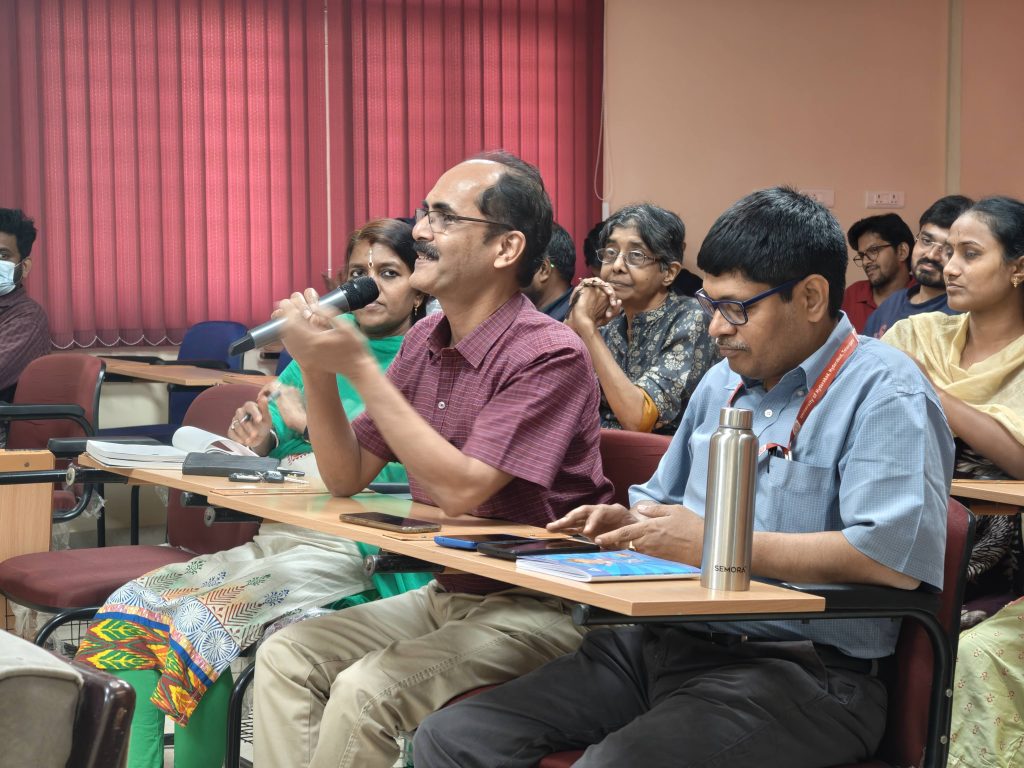
After the panelists spoke, an interactive Q&A session followed, during which participants asked insightful questions. The discussion covered key themes, including the role of AI in industry, its emerging applications in public health, and the broader societal implications of AI-driven technologies. The session concluded with a thoughtful emphasis on the need for effective regulation and responsible governance of AI to ensure its positive and ethical impact on society.
Poster Presentation and Distinguished Talk
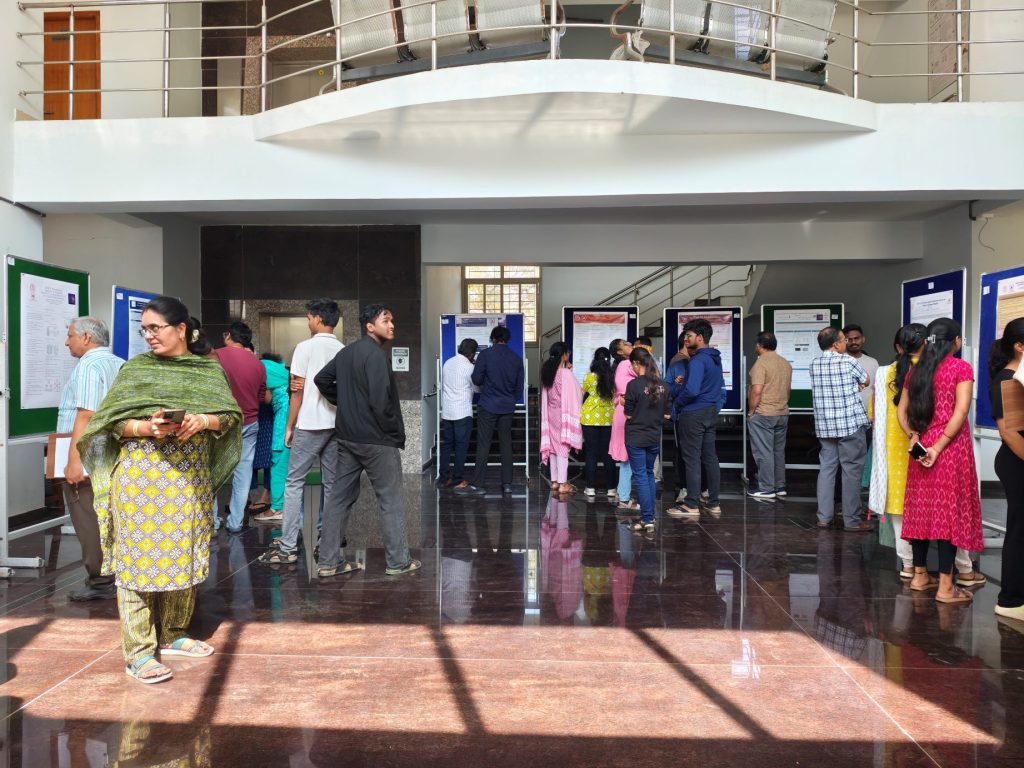
Day 2 highlighted students’ creative and research capabilities through a Poster Presentation featuring 15 participants, who showcased projects and innovative ideas demonstrating interdisciplinary applications of Artificial Intelligence. An expert jury evaluated the presentations and provided valuable feedback.
🏅 Jury Members:
Dr. Srinivas Jandhyala, Director & Software Consultant, Visesh Global Technologies Ltd
Prof. B. M. Mehtre, IDRBT (Retd.) & Prof. S. Bapi Raju, IIIT Hyderabad
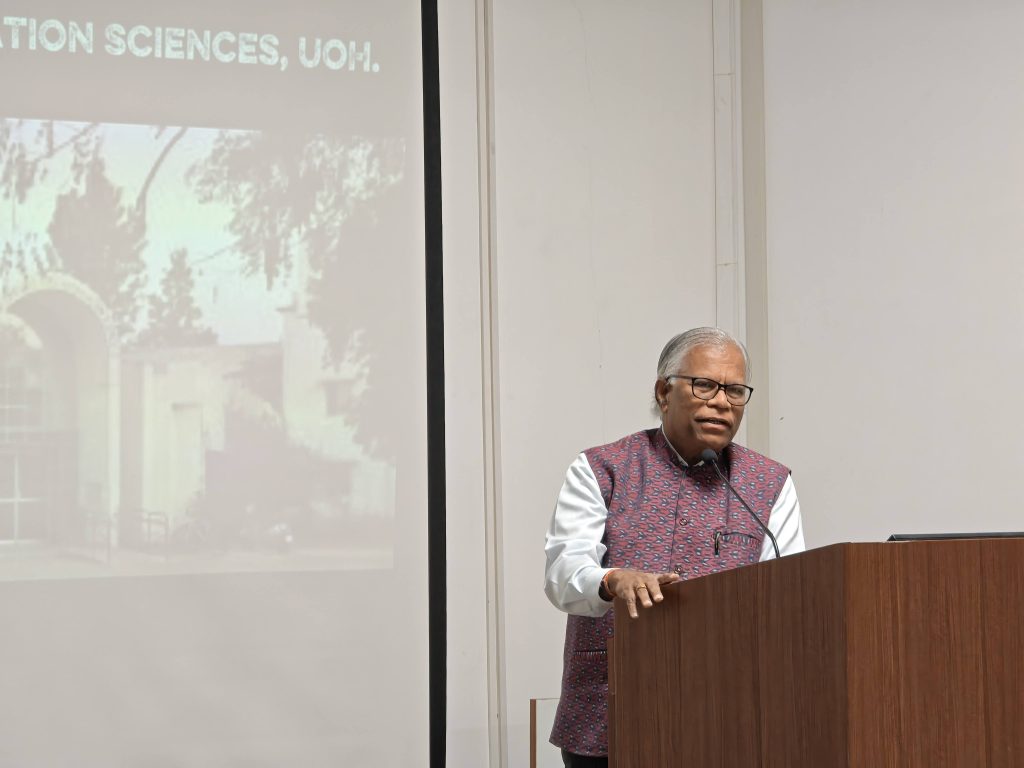
The Hon’ble Vice-Chancellor, University of Hyderabad, Prof. B. J. Rao, who inaugurated the inaugural session as the chief guest, visited the poster presentations and interacted with the student presenters. In his speech, he praised the posters’ overall quality, relevance, and clarity, noting that they showcased high-quality work. He made an encouraging remark that the students and the institution are moving in the right direction and aiming for meaningful, socially relevant AI goals. In his address, the Vice-Chancellor emphasized the importance of aligning AI research with ethical values and national priorities, while encouraging students to pursue innovation that benefits society.
The Dean of the School of Computer and Information Sciences, Prof. Siba Kumar Udgata, also shared his remarks, highlighting the importance of interdisciplinary research in AI and commending the students and organizers for creating a platform that balances technical depth with societal impact.
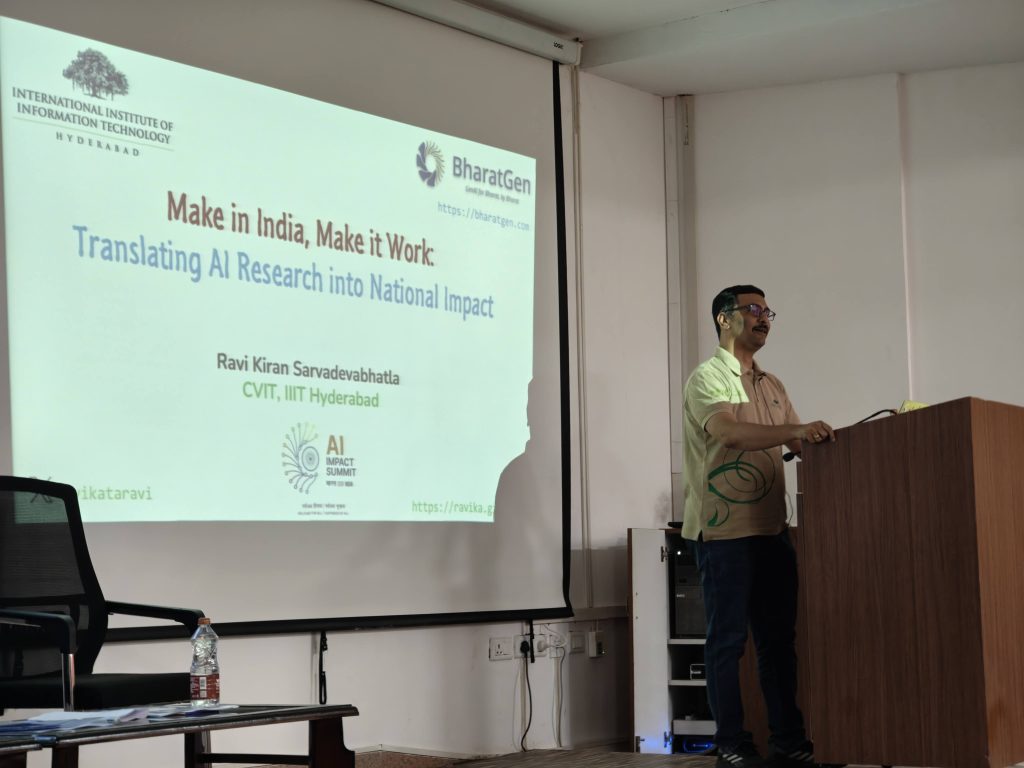
The event culminated with a Distinguished Talk delivered by Dr. Ravi Kiran Sarvadevabhatla, Associate Professor at IIIT Hyderabad and Core Member of BharatGPT. His address inspired students to explore deeper research and innovation avenues in Artificial Intelligence. As part of the event proceedings, the distinguished talk introduced BharatGen, outlining its purpose, scope, and national relevance in building indigenous AI capabilities. The speaker discussed key projects undertaken in collaboration with the Government of India, including AI-driven earthquake impact assessment on infrastructure and the detection of two-wheeler traffic violations, demonstrating the role of computer vision in public safety, disaster response, and governance.
The talk further focused on foundation models under development at BharatGen, with particular emphasis on the speaker’s contributions to Patram, a vision-language document foundation model. Insights were shared on the motivation, development process, and challenges involved in building an India-specific model that incorporates multilingual support and enables accessibility across diverse linguistic and document environments. The talk concluded with an overview of BharatGen’s long-term vision, outlining a roadmap to develop indigenous AI models aligned with national priorities and to strengthen India’s self-reliance in advanced AI research and deployment.
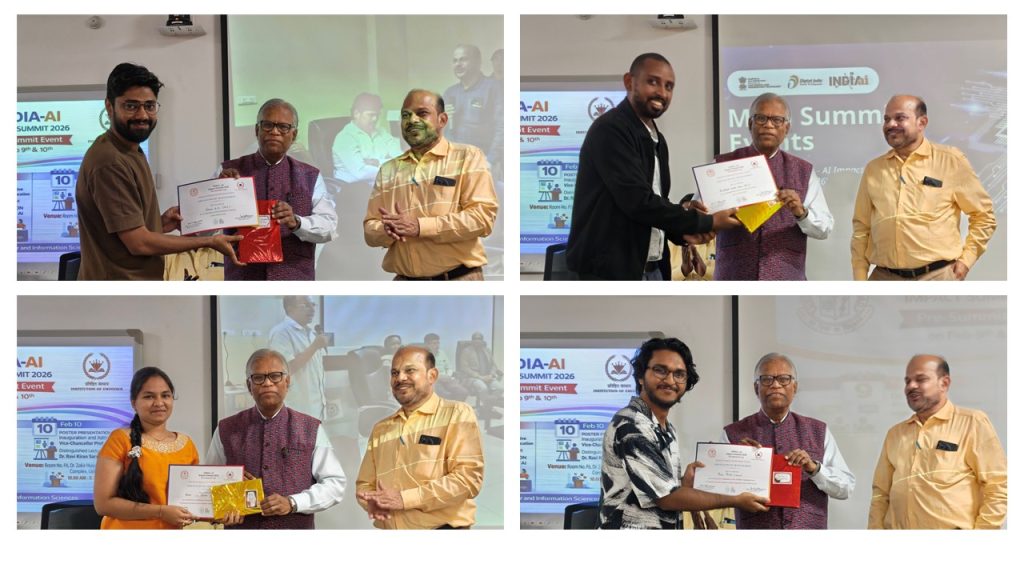
The organizers gratefully acknowledged the support and sponsorship received from NetElixir Pvt Ltd., which played a vital role in the successful conduct of the event. Prizes were distributed to the winners of the Debate and Poster Presentation competitions, with awards presented for Best Performance in the Affirmative and Best Performance in the Opposition in the debate, and for First and Second Prizes in the poster presentation category. The winners of the Debate competition are Pranav Prerepa (IMTech (CS)) and Sri Harika (M.Tech (IT)). The winners of the Poster Presentation are Salman KH (PhD (CS)), Keabineh Kaleb Keba (PhD (CS)). The proceedings concluded with a vote of thanks delivered by the Event Coordinator, Prof. P. S. V. S Sai Prasad, on behalf of the Organizing Committee composed of Prof. Chakravarthy Bhagwati, Prof. Atul Negi and Prof. Vineet CP Nair expressed gratitude to the Vice-Chancellor, Dean, speakers, jury members, faculty, students, sponsors, and volunteers for their collective efforts in making the India AI Pre-Summit Event a success.