
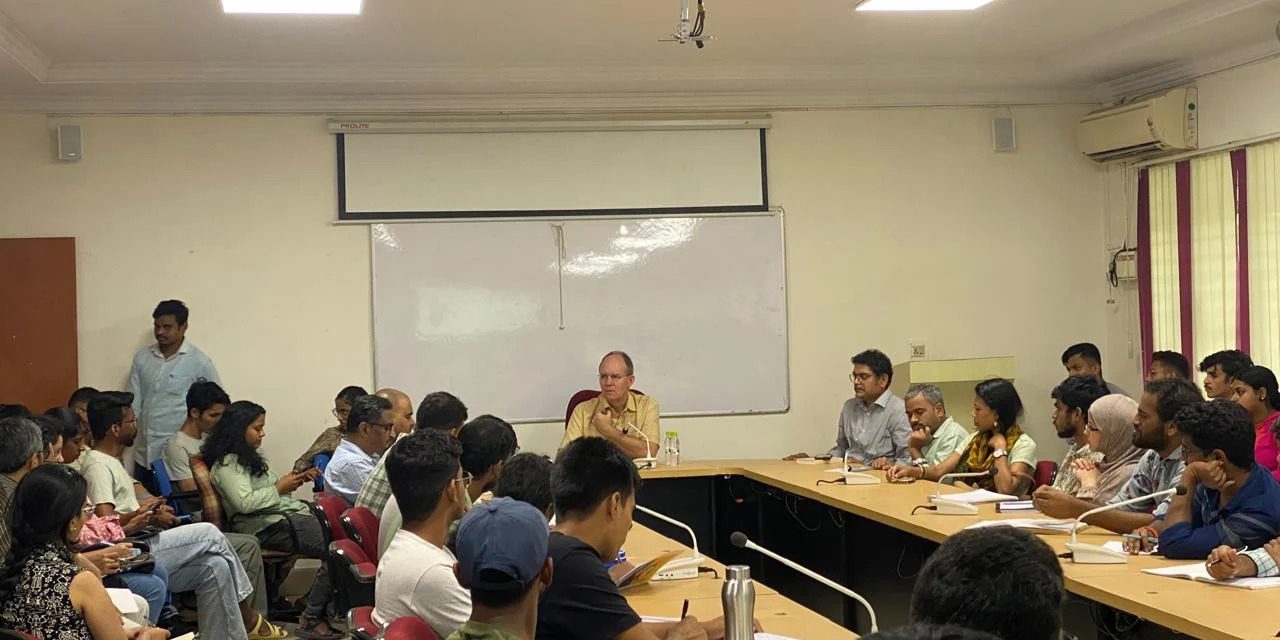
The Department of Anthropology, School of Social Sciences, University of Hyderabad (UoH), hosted a Guest lecture titled “Reflections on Ethnographic Fieldwork in India and the US” delivered by Prof. Murphy Halliburton, Professor, Anthropology at Queens College and the Graduate Center, The City University of New York on August 1, 2025.
Prof. Murphy’s interdisciplinary work in the field of Critical Medical Anthropology with respect to the Mental Health sector attracted faculty and students from Anthropology as well as other Social, Behavioural and Medical Sciences.
The session began with a warm welcome note from Dr. Nanda Kishore, Associate Professor, Department of Anthropology, who highlighted the works of Prof. Murphy in the field of Medical Anthropology and his ethnographic approach towards emerging contemporary issues of mental health. Dr. Alok Kumar Pandey, Assistant Professor, Department of Anthropology, introduced Prof. Murphy, shedding light on his significant contributions to the field, his areas of study, particularly his works in the field of critical medical anthropology.
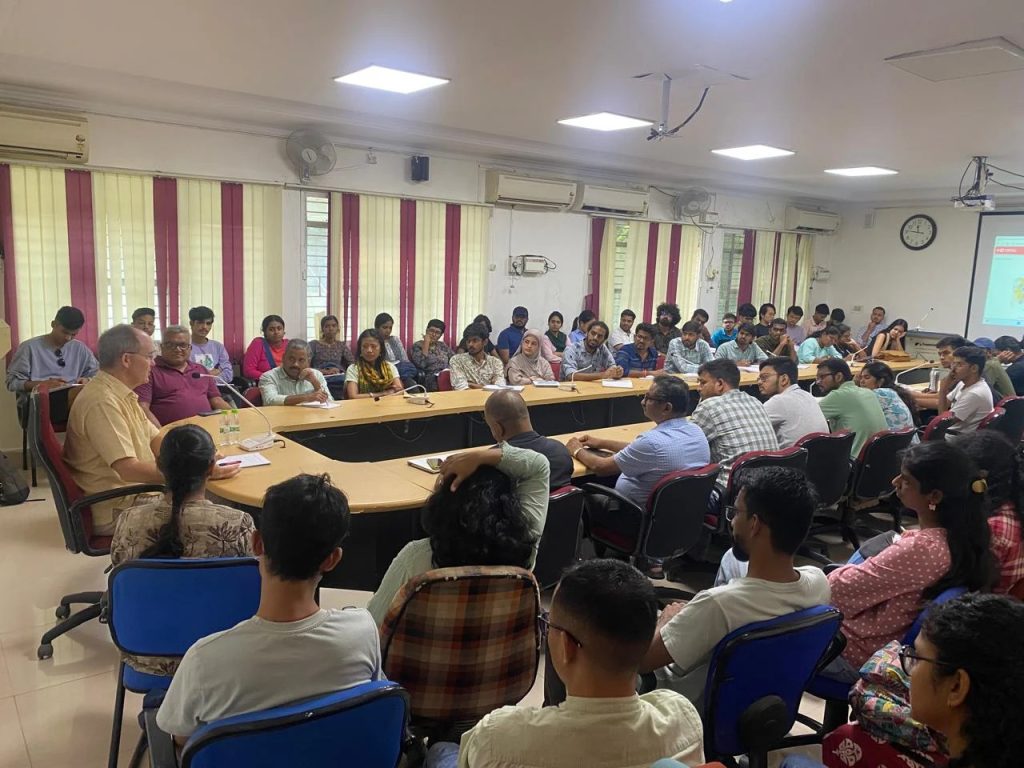
The talk revolved around his ethnographic reflections from his works in both India and the US, which are based on his two famous works 1. India and the Patent Wars: Pharmaceuticals in the New Intellectual Property Regime, published by Cornell University Press in 2017, and 2. Mudpacks and Prozac: Experiencing Ayurvedic, Biomedical and Religious Healing. Through discussing these works, he gave insights into capitalist exploitative methods of patenting medicinal items of Indigenous knowledge systems, global pharmaceutical giants ‘ profit- making strategies over traditional medicines, misuse of intellectual property rights, and the intersectionality between different mental health practices, especially ayurveda, allopathy, and religious places. The aspects he worked on are highly contemporary and in need of the time. Studying such emerging issues through the lens of ethnography in real-time settings sheds light on the expanding scope of Anthropology.
Prof. Murphy gave insights on how mental illness like schizophrenia is dealt with by allopathy, ayurveda, and religious places like temples in their own ways, which might have commonality in drugs but differ in their approach towards the ailment. He found that allopathic medicine treats the mental ailment in human physiological aspects but religious and ayurvedic therapies treat mental ailments holistically, which includes social and psychological aspects.
During this work, his interaction and openness to hear the voice of those respondents (who are victims or patients) itself turned out to be a type of therapy for them, where they opened up themselves, revealed hidden emotions and narratives which are not even shared with the doctors. Though it’s a method in ethnography, it turned out to be a therapeutic technique unknowingly.
He talked about Biopiracy, where biopiracy is the act of commercially exploiting biological resources, especially from indigenous communities and developing countries, through patents or other intellectual property rights, often without their consent or benefit sharing. He connected it with aspects of indigenous knowledge systems, availability and accessibility of medicines, and politics of ayurveda.
Dr. Murphy’s work tailored traditional ethnographic methods with new emerging and requisite methods of ethnographic research. He stressed how important it is to study up, down, and sideways to represent both dominant and invisible sections of the field and to gain an understanding of multiple realities or perspectives. He discussed the surge in digital Ethnographic methods, especially during the COVID pandemic, where Zoom or Google Meet were employed in reaching out to respondents.
Through his works, Dr. Murphy exemplified how modern contemporary fields like giant pharmaceutical companies (Pfizer) can be studied using ethnography both as a method and an approach. He discussed how hierarchy works in giant corporate companies, resulting in information lag, and how the elite control and prevent information flow. During this discussion, he shared his struggles as an ethnographer and how hard it might be to get access to information from elite companies or corporations. An ethnographer must be ready to face unexpected surprises in the field, which demands patience, skills, and time management. Many times, what we assume and what we observe might not be the same, or contradicting, or indifferent.
At the end of the program, students were encouraged and given the opportunity to ask questions, to which the Prof. Murphy gave warm and clear answers. He advised on writing ethnographic reports in a way that captures both the visible and the hidden meanings of the findings. He encouraged us to write not just what we see, but what our respondents might be trying to say between the lines. He also advised how to handle emotional stress in doing fieldwork, especially while working on sensitive topics.