
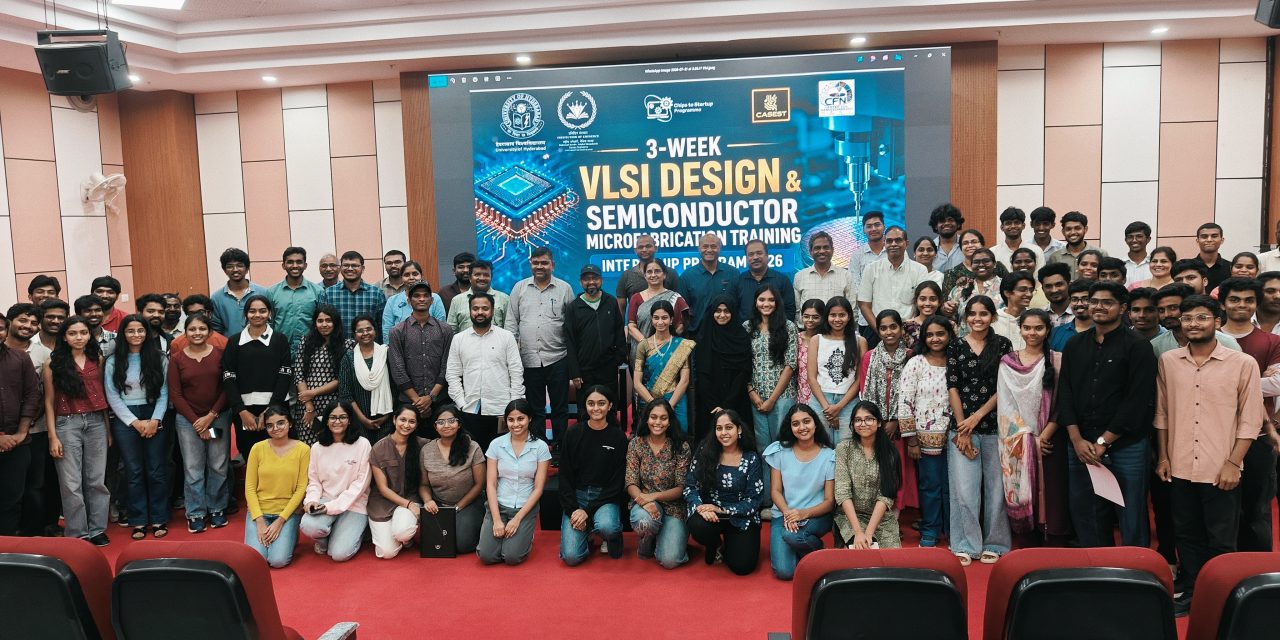
The Centre for Advanced Studies in Electronics Science and Technology (CASEST), School of Physics, University of Hyderabad (UoH), successfully concluded two intensive three-week training programmes on VLSI Design and Semiconductor Microfabrication (July 1–21, 2026), equipping students with hands-on skills in semiconductor design and fabrication. The Semiconductor Microfabrication program was jointly offered with the Centre for Nanotechnology, UoH.
A unique highlight of the Semiconductor Microfabrication Training Programme was that every participant designed, fabricated, tested, and characterized a Thin Film Transistor (TFT) using the University’s microfabrication facilities. In a first-of-its-kind initiative, the actual TFT fabricated by each participant was embedded into his or her certificate, making it a lasting record of the student’s hands-on achievement.
The VLSI Design Internship Programme covered the complete integrated circuit (IC) design cycle, including digital and analog IC design, Verilog HDL, RTL design, functional verification, logic synthesis, static timing analysis, physical design, design verification, analog and mixed-signal circuit design, and layout techniques using industry-standard Electronic Design Automation (EDA) tools. Participants gained practical experience through extensive laboratory sessions and design exercises.
The microfabrication programme provided hands-on training in wafer preparation, oxidation, photolithography, thin-film deposition, diffusion, etching, metallization, process characterization, and device fabrication, enabling every participant to fabricate a working Thin Film Transistor.
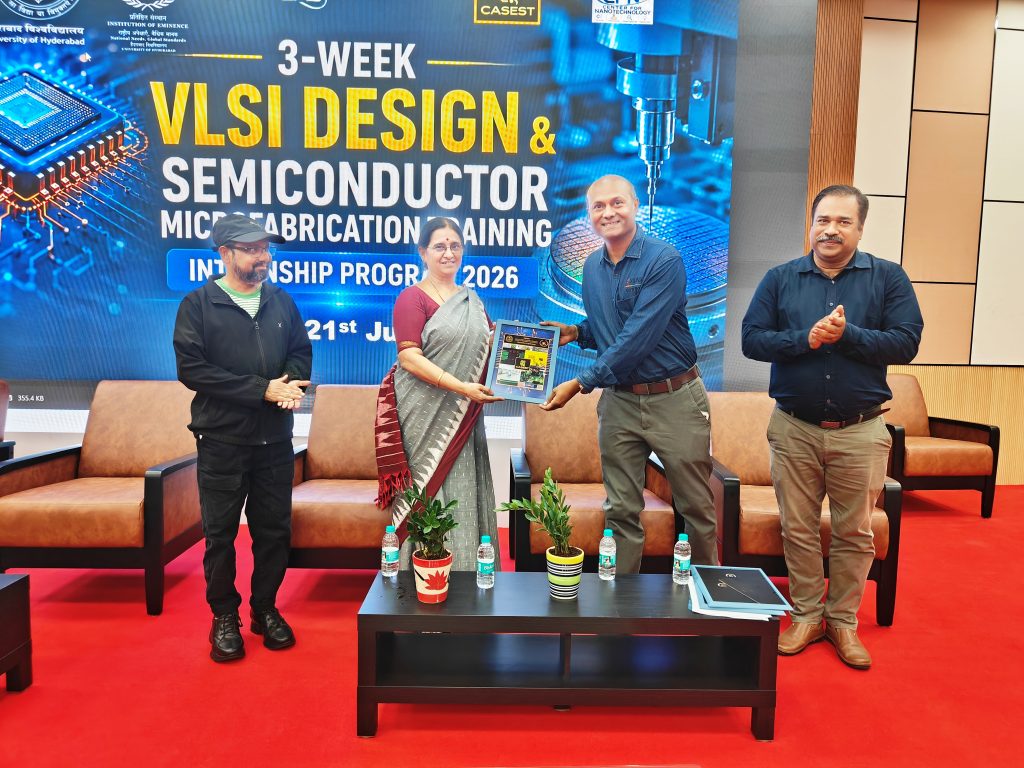
Speaking on the occasion, Prof. Samrat L. Sabat, Head, CASEST, congratulated the programme coordinators, Dr. Anjali Priya and Dr. L. D. Varma Sangani, for successfully organizing the training. He acknowledged the support of the Chip2Startup (C2S) programme, which has enabled the University to access industry-standard EDA tools for VLSI education. He noted that embedding the self-fabricated TFT into the certificate reflects the University’s commitment to experiential learning and skill development.
The valedictory ceremony was graced by Dr. Santosh Yechareni, Senior Director, Silicon Design Engineering, AMD India, as the Guest of Honour. He highlighted the tremendous opportunities emerging in India’s semiconductor sector and encouraged students to build strong technical foundations to contribute to the nation’s semiconductor ecosystem.
Prof. P. K. Suresh, Dean, School of Physics, appreciated the faculty members for organizing high-quality, industry-oriented training programmes and noted that such initiatives strengthen the University’s commitment to semiconductor education, research, and academia-industry collaboration.
Presiding over the function, Prof. J. Anuradha, Vice-Chancellor (i/c), University of Hyderabad, commended CASEST for organizing programmes aligned with the national semiconductor mission and emphasized the importance of experiential learning in developing a highly skilled semiconductor workforce.
Certificates, featuring the embedded Thin Film Transistor chips for the microfabrication participants, were presented during the valedictory ceremony.