
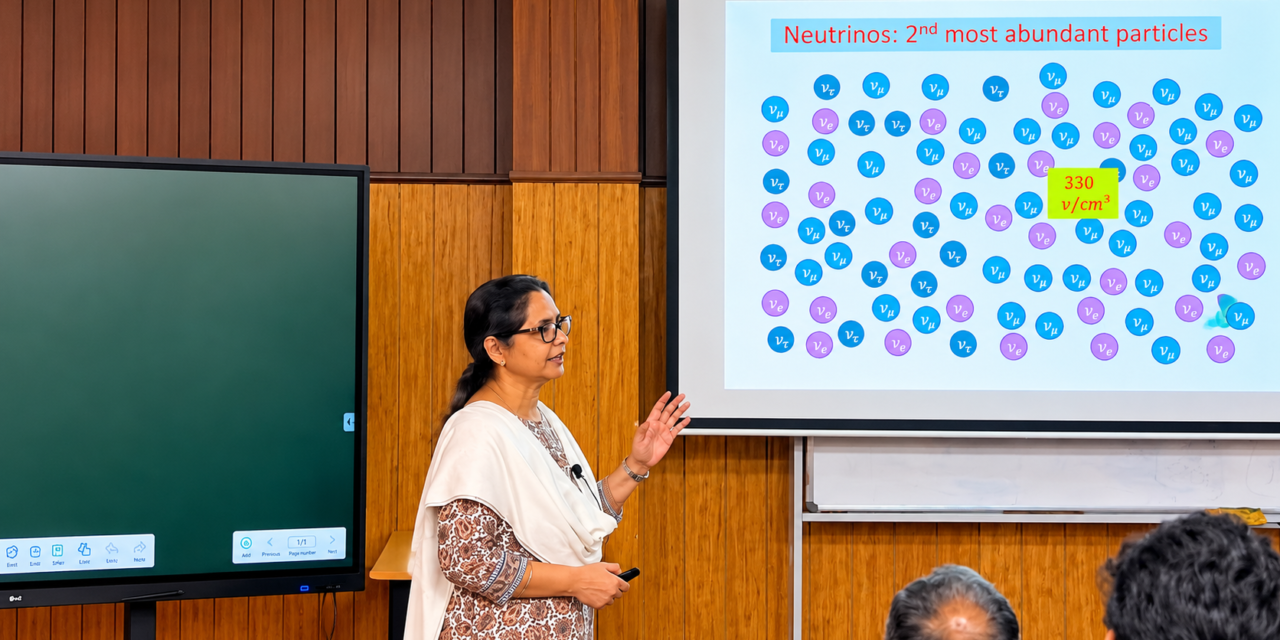
On November 4, 2026, the Zenith Astronomy Club at the School of Physics, University of Hyderabad, organised the Lecture 1 of the 2026 Nobel Prize in Physics Talk Series at the Marie Curie Seminar Hall, School of Physics. The talk was delivered by Senior Professor, Dr. Rukmani Mohanta.
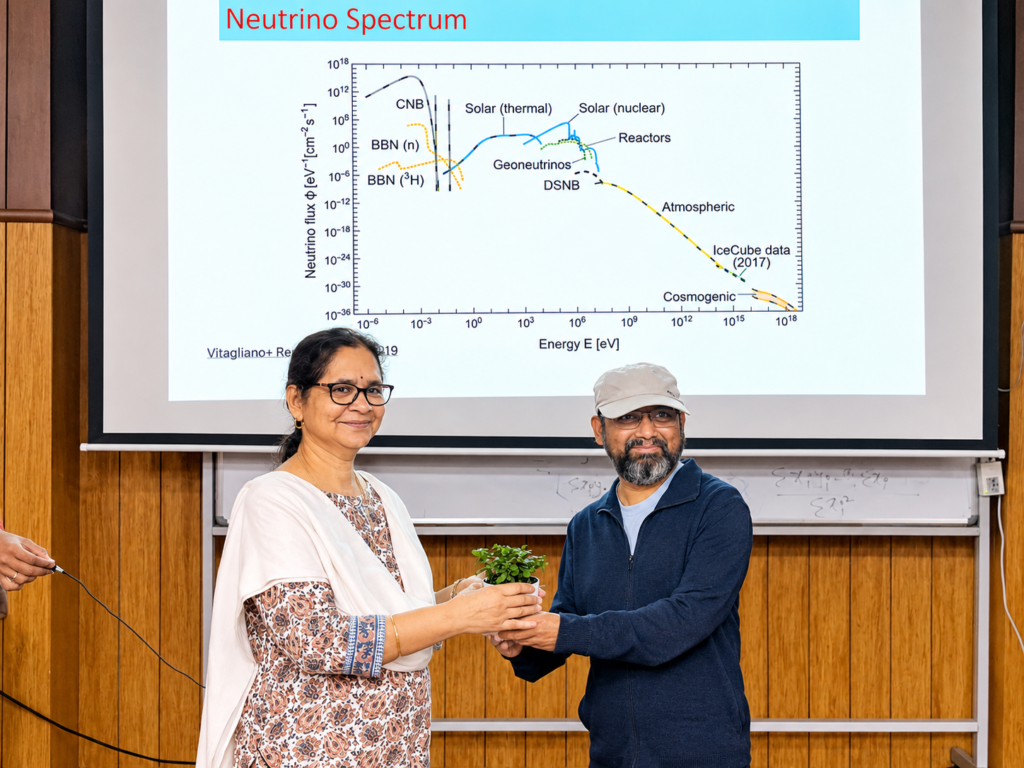
The session commenced with a brief introduction of the speaker and her research interests. Her research expertise spans both Theoretical and Experimental High Energy Physics, with primary research interests in Heavy Flavour Physics and CP Violation, Physics Beyond the Standard Model, Neutrino Physics, and Dark Matter phenomenology. She is also associated with the long-baseline neutrino experiments NOvA and DUNE at Fermilab, USA.
Prof. Mohanta began her talk with a comprehensive introduction to neutrinos, covering their history, origin, theoretical foundations and experimental discoveries. She highlighted the five Nobel Prizes in Physics associated with significant contributions to neutrino research, including this year’s Nobel Prize awarded to Francis Halzen for his contributions to the IceCube Neutrino Observatory and the discovery of high-energy neutrinos of astrophysical origin. She also provided an overview of the Standard Model and its fundamental constituents. Adding a touch of humour to the session, she presented an entirely empty slide while discussing the properties of neutrinos, aptly reflecting how elusive and difficult these particles are to study!
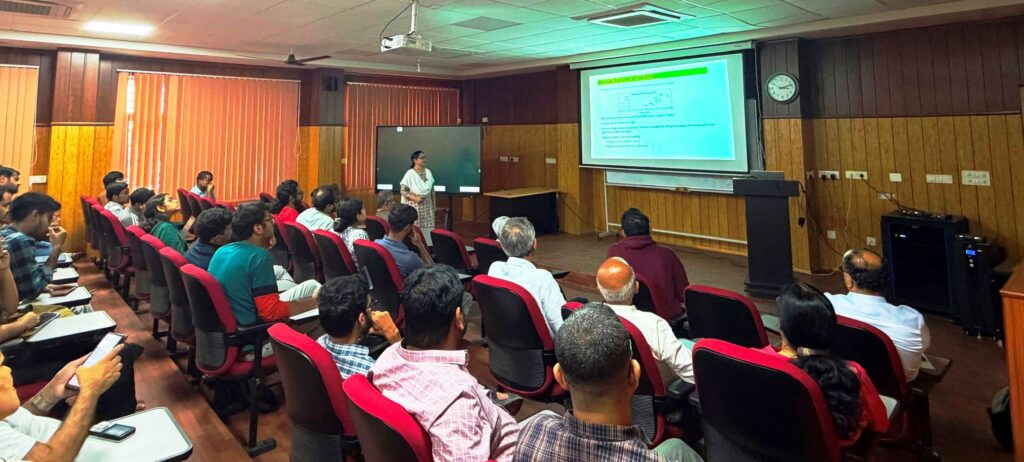
Moving forward, she discussed some of the major shortcomings of the Standard Model and the open questions in particle physics, particularly the origin of the extremely small but non-zero masses of neutrinos, which the Standard Model in its original formulation cannot explain. She emphasised how several of these unanswered questions are closely connected to neutrinos, motivating the need for further research into these little neutral particles.
Despite being the second most abundant particles in the universe, neutrinos are exceptionally difficult to detect due to their extremely weak interactions with matter. Prof. Mohanta elaborated on the phenomenon of neutrino oscillations, which explains the experimental observations involving atmospheric neutrinos.
The highlight of the session was her discussion of the “IceCube Neutrino Observatory”. She took the audience through its conception, history and construction, explaining how the detector uses Digital Optical Modules (DOMs) embedded deep within the Antarctic ice to detect Cherenkov radiation produced by charged particles resulting from neutrino interactions. She discussed the three major event signatures observed in IceCube, namely cascades, tracks and double-bang events. She also highlighted some of its key scientific results, including evidence linking high-energy neutrinos to the blazar TXS 0506+056.
Towards the conclusion of her talk, she introduced the audience to some of the exciting future neutrino experiments, particularly the Deep Underground Neutrino Experiment (DUNE), in which the University of Hyderabad is a collaborator. This provided a glimpse into the future of neutrino research and the possibilities that upcoming experiments hold.
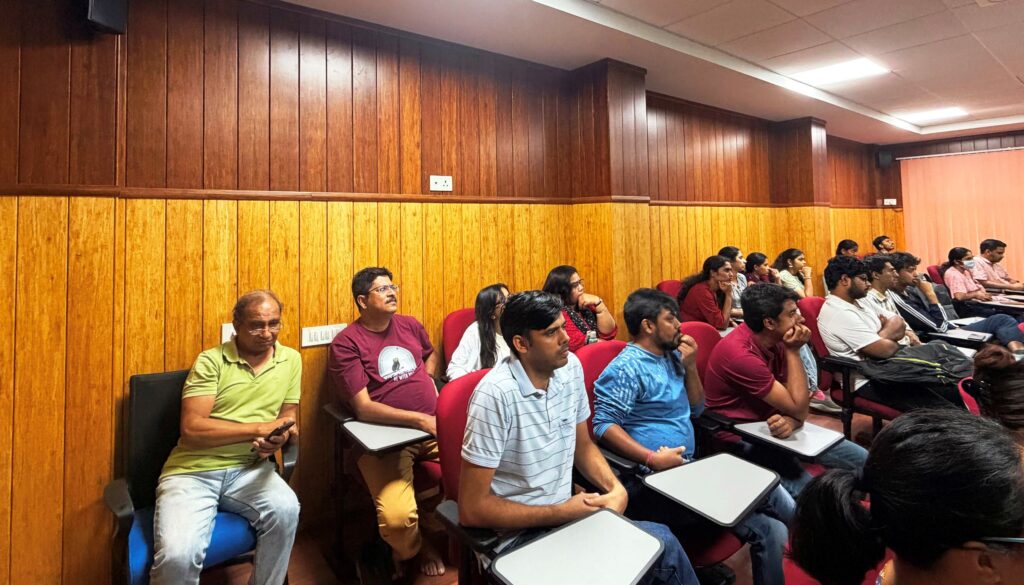
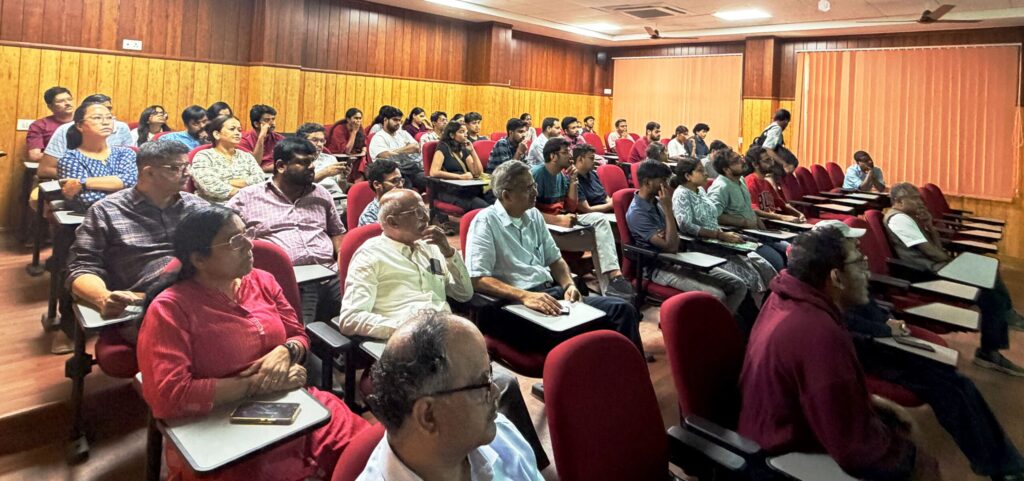
The talk session witnessed active participation from the audience. Students, Professors and research scholars engaged enthusiastically during the question–answer segments, posing insightful queries that reflected their keen interest in the topics discussed.
The event concluded with a token of appreciation being presented to the speaker by the Dean, School of Physics. The session successfully achieved its objective of familiarising students with the significance of the 2026 Nobel Prize in Physics while providing them with a broader understanding of neutrino physics, its experimental developments and the exciting avenues of ongoing research.