
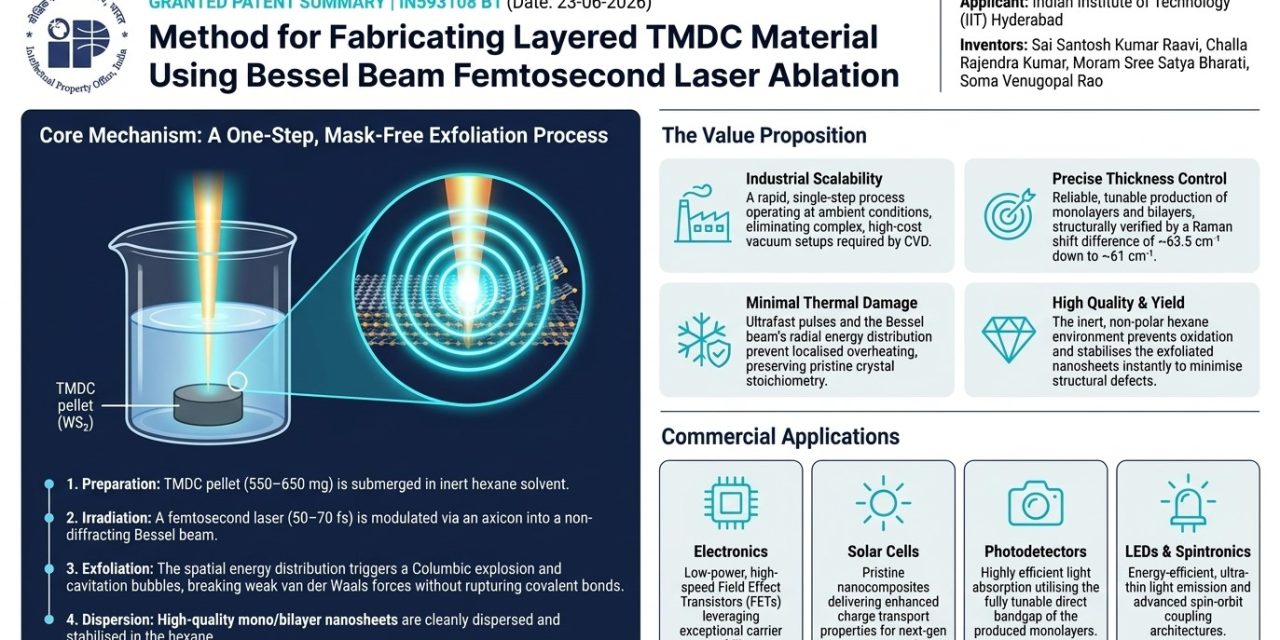
In a major breakthrough for the field of nanotechnology and advanced materials, a collaborative research team from the University of Hyderabad (UoH) and the Indian Institute of Technology Hyderabad (IITH) has been granted a prestigious Indian patent. The patent, titled “Method for fabricating one or more layered TMDC material using Bessel beam femtosecond laser ablation” (Application No. 202541061247; Grant No. 593108), introduces a highly efficient, cost-effective, and rapid technique for producing atomically thin transition metal dichalcogenide (TMDC) nanosheets.
The inventors behind this pioneering innovation are Dr. Sai Santosh Kumar Raavi (IITH), Dr. Challa Rajendra Kumar (IITH), Dr. Moram Sree Satya Bharati (IITH/UoH), and Prof. Soma Venugopal Rao (UoH).

The Innovation: Overcoming the Nanotechnology Size-Confinement Challenge
Transition metal dichalcogenides (TMDCs) are a class of two-dimensional (2D) materials that have taken the electronics world by storm due to their exceptional optical, electronic, and mechanical properties. While bulk TMDC contains strong covalent bonds within individual layers, these layers are stacked together by weak van der Waals forces. Isolating single or few-layered nanosheets requires breaking these weak interlayer forces.
Traditionally, this has been achieved through methods like mechanical exfoliation (the Scotch-tape method), chemical exfoliation, or chemical vapor deposition (CVD). However, these conventional processes are heavily bottlenecked—they are either incredibly time-consuming, chemically intensive, high-cost, or difficult to scale due to size-confinement constraints.
The Power of the Bessel Beam and Femtosecond Lasers
The newly patented method bypasses these traditional limitations by deploying ultra-short, high-precision laser technology. The technique involves shaping a femtosecond laser beam into a specialized Bessel beam profile and focusing it directly onto a synthesized TMDC pellet.
By firing one or more ultra-fast laser pulses at the target, the intense energy precisely breaks the weak van der Waals forces holding the layers together without damaging the chemical structure of the material itself. This localized laser ablation successfully produces pristine, single, or multi-layered TMDC nanosheets instantaneously, creating a highly efficient path for industrial-scale manufacturing.
A Testament to Inter-Institutional Excellence
This invention stands as a stellar example of institutional synergy between two of India’s premier educational hubs. The collaborative effort features deep roots at the University of Hyderabad: Prof. Soma Venugopal Rao is a senior professor at the School of Physics and DIA-CoE (formerly ACRHEM), UoH, while co-inventor Dr. M.S.S. Bharati completed her doctoral research under the School of Physics (ACRHEM), UoH, before bridging her work with IIT Hyderabad.
The University of Hyderabad community congratulates the entire research team on this monumental success, which positions the institution at the absolute forefront of global 2D-materials and laser-physics research.