
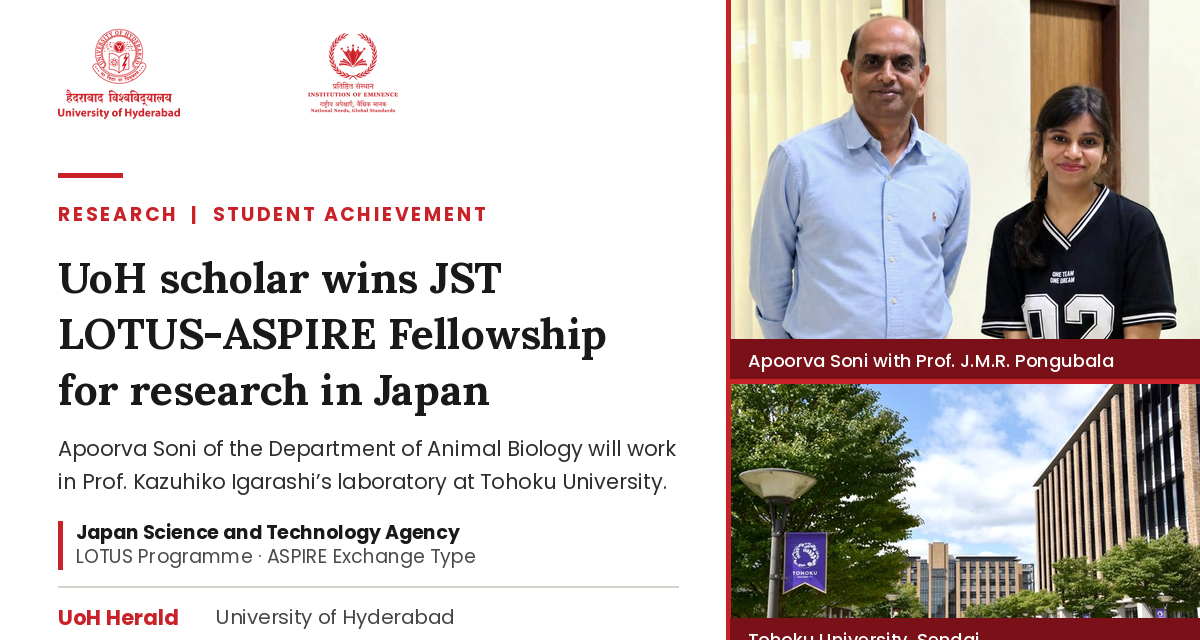
Department of Animal Biology scholar Apoorva Soni to continue her work on B-cell development at Tohoku University, Japan
The University of Hyderabad is founded on a commitment to academic and research excellence across diverse areas of enquiry — a commitment reflected in a distinguished faculty whose contributions to science and other disciplines have earned national and international recognition. That tradition now extends to a new generation of researchers. Ms. Apoorva Soni, a research scholar in the Department of Animal Biology working under the supervision of Prof. Jagan M.R. Pongubala, has been selected under the prestigious Indo-Japan LOTUS-ASPIRE programme of the Japan Science and Technology Agency (JST).

Tohoku University, Sendai, Japan
Administered by JST, the LOTUS Programme — formally the India-Japan Circulation of Talented Youths in Science Programme — invites outstanding Master’s and doctoral students, as well as postdoctoral researchers, from Indian institutions to undertake research in Japan under joint supervision. Its ASPIRE Exchange Type track, LOTUS-ASPIRE, supports long-term stays of up to 36 months, and is designed to produce tangible research outcomes such as publications and conference presentations while strengthening enduring research links between the two countries.
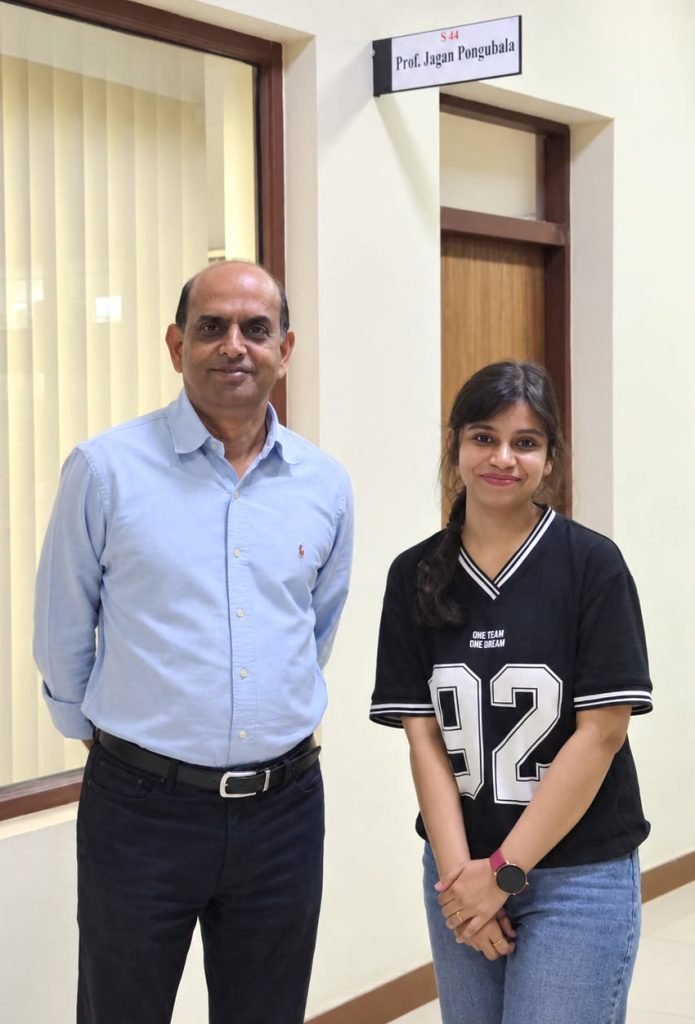
Apoorva Soni with her supervisor, Prof. Jagan M.R. Pongubala, at the Department of Animal Biology, University of Hyderabad
As part of her doctoral work at UoH, Apoorva has been studying the role of IRF4, a crucial transcription factor, during B cell development. Using functional genomics and computational approaches, she has demonstrated that IRF4 controls B cell maturation through multiple regulatory mechanisms, including epigenetic regulation of a distinct set of B-lineage-specific genes.
Under the fellowship, Apoorva will continue these studies in the laboratory of Prof. Kazuhiko Igarashi at the Department of Biochemistry, Tohoku University Graduate School of Medicine, Sendai. Prof. Igarashi’s group is internationally recognised for its work on the transcriptional repressors BACH1 and BACH2, which govern antibody class switching and plasma cell differentiation — a body of research that complements the IRF4-centred questions Apoorva brings from Hyderabad.
At Tohoku, she will interrogate the physiological roles of several of these newly identified genes using a recently developed IRF4-inducible animal model system, together with the latest gene-editing technologies. Ultimately, Apoorva hopes to map the large sets of genes and regulatory sequences through which IRF4 acts. These studies are anticipated to illuminate previously obscure gene regulatory networks that govern the development and activation of B cells — work with implications for how the immune system is built and how it fails in disease.
Speaking of his student’s selection, Prof. Pongubala said, “There is no greater reward for a teacher than witnessing students create opportunities for themselves and pursue their aspirations with confidence.”
The University of Hyderabad joins Prof. Pongubala in congratulating Apoorva Soni on this well-deserved achievement and wishes her the very best in this exciting new phase of her scientific journey.