
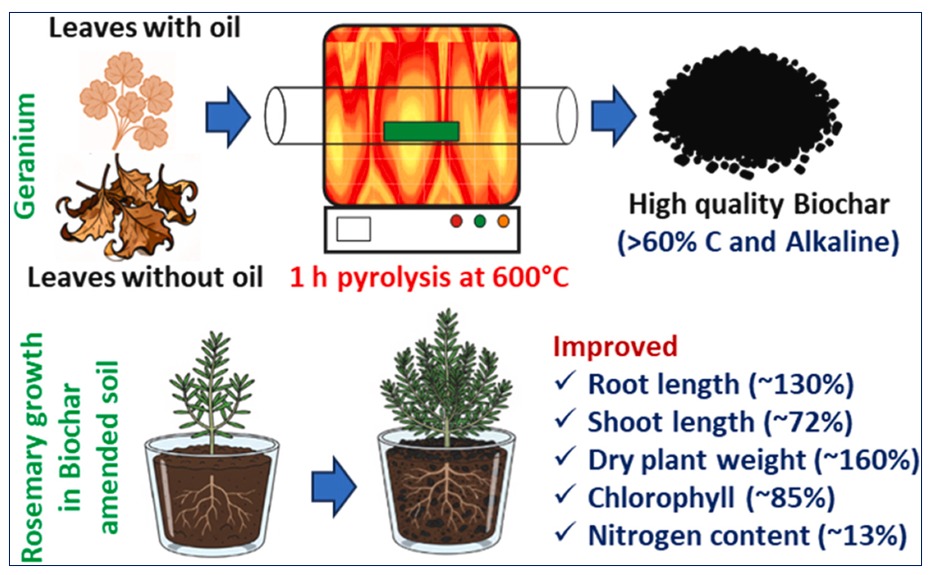
In a notable example of sustainable innovation, a multidisciplinary research team from the University of Hyderabad (UoH) has developed a method to upcycle waste Geranium leaves, an often-discarded byproduct of the essential oil industry, into a value-added material that can rejuvenate soils and enhance plant growth. The research, recently published in a special issue of the prominent journal Biomass and Bioenergy (Elsevier, November 2025), demonstrates how scientific ingenuity can transform agricultural waste into a powerful tool for environmental sustainability.
The study, titled “Upcycling of Waste Geranium Leaves into Biochar for Soil Amendment,” was carried out through a collaborative effort between the School of Life Sciences (SLS) and the School of Engineering Sciences and Technology (SEST) at UoH. The project was jointly led by Prof. Appa Rao Podile (SLS) and Prof. Dr.-Ing. V.V.S.S. Srikanth (SEST). The research team consisted of Dr Danteswari Ch, Dr Sarma P.V.S.R.N., Mr Akshay Rao, Mr Dharani Kumar, and Dr Ravikiran, each contributing to various aspects of the study. The interdisciplinary team combined expertise in plant sciences and materials engineering to design an efficient process for transforming Geranium residues into biochar, a carbon-rich product known for its ability to enhance soil fertility and sequester carbon.

Comprehensive analyses revealed that the biochar derived from Geranium leaves possessed a high carbon content (~65%) and contained minerals such as calcium, potassium, magnesium, phosphorus, and exhibited alkaline properties, which are beneficial for improving soil fertility. When used to amend soil, biochar significantly enhanced the growth of Rosemary plants, confirming improvements in plant vigour and nutrient assimilation. These outcomes highlight the dual environmental and agricultural benefits of biochar, thereby reducing waste while improving soil productivity and supporting a circular bioeconomy.
According to the authors, the process also has substantial economic potential, as Geranium residues are abundant and inexpensive. The energy requirement for the process was modest (~9 kWh per batch), and the estimated production cost per kilogram of biochar was substantially lower than many commercial biochar products available globally.
The project received financial support from the Department of Biotechnology (DBT), Government of India. The team also used advanced analytical facilities supported by the DST-FIST (Department of Science and Technology – Fund for Improvement of S&T Infrastructure). The authors also acknowledge support from the Institution of Eminence (IoE-UoH) program.
Speaking about the significance of the study:
Prof. Appa Rao Podile noted that the work demonstrates “how a waste product from the essential oil industry can be turned into a sustainable soil enhancer that supports plant health, soil restoration, and carbon sequestration.”
Prof. Dr.-Ing.VVSS Srikanth emphasized that “the collaboration between engineering and life sciences enabled a holistic approach, from process design to agricultural application -showing how interdisciplinary research can generate tangible environmental benefits.”
This investigation not only contributes to India’s bioeconomy and waste valorisation goals but also provides a scalable model for the sustainable management of aromatic crop residues. By turning Geranium waste into a valuable biochar resource, the University of Hyderabad team has demonstrated how Interdisciplinary collaboration and government support can drive green technology innovations that benefit both farmers and the environment.
Publication link: https://doi.org/10.1016/j.biombioe.2025.108556.