
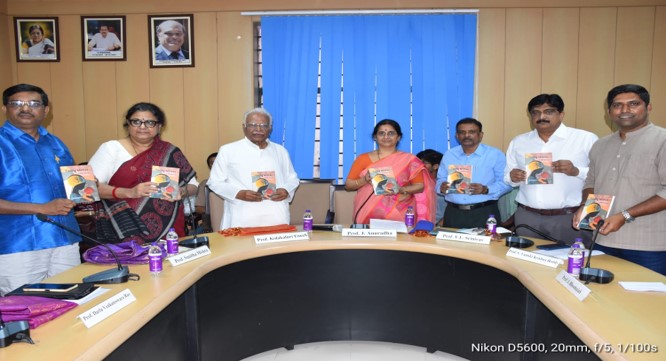
A programme in connection with the launch of Toiling Mother and Other Poems, authored by Prof. J. Bheemaiah, was held at the Centre for Comparative Literature on 6th August 2026 (Thursday) evening. The book was unveiled by Kolakaluri Enoch, the Chief Guest and formerly Vice-Chancellor of Sri Venkateswara University, Andhra Pradesh. Prof. J. Anuradha, Vice-Chancellor of the University of Hyderabad; Y. L. Srinivas, Vice-Chancellor of Sammakka Sarakka Central Tribal University; Darla Venkateswara Rao, formerly Head, Department of Telugu, University of Hyderabad; and Prof. J. Vamshi Krishna Reddy, Head, the Centre for Comparative Literature, graced the book launch function.
Apart from the dignitaries who attended the programme in person, Prof. A. S. Dasan, Department of English, Mysore, and Prof. Kashinath Ranveer, Department of English, Dr. Babasaheb Ambedkar Marathwada University, and Prof. Ajith Kanna, Department of French and Franca Phone, JNU, participated in the programme online. The book launch programme was chaired by Prof. Sunita Mishra, Dean, School of Humanities.
Book Launch Ceremony of Toiling Mother and Other Poems at the Centre for Comparative Literature
Prof. Kolakaluri Enoch unveils the book. Prof. J. Anuradha , Prof. Sunita, Prof. Darla Venkateswara Rao , Prof. J. Bheemaiah, Prof. Y. L. Srinivas, and Prof. Vamshi Krishna Reddy participate in the ceremony.
About the Book
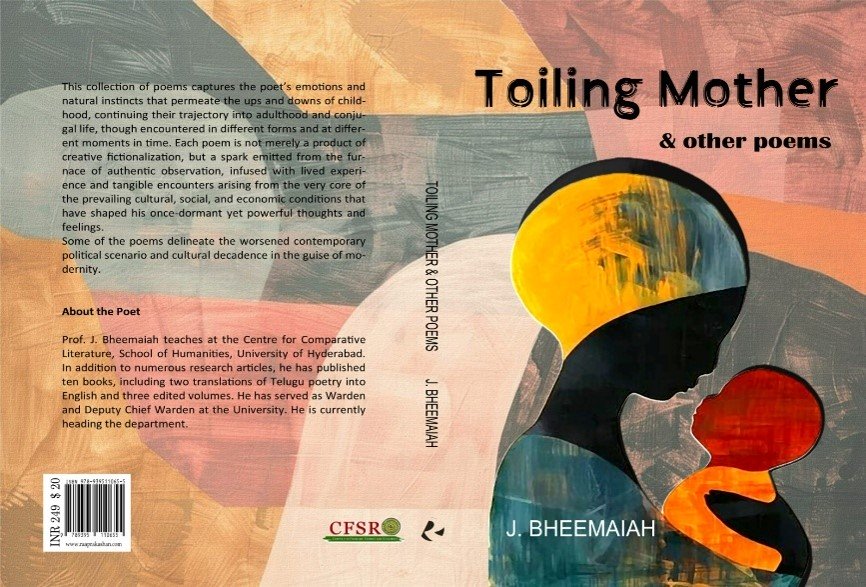
The collection of poems is enriched with the poet’s mature ideas, each exploring varied themes connected with contemporary socio-economic and cultural issues. Some of the poems mirror the poet’s autobiographical elements deeply rooted in his childhood experiences in the rural milieu. Each poem has its unique theme, delving into the complexities of human relationships in society. Among all the poems, “Toiling Mother” is pioneering and towering in both stature and structure, enriched with reminiscences that portray the trials and triumphs of the committed life of the poet’s late mother, who is presented as a representative of millions of toiling mothers. The opening poem is composed as a tribute to her, recalling her ideals of hard work and dedication, which serve as a model for every toiling woman. In fact, labour was her worship in her daily life.
The poetry foregrounds the lives of occupational social groups in villages. While portraying cobblers and drummers, the poet looks not only into their economic backwardness but also into the discriminatory attitude displayed by the dominant sections of society towards them, despite the invaluable services they render. This poetry collection fearlessly confronts systemic injustices and portrays social and political crises with remarkable adeptness and insight.
The poetry critiques the cultural and moral decadence that overpowers an average individual in contemporary society, which becomes a matter of concern. Without resorting to complex symbols and traditional prosodies the poet unveils profound social truths through ordinary images such as dogs, wells, lightning, thundering and so on. His poetry is marked more by its raw honesty than by mere ornamental embellishment. The poet is down-to-earth in his presentation of social facts. This collection stands as a powerful voice for the marginalized and the oppressed majority, striving to awaken a new social consciousness.