
A new News & Views article published in Nature Plants by Prof. Rajagopal Subramanyam and Dr. Ranay Mohan Yadav from the Department of Plant Sciences, University of Hyderabad, highlights a fundamental shift in our understanding of plant biology.

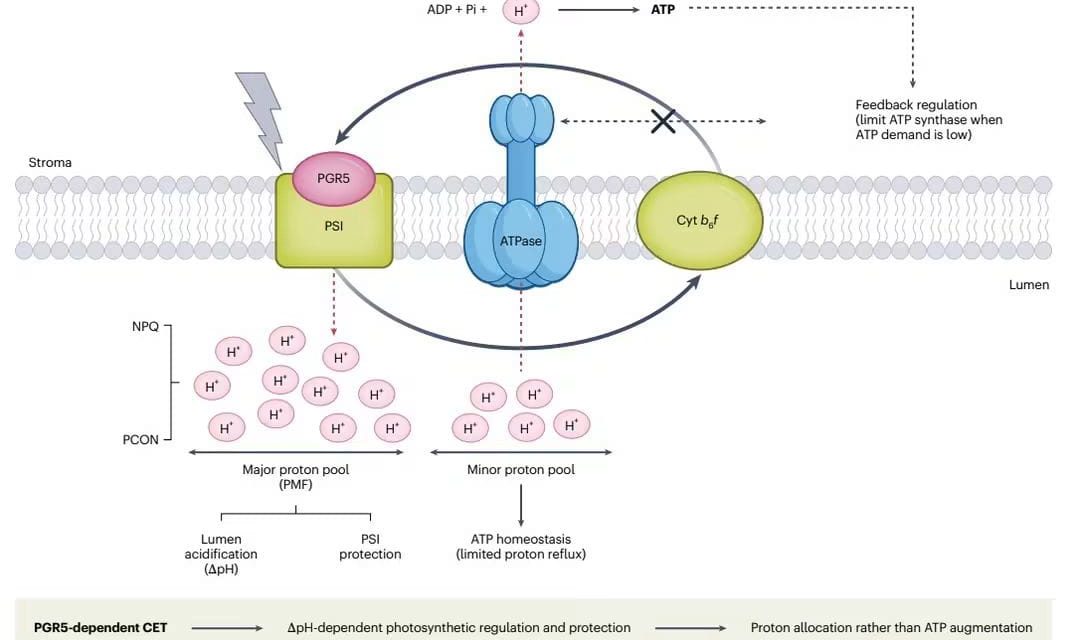
Commenting on a landmark study in the journal, the authors explain how two decades of established thinking regarding plant energy management are being challenged. For years, the primary function of PROTON GRADIENT REGULATION 5 (PGR5) was believed to be boosting ATP production through cyclic electron transport. However, recent findings reveal that PGR5’s main role is actually photo protection via pH-dependent regulation.
Key takeaways highlighted in the article include:
Shift in PGR5 Function: Rather than serving directly to enhance ATP output, PGR5 maintains the pH driven regulation of photosynthesis to ensure redox homeostasis and photosystem stability.
Balanced Energy Management: Within this refined model, ATP synthesis remains relatively stable or is selectively reduced, while proton flux is preferentially directed toward safeguarding the photosynthetic machinery.
Photosystem Resilience: The insights underscore that photosynthesis functions not merely as an energy factory, but as a finely tuned protective system designed to preserve fragile molecular structures against light-induced damage.
This commentary emphasizes how plants balance energy production with photoprotection to maintain resilience under varying environment conditions.
For further details, the full News & Views article can be accessed at Nature Plants https://rdcu.be/fBfEg