
Thirty-Seven Years, and the City Says Yes
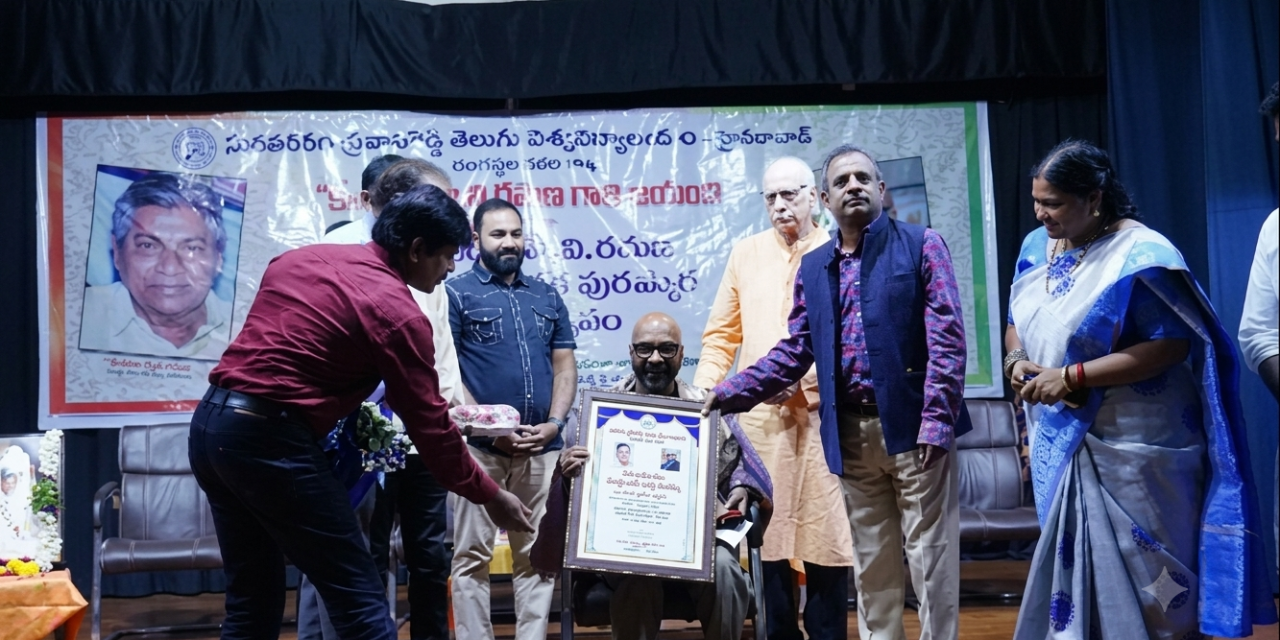
Some of Dr Rammohan Holagundi’s earliest performances began with a walk. Three kilometres, sometimes four, because the group had no money for transport and the show was not going to wait. Thirty-seven years later, at the Dr Nandamuri Taraka Rama Rao Kalamandiram in Nampally, the Suravaram Pratapa Reddy Telugu University presented him the Dr P. V. Ramana Memorial Award 2026 and conferred upon him the title of Best Theatre Director.
For the University of Hyderabad, the honour lands close to home. Dr Holagundi is an alumnus of the Department of Theatre Arts at the Sarojini Naidu School of Arts and Communication, where he took his Master of Performing Arts in 1997 as a gold medallist, having earlier completed a PG Diploma in Acting on the same campus. He went on to earn a doctorate in Theatre Arts from Osmania University in 2013. Between rehearsals, he also found time to represent the University in football at the inter-varsity level — a reminder that the discipline of the stage and the discipline of the field are not such distant cousins.
Speaking after receiving the award, he described the moment as the city finally accepting him as its own, and said he now felt like a pakka Hyderabadi.
The long apprenticeship
His theatre life dates to 1989, when he and his friend Krishna Prasad joined Torn Curtains, the English theatre group run in Hyderabad by Mala Pasha and Tony Mirchandani. What he remembers of those years is not applause but distance and duty: long journeys across the city, and devoted work backstage before any of it was work anyone could see.
From Torn Curtains, his practice widened into some of the most socially engaged platforms the twin cities had to offer — the Confederation of Voluntary Associations (COVA) and its affiliate Koshish Theatre Group, SPIC-MACAY, Rangadhara – The Theatre Stream, Sutradhar – School of Acting, Trimurthi – School of Performing Arts, and Apna Watan, a voluntary organisation working with the socially oppressed. He learnt the craft on stage under directors including Bhaskar Shewalkar, Chatla Sreeramulu, N. J. Bikshu, Tallavajula Sundaram and D. S. N. Murthy, acting in roughly seventy-five plays and playlets drawn from Eugène Ionesco, Dharamvir Bharati, Asghar Wajahat, Manoranjan Das, Yandamuri Veerendranath and Rachakonda Viswanatha Sastry.
Nishumbita
The turn from actor to director came in 1995, with Nishumbita, founded with like-minded people he met in and around the University. The name, he explains, carries the sense of victorious — though the group’s purpose was never triumph so much as attention. It was built, in his own account, on a single motto: to encourage people and bring awareness in society through theatre.
Three decades on, Nishumbita counts some 275 people who have moved through it and around forty regular members. It stages twenty-three to twenty-four performances a year, ten to twelve of them in Telugu. Some of its members come off night shifts and still arrive for morning rehearsals.
As its Director and Founder Member, Dr Holagundi has staged close to 250 plays and playlets. The range is deliberately unbounded: Shakespeare’s Macbeth and Julius Caesar; Beckett’s Waiting for Godot; Vijay Tendulkar’s Anji and Kaamosh, Adalat Jaari Hai; Girish Karnad’s Nagamandala; Dharamvir Bharati’s Andha Yug; Madavane’s The Mahabharata of Women; H. K. Madhav’s Being Eunuch and Antraal. Alongside these sit street plays, awareness performances and physical theatre — and, increasingly, children’s theatre, which now occupies much of his attention. He has served as a dramatics instructor in schools for close to two decades.
He is careful about how that work is done. He does not treat himself as a sir, he says, and the children he works with do not treat him as one; they are friends, and some bring him problems they hesitate to take to their parents. He asks for consent before turning any of those conversations into a script. Academic pressure recurs — particularly the expectation that a child must score above ninety even when the child prefers cricket, music, dance or performance.
Among his recent work, he points to a September 2024 production of Natyashastra as one of the pieces closest to him. His latest production, Shikandi, preceded the award ceremony — a thirty-minute mono act he describes as multi-character work.
A stage that keeps building
The awards have come before: a Best Director award for performances on environment and protection in 2001–02; the Red & White Bravery Award in the Acts of Social Courage category in 2003, for using theatre as a medium of rehabilitation, training and education; the title of Natya Bhusan at the International Theatre Festival at Cuttack in 2004; invitations to the Ibsen Conference in Dhaka and to the International Federation for Theatre Research conference at Helsinki, both in 2006; recognition as an “Outstanding Theatre Persona” in 2008; and, in 2012, the title of “Theatre Couple of Hyderabad” conferred on him and his wife Soumya Ram for their joint contribution through theatre.
What the Dr P. V. Ramana Memorial Award adds is a particular kind of closure — recognition, in the city he walked across, of a body of work that began without transport and has since carried a great many people.
The University of Hyderabad congratulates Dr Rammohan Holagundi. The stage he trained on here continues to light up many others.