
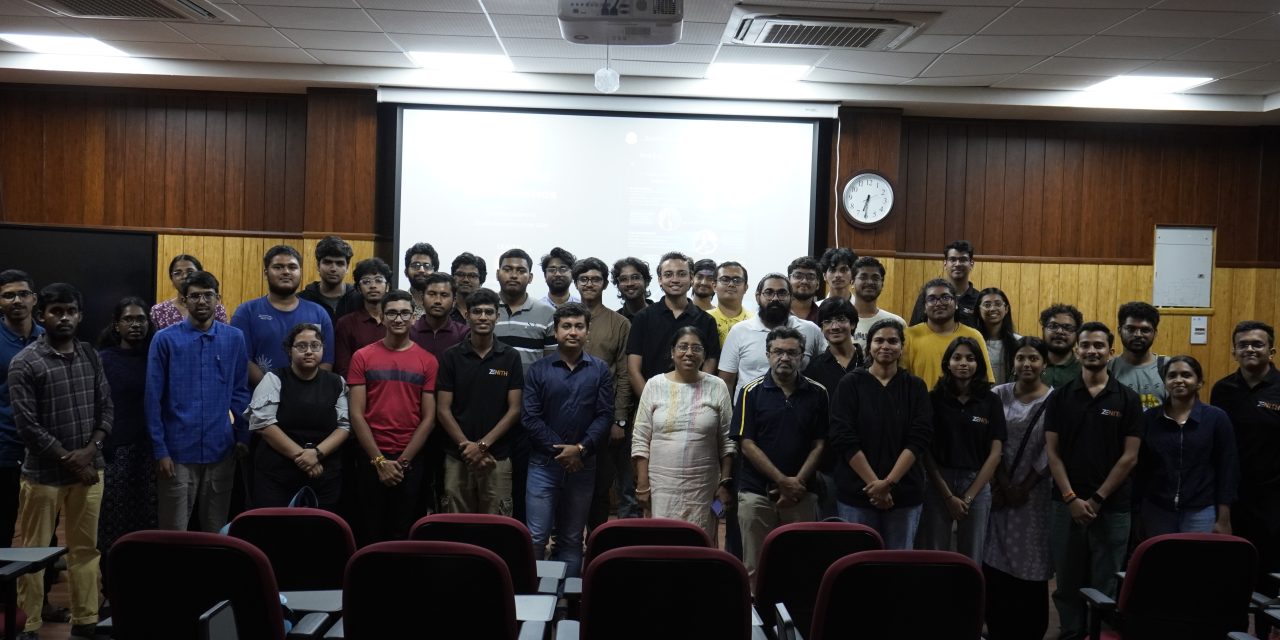
The Zenith Astronomy Club, University of Hyderabad, organized a One Day Lecture Series on September 03, 2025 at the Marie Curie Seminar Hall, School of Physics.
The primary objective of the event was to provide students, research scholars, and faculty members with exposure to contemporary developments in astrophysics and astronomy through lectures delivered by distinguished experts.
The program commenced with an inaugural session were Dr. Ashoka Vudayagiri, Associate Professor and Faculty Coordinator welcomed the speakers and honored them with mementos.
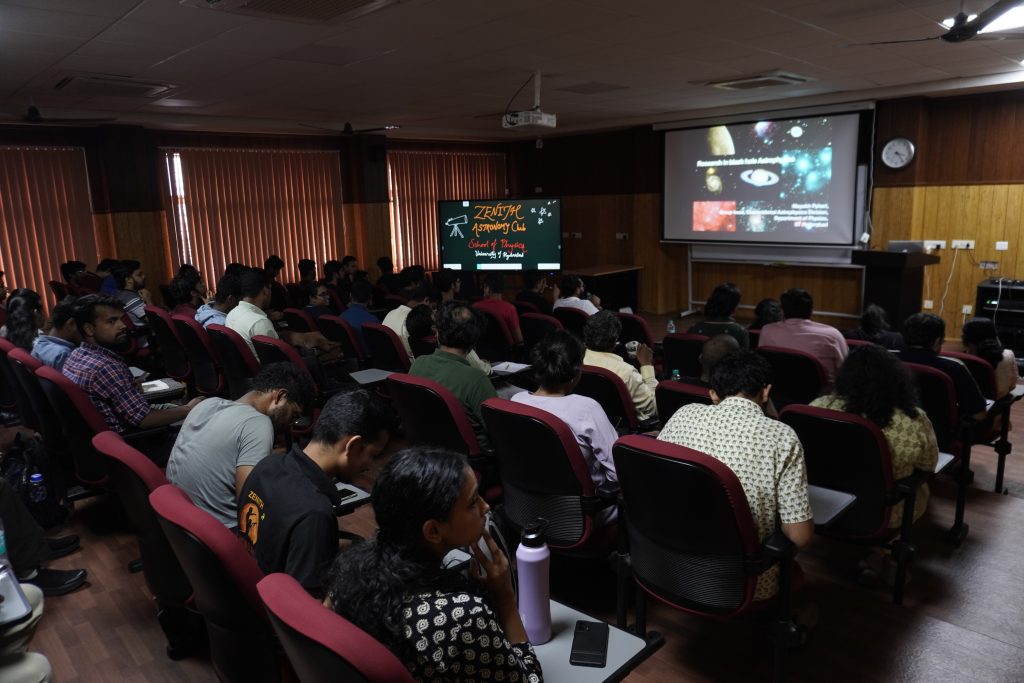
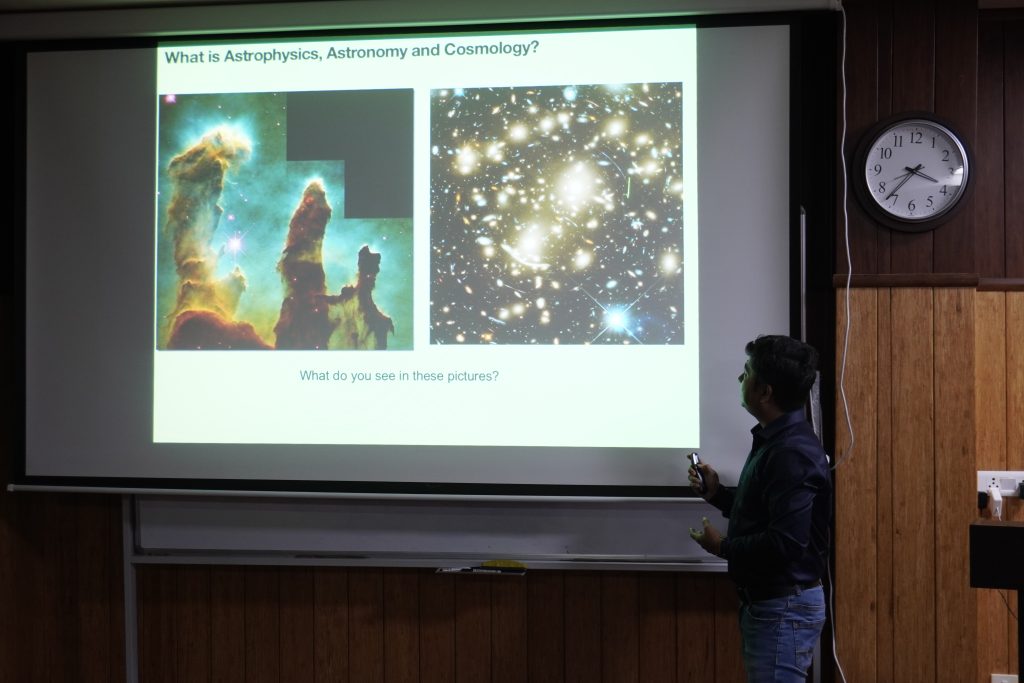
The first lecture was delivered by Dr. Mayukh Pahari, Assistant Professor, Department of Physics, IIT Hyderabad, on the topic “Cutting-edge Research in Black Hole Astronomy”. Dr. Pahari presented an overview of modern astronomical research carried out across multiple wavelengths—optical, ultraviolet, and X-ray. He elaborated on the study of black hole accretion processes, relativistic jets, and the role of advanced observatories in probing regions near the event horizon. He also highlighted the observational techniques and the physical processes that connect stellar astrophysics with planetary system formation.
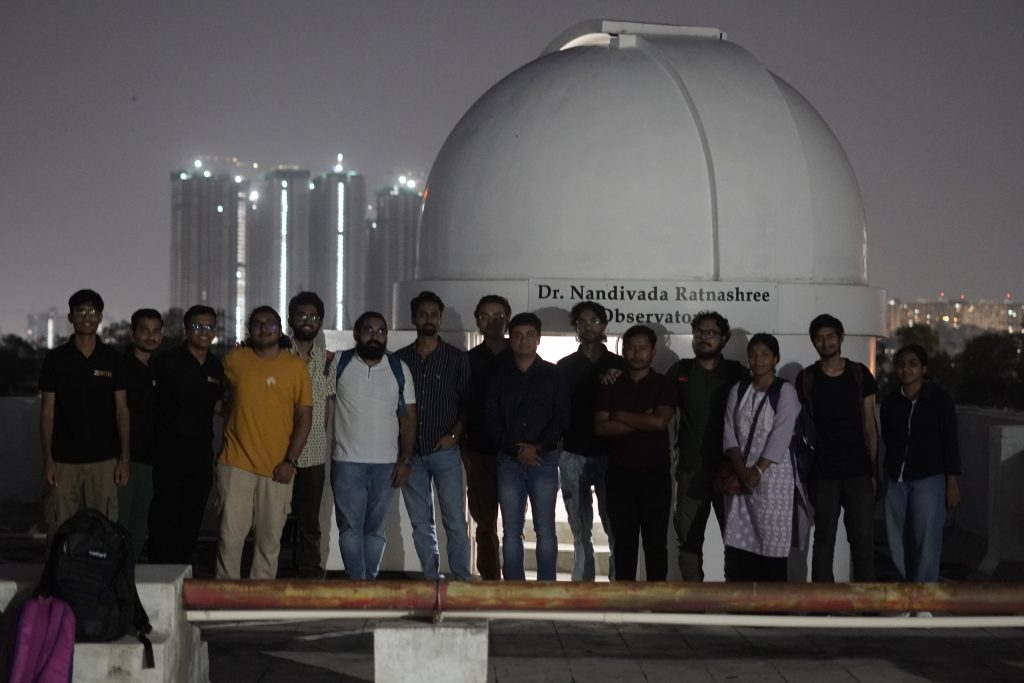
The second lecture was presented by Prof. Sarmistha Banik, Professor and Head, Department of Physics, BITS Pilani, Hyderabad Campus, on the theme “Observational Aspects of Neutron Stars and Pulsar Timing”. Prof. Banik’s lecture addressed the physics of compact stars, particularly neutron stars, which serve as unique laboratories for testing theories of dense matter and strong gravity. She described observational methods used in pulsar timing and their applications in constraining the internal structure of neutron stars. The talk also highlighted the intersection of pulsar astrophysics with nuclear astrophysics and gravitational wave astronomy.
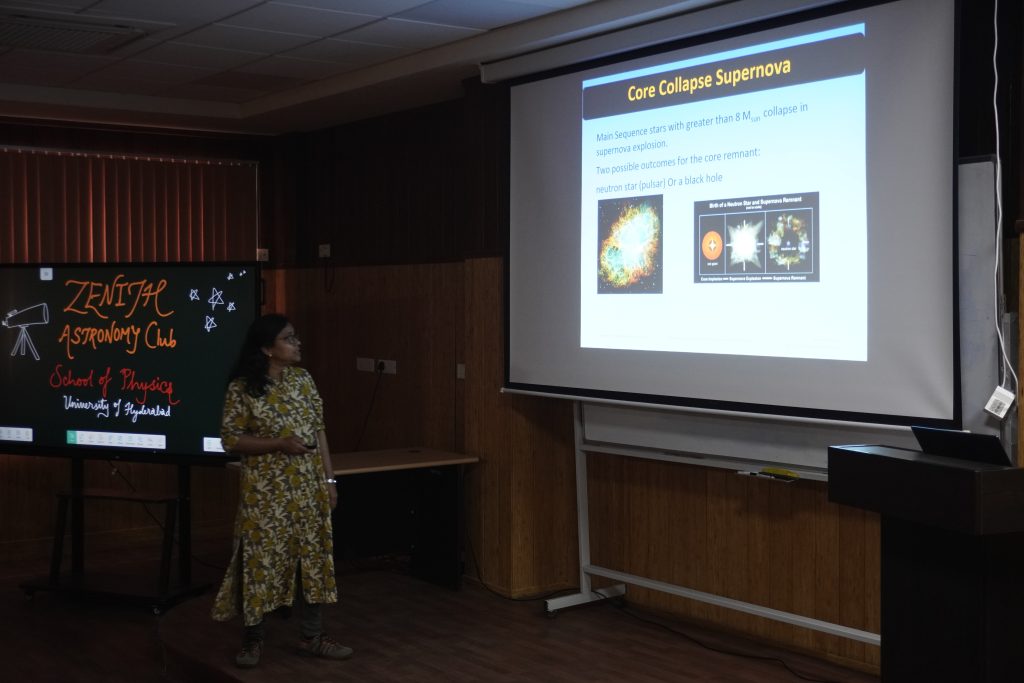
The final lecture, entitled “The Art of Planet Hunting: Methods of Exoplanet Discovery”, was delivered by Ms. Megha Tomer, Research Scholar, Department of Physics, IIT Hyderabad. Ms. Tomer explained the principal techniques used for exoplanet detection, including the transit method, radial velocity measurements, and direct imaging. She emphasized the importance of precision instrumentation and data analysis in confirming planetary candidates and the rapidly evolving field of exoplanet studies. Additionally, she discussed her research contributions related to Chandrayaan-3 rover modelling, underscoring the broader relevance of planetary science in ongoing space exploration missions.
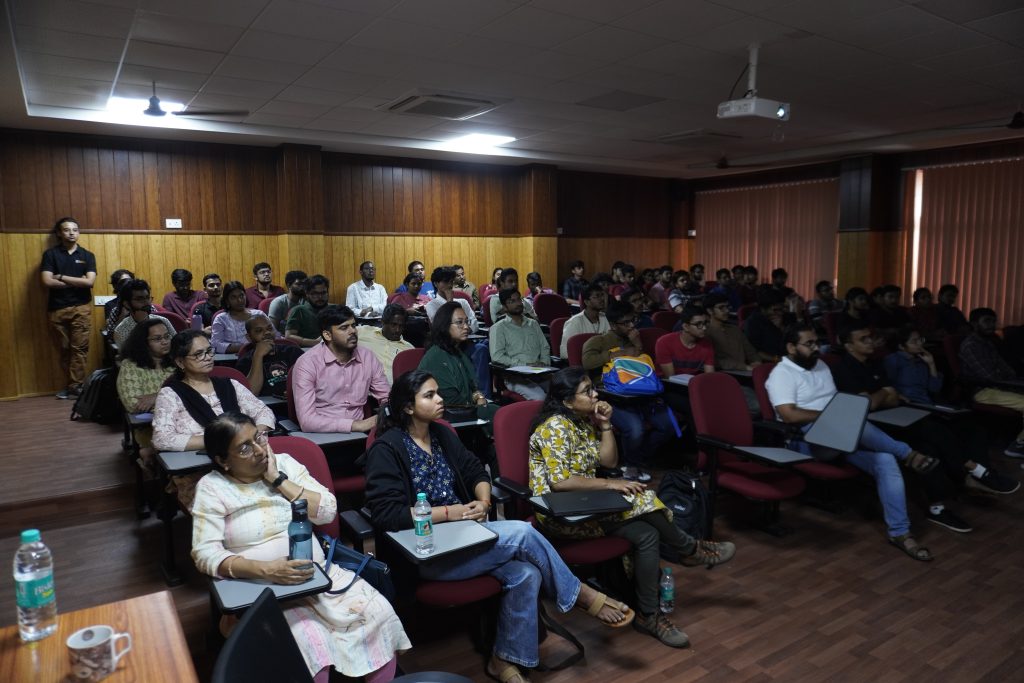
The lecture sessions witnessed active participation from the audience. Students and research scholars engaged enthusiastically during the question–answer segments, posing insightful queries that reflected their keen interest in the topics discussed.
The event concluded with an expression of gratitude to the speakers and participants. The lecture series successfully achieved its objective of enhancing scientific awareness and stimulating academic discussion on frontier areas of astrophysics.