
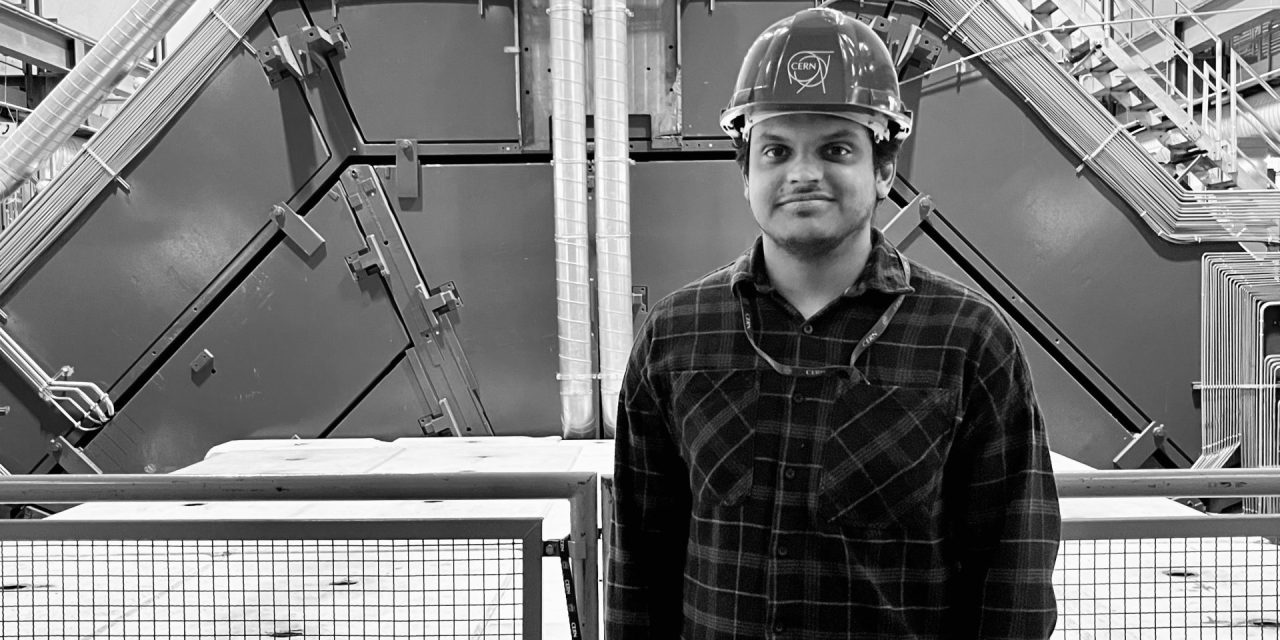
The University of Hyderabad (UoH) takes pride in celebrating the achievement of its alumnus Dr. Rahul Ramachandran Nair, who is among the scientists recognised as part of the ALICE Collaboration at CERN, Geneva, which has been awarded the 2025 Breakthrough Prize in Fundamental Physics.
The 2025 Breakthrough Prize in Fundamental Physics has been awarded to the ALICE, ATLAS, CMS, and LHCb collaborations at CERN, recognising decades of collective scientific endeavour at the Large Hadron Collider (LHC). The prize is shared among thousands of scientists across these major international experiments.
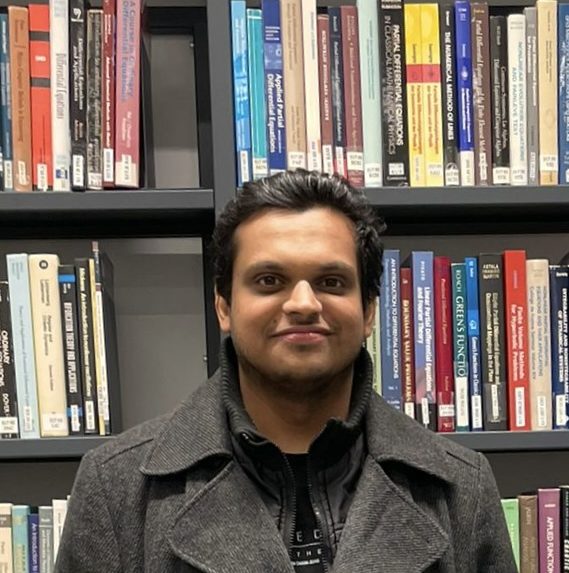
Dr. Rahul Ramachandran Nair completed his Master’s in Physics at the University of Hyderabad during 2011–2013.
The recognition reflects the scale and complexity of modern experimental high-energy physics. Precision measurements at the energy and luminosity frontiers require advanced detector systems, large-scale data infrastructure, theoretical insight, and the coordinated efforts of thousands of specialists across continents. Large international collaborations such as ALICE, therefore, form the foundation of discovery in contemporary particle physics.
The ALICE experiment at the LHC seeks to understand the conditions that existed in the earliest moments of the universe. While astronomers observe distant galaxies to look back in time, ALICE takes a complementary approach by colliding heavy nuclei, such as lead, at ultra-relativistic energies. These collisions briefly recreate the extreme conditions of temperature and energy density believed to have existed shortly after the Big Bang.
Under such conditions, ordinary hadronic matter dissolves into its constituent quarks and gluons, forming a state known as the Quark-Gluon Plasma (QGP). The study of this state, through its thermodynamic properties, collective behaviour, and particle production mechanisms, offers important insights into the earliest phases of the universe.
Dr. Nair’s contribution to the ALICE Collaboration centred on the development of a sophisticated monitoring tool for the ALICE forward trigger during the LHC’s Run 2 data-taking period. This tool played a critical role in determining the quality and usability of the collected data. It served as a vital gatekeeping system, helping identify which datasets were reliable enough to be used for physics analyses. Such work forms the foundation for the scientific results produced by the collaboration.
His broader research, carried out during his doctoral work, focused on the thermalisation of the Quark-Gluon Plasma, an extraordinarily rapid process through which this primordial state of matter reaches local thermal equilibrium. His scientific interests include QCD phase transitions, confinement mechanisms, particle production in ultra-relativistic nuclear collisions, and the application of advanced statistical methods to heavy-ion physics.
Dr. Nair has also worked on the study of collisions involving deformed nuclei, where the geometry of the colliding system adds further complexity to the underlying physics and offers rich possibilities for understanding the behaviour of strongly interacting matter.
Dr. Rahul Ramachandran Nair completed his B.Sc. at S.B. College, Changanacherry in 2010, before joining the University of Hyderabad for his M.Sc. in Physics. He later moved to the National Centre for Nuclear Research (NCBJ), Warsaw, Poland, where he earned his Ph.D. in 2020. He subsequently continued as a Scientific Associate with the ALICE group at NCBJ through 2023 and held a research position at the University of Culiacan, Mexico, based at CERN, through 2024.
Dr. Nair’s association with the ALICE Collaboration and his contribution to a globally recognised scientific effort is a matter of pride for the University of Hyderabad. His journey reflects the strong academic foundation provided by UoH and the significant role played by its alumni in advancing frontier research in fundamental science.