
Two alumni of the University of Hyderabad (UoH), Dr. Jimin George and Dr. Suvarna Ramachandran, have brought pride to the University by being part of the prestigious Muon g-2 collaborations, which have been awarded the Breakthrough Prize in Fundamental Physics.
The Breakthrough Prize, often described as the “Oscars of Science,” is regarded as the world’s largest science prize. It is awarded annually in three categories — Fundamental Physics, Life Sciences, and Mathematics — to honour path-breaking contributions that expand human understanding of the universe.
This year, the Breakthrough Prize in Fundamental Physics has been awarded to the Muon g-2 collaborations at CERN, Brookhaven National Laboratory, and Fermilab. The prize amount of 3 million US dollars will be shared among approximately 300 scientists who contributed to this major international scientific effort.
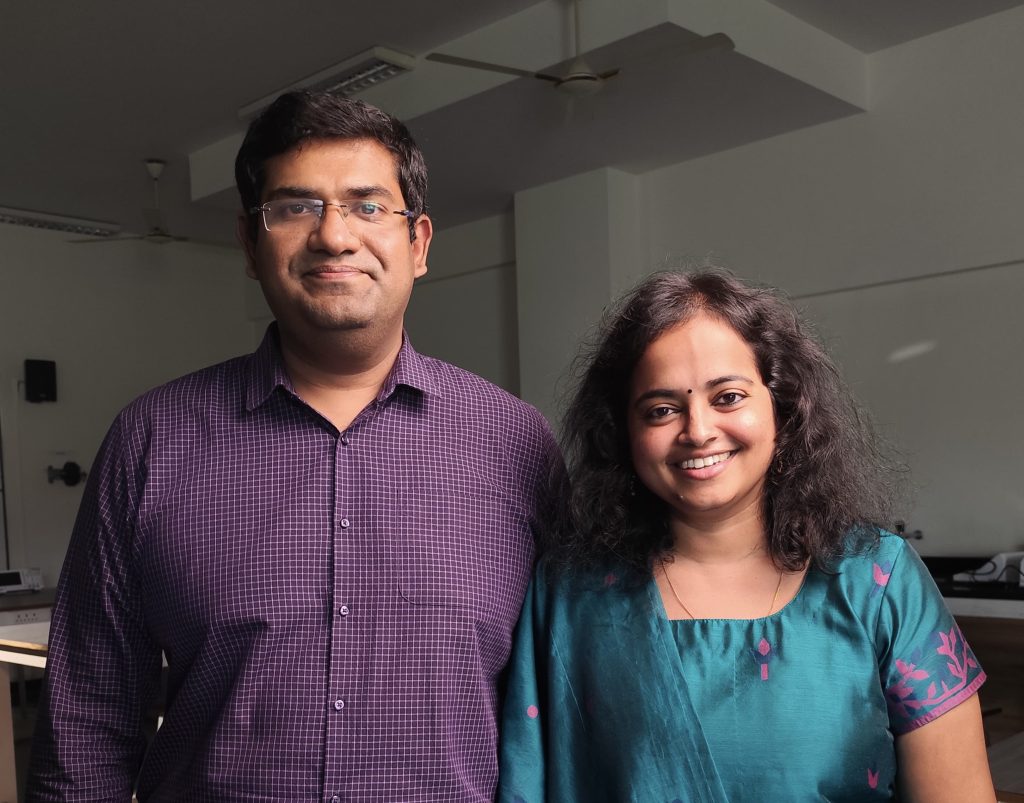
Among the honoured scientists are Dr. Jimin George and Dr. Suvarna Ramachandran, who completed their Master’s in Physics at the University of Hyderabad during 2007–2009.
The Muon g-2 experiment is one of the most precise and challenging experiments in modern particle physics. It measures the value of the muon’s anomalous magnetic moment with extraordinary accuracy. The experiment was first carried out in the 1960s at CERN, later in the 1990s at Brookhaven National Laboratory, and most recently at Fermilab, where it achieved an ultra-high precision of 127 parts per billion.
A muon is a fundamental particle with the same electric charge as an electron, but almost 200 times more massive. Unlike electrons, muons are not part of ordinary matter around us. They are produced during high-energy collisions of subatomic particles and exist only for a very short time — about 2.2 microseconds — before decaying into other particles.
Each muon has a magnetic moment, making it behave like an extremely tiny magnet. Measuring this magnetic moment with very high precision is important because it helps scientists test the limits of the Standard Model of particle physics, the theory that describes the fundamental particles and forces in nature.
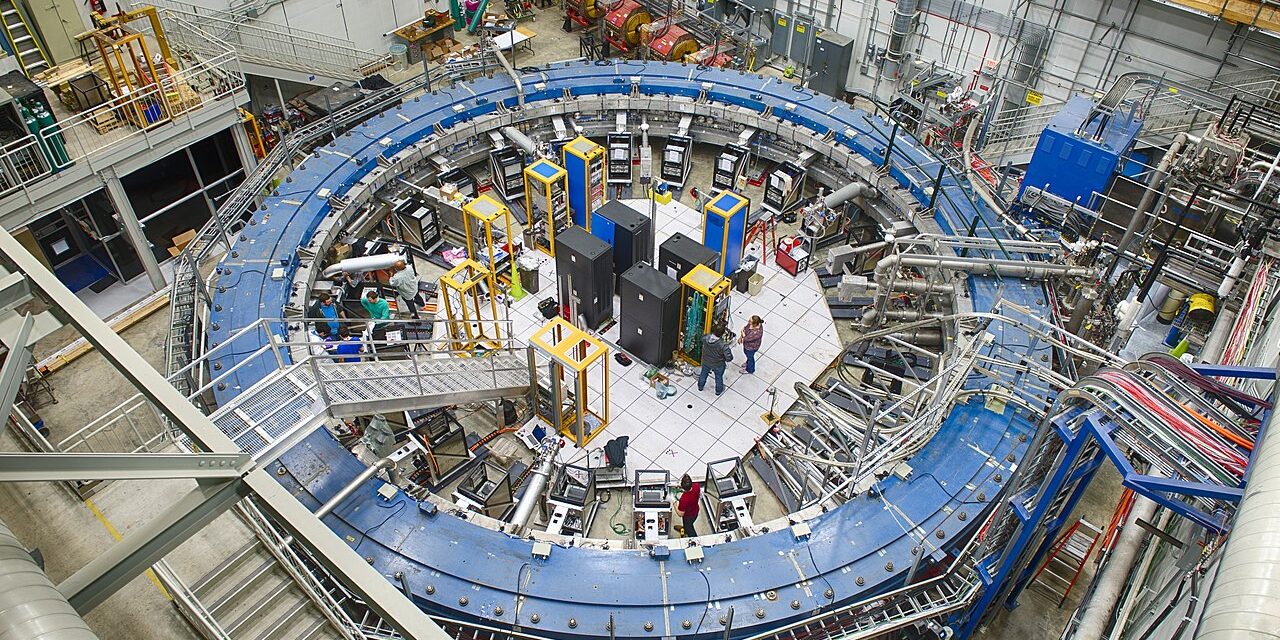
For the experiment, muons are made to travel very close to the speed of light. They are guided into a circular ring of 45 metres in circumference, which is completely evacuated using vacuum pumps. A highly uniform magnetic field of 1.45 Tesla is applied throughout the ring to keep the muons moving in a circular path. This magnetic field is produced using a superconducting magnet cooled to about –270°C with liquid helium, with a current of nearly 5000 amperes flowing through the superconducting coils.
At this speed, the muons make nearly 7 million trips per second around the ring. As they decay, they produce positrons and neutrinos. The positrons are detected using particle detectors called calorimeters placed around the ring. By combining the precise measurement of the magnetic field with the time distribution of the detected positrons, scientists calculate the anomalous magnetic moment of the muon.
The experiment requires not only advanced scientific knowledge but also extraordinary engineering, computing, and data analysis capabilities. The high-energy particles and their decay products produce significant radiation, and therefore the experiment is controlled from a specially protected control room with thick concrete shielding. The detector accumulated petabytes of data, and the analysis took several years to complete.
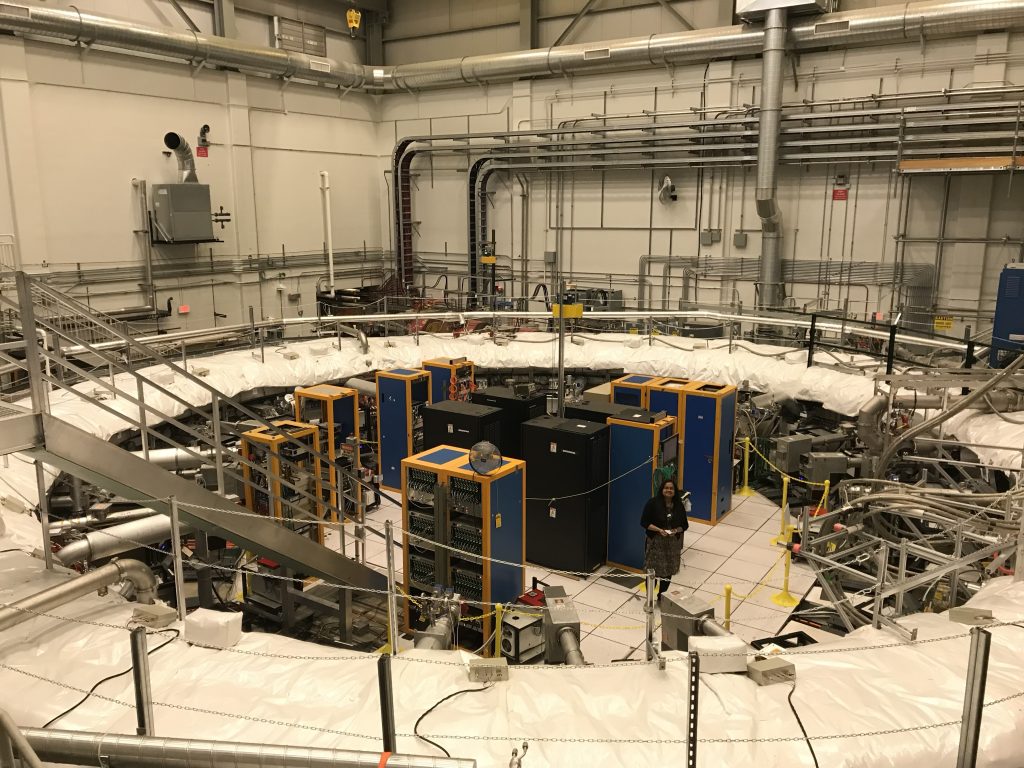
Dr. Jimin George joined the Muon g-2 collaboration in 2015 as a Postdoctoral Researcher at the University of Texas at Austin. Dr. Suvarna Ramachandran joined the collaboration in 2018 as a Postdoctoral Researcher at Argonne National Laboratory, Chicago. Both were based at Fermi National Laboratory till 2020 and contributed to several crucial stages of the experiment, including building the experiment, commissioning, data collection, and data analysis.
Both UoH alumni are currently serving as Assistant Professors at Alliance University, Bengaluru.
Their contribution to a globally recognised scientific collaboration is a matter of great pride for the University of Hyderabad. It reflects the strong academic foundation provided by UoH’s School of Physics and highlights the important role played by its alumni in advancing frontier research in fundamental science.