
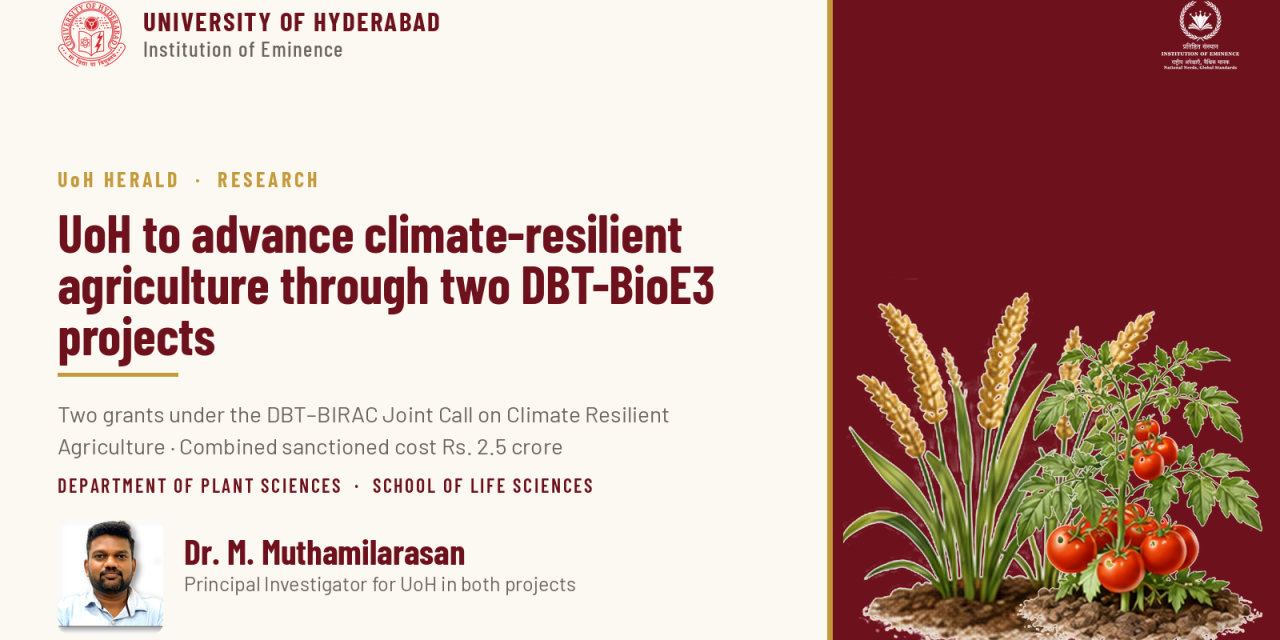
Two competitive grants under the Department of Biotechnology’s BioE3 Policy bring a combined sanctioned cost of Rs. 2.5 crores to a national consortium, with Dr. M. Muthamilarasan of the School of Life Sciences leading the University’s share of the work in both.
The University of Hyderabad (UoH) has secured two competitive research grants under the Department of Biotechnology’s (DBT) BioE3 — Biotechnology for Economy, Environment and Employment — Policy, through the DBT-BIRAC Joint Call for Proposals on “Climate Resilient Agriculture.” The two projects carry a combined sanctioned cost of Rs. 2.5 crores, of which approximately Rs. 1 crore has been allocated to the University.
Dr. M. Muthamilarasan of the Department of Plant Sciences, School of Life Sciences, is the Principal Investigator for the University in both projects, which bring together scientists from multiple national institutions to develop biotechnology-driven solutions for climate-resilient farming.
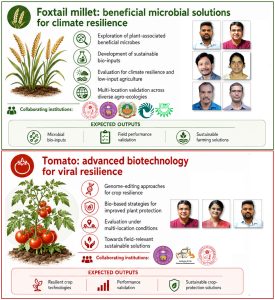
The first project takes up the development of climate-resilient microbial consortia to enhance resilience in foxtail millet. It is being implemented by Dr. Muthamilarasan as Principal Investigator, with Dr. Jogi Madhuprakash as Co-Principal Investigator, both from the Department of Plant Sciences. The other Principal Investigators are Prof. Manoj Prasad, University of Delhi South Campus (UDSC); Prof. K. Iyanar, Tamil Nadu Agricultural University, Coimbatore; Dr. T. Swaroopa Rani, GITAM, Hyderabad; and Dr. Gulab Arya, KIIT University, Odisha. The work spans the exploration of plant-associated beneficial microbes, the development of sustainable bio-inputs, their evaluation for climate resilience and low-input agriculture, and multi-location validation across diverse agro-ecologies. The resulting bio-inputs are expected to strengthen crop resilience to climate stress, reduce farmers’ dependence on chemical inputs, improve soil health and yields, and add to India’s indigenous bio-manufacturing capacity.
The second project aims at imparting viral resistance in tomato through gene editing and peptide-based foliar treatment. Its Principal Investigators are Prof. Manoj Prasad, UDSC (on deputation as Director, BRIC-NIPGR, New Delhi); Dr. Namisha Sharma, BRIC-Institute of Life Sciences, Bhubaneshwar; and Dr. M. Muthamilarasan of the Department of Plant Sciences at UoH. Combining genome-editing approaches for crop resilience with bio-based strategies for plant protection, and testing both under multi-location field conditions, the project is expected to raise tomato productivity, strengthen food security, and reduce reliance on chemical pesticides.
Speaking about the projects, Dr. Muthamilarasan said, “These two BioE3 projects are a natural extension of our research journey on tomato and millets, one strengthens tomato’s defenses against most damaging viral diseases, and the other harnesses the resilience of foxtail millet to help crops cope better with a changing climate. With these two grants, our lab’s project portfolio has grown to Rs. 417.71 lakhs, built on support from ANRF, the Institution of Eminence scheme at UoH, and DBT. It reflects the confidence placed in our work and reaffirms the University of Hyderabad’s growing standing as a national hub for tomato and millet research.”
With these two grants, UoH reinforces its growing role in India’s bioeconomy and its commitment to translating cutting-edge plant biotechnology research into field-ready solutions for climate-resilient agriculture. Through genome-edited crops and bio-based microbial solutions, the University also seeks to contribute to more resilient farms, secure harvests, reduced dependence on chemical inputs, and a sustainable agricultural future.