

On January 8, the Department of Political Science, School of Social Sciences, University of Hyderabad (UoH), organized an academic talk titled “The Concerns and Constraints of Public Policy”. The department invited Dr. Tanvir Aeijaz, Associate Professor, Ramjas College, University of Delhi, as the resource person for the talk.
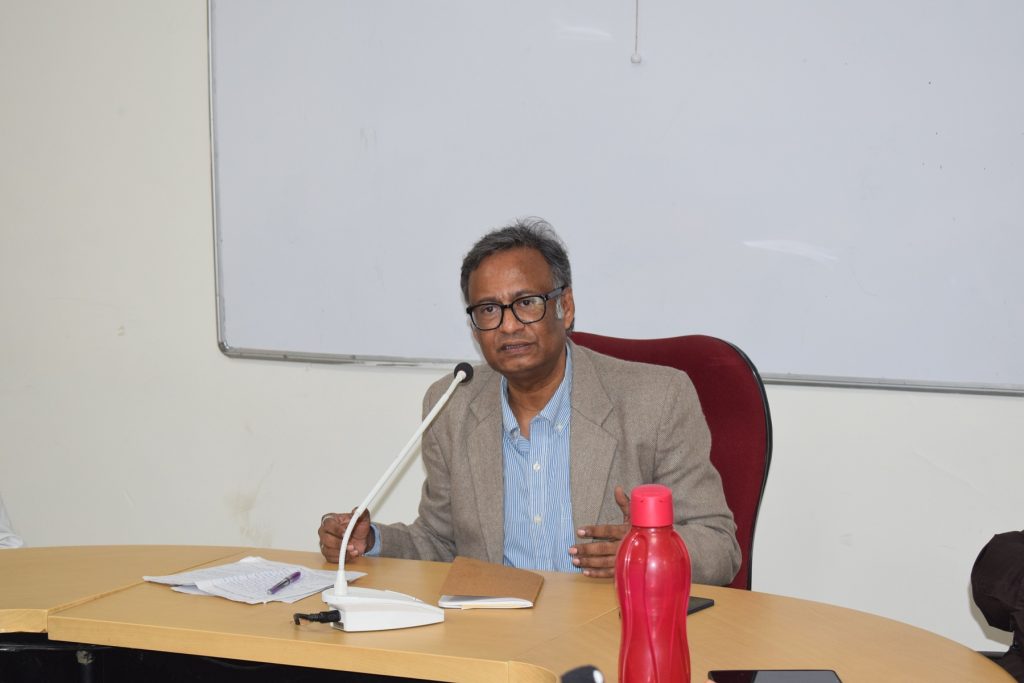
The programme commenced with welcome remarks by Prof. Kham Khan Suan Hausing, a faculty member of the Department of Political Science. He formally welcomed the guest speaker and briefly acknowledged the presence of the faculty members and students.
The session was then taken over by the guest speaker, Dr. Tanvir Aeijaz, who began by expressing his appreciation and acknowledging the presence of the faculty members and the audience. He then initiated an insightful discussion on the theme of the day. Dr. Aeijaz critically examined the disciplinary relationship between Political Science and Public Policy, particularly in the context of public policy-making processes. He pointed out that public policy, though a subfield of political science, has been relatively neglected within the discipline and has increasingly been appropriated by other disciplines such as economics and management. This, he argued, has added complexity to interdisciplinary approaches and diluted the political dimensions of public policy.

He observed that the lack of adequate academic study and systematic knowledge production within political science has resulted in reduced engagement with public policy. He emphasized that public policy is inherently rooted in the idea of “publicness”, but its essence has been reduced due to a lack of accessibility and openness. Referring to Harold Lasswell’s quote, “Who gets what, when, and how”, the speaker asserted that politics must continuously seek answers to these fundamental questions.

The lecture then moved to discussing the major challenges in public policy. He concluded by presenting arguments for strengthening public policy as a subfield within political science. While acknowledging the advantages of a multidisciplinary approach, he stressed the need to prevent the erosion of public policy from its disciplinary roots. The key takeaway of the talk focused on the importance of strengthening political science as a discipline to critically engage with public policy frameworks.

Dr. Anju Helen Bara, a faculty member in the department, provided her intervention by pointing out the important insights of the talk and the significance of the lecture. The talk was followed by a Q&A session, in which scholars and students participated. The session concluded with a vote of thanks delivered by Prof. Suan Hausing.
Report by: Karinka V M, MA student, Department of Political Science