

The Supreme Court of India’s landmark judgment in Prajwala vs Union of India (29 May 2026) has opened a new chapter in India’s legal understanding of human trafficking, rehabilitation, dignity, and consent. In 2004, Prajwala, a Hyderabad-based anti-trafficking organisation co-founded by Sunitha Krishnan, filed Public Interest Litigation (PIL) No. 56/2004 seeking stronger legal protections, rehabilitation mechanisms, and institutional accountability for victims of trafficking and commercial sexual exploitation. The 297-page judgment, delivered by Justice J.B. Pardiwala and Justice R. Mahadevan, is being widely discussed for its emphasis on trafficked survivor dignity, constitutional rights, and the need to move beyond narrow “rescue” frameworks in addressing trafficking for commercial sexual exploitation. The judgment acknowledged/mentioned the Economic and Political Weekly (EPW) “Review of Women’s Studies” special issue (2016) on human trafficking, edited by renowned historian Geraldine Forbes, distinguished Professor emerita, State University of New York, Oswego, USA.
The EPW special issue brought together critical feminist and sociological perspectives questioning simplistic binaries of “victimhood,” “rescue,” and “rehabilitation.” The special issue (https://www.epw.in/journal/2016/44-45) include articles of Samita Sen (Impossible Immobility: Marriage, Migration and Trafficking in Bengal), Kimberly Walters (Humanitarian Trafficking: Violence of Rescue and (Mis)calculation of Rehabilitation), Paula Banerjee (Criminalising the Trafficked: Blaming the Victim), Ajailiu Niumai (Unspoken Voices of Trafficked Women and Children in Manipur), Barnali Das (Who Would Like to Live in This Cage?), and Baitali Ganguly (Next Time I Will Go to Dubai’: How Rescue and Rehabilitation Fails Women).
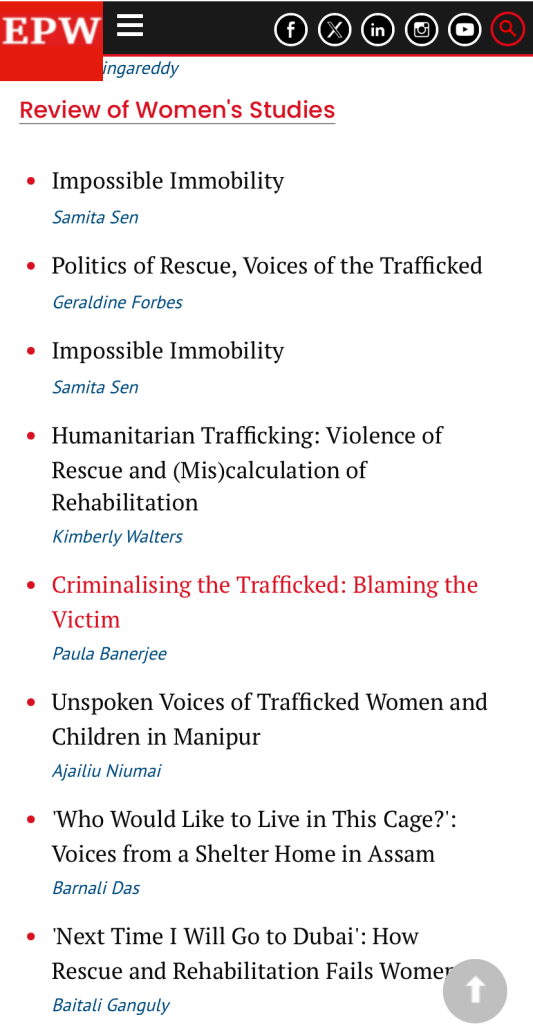
The special issue is an outcome of a panel that was presented at the Women’s World Congress held from 17 to 21 August 2014 at the University of Hyderabad. What makes this Supreme Court judgment more significant is the recognition of scholarly contributions made by researchers associated with the University. Among the academic works cited in the judgment are the writings of Dr. Barnali Das, an alumna of the University of Hyderabad, and Kimberly Walters. Walters argued that humanitarian interventions often construct trafficked women as passive victims in need of saving while ignoring their own survival strategies, aspirations, and voices. The Supreme Court’s observations resonate strongly with the concerns raised in the six articles including the editorial of the EPW special issue nearly a decade earlier. The special issue critically examined how anti-trafficking interventions sometimes reproduce institutional violence through forced rescue, confinement, surveillance, and inadequate rehabilitation practices, even in cross-border trafficking. By highlighting survivor voices and structural inequalities, the articles challenged dominant narratives that portrayed trafficked women merely as passive victims without agency.
Dr. Barnali Das’s work highlighted how shelter homes in Assam, despite their protective intent, could become spaces of confinement, silence, and restricted autonomy. Drawing from field-based research in Assam, she questioned whether institutional rehabilitation genuinely restores dignity if survivors remain excluded from decision-making about their own lives. Similarly, Prof. Ajailiu Niumai’s article demonstrated that trafficking of women and children in Manipur cannot be understood solely through criminal law frameworks but must also be analysed through structures of social exclusion and regional marginality. The recognition of the scholarly articles demonstrates how academic research can travel beyond classrooms and journals into public policy, constitutional interpretation, and national legal discourse.
The significance of the EPW special issue also lies in its collaborative and interdisciplinary nature. Under the editorship of Geraldine Forbes, the issue created space for scholars from different disciplinary backgrounds to critically engage with the politics of trafficking, rescue, rehabilitation, and law. The contributors collectively argued that trafficking must be understood not merely as an issue of criminality but as a complex phenomenon linked to poverty, gender inequality, migration, caste, tribe, labour precarity, social stigma, and structural violence. The Supreme Court judgment’s engagement with these broader debates reflects a growing recognition within Indian jurisprudence that constitutional dignity cannot be reduced to moral paternalism.
The Prajwala judgment has become notable for emphasising that trafficked survivors cannot merely be treated as passive objects of rescue. The Court observed that rescue operations alone do not guarantee justice because survivors frequently continue to face poverty, social exclusion, intimidation, psychological trauma, and risks of re-trafficking even after state intervention. It therefore held that rehabilitation must be understood as part of the constitutional obligation of the State under the framework of dignity and fundamental rights. Importantly, the Court cautioned against conflating trafficking with consensual adult sex work and held that voluntary adult sex workers cannot be forcibly detained or “rescued” against their will. The judgment observed that moral assumptions surrounding prostitution often deprive adult sex workers of dignity and equal legal protection. At the same time, it reaffirmed the State’s responsibility to combat organised trafficking and commercial sexual exploitation through stronger institutional mechanisms and survivor-centred approaches.
The Supreme Court also issued a comprehensive “Victim Protection Plan” and recommended institutional reforms, including strengthening Anti-Human Trafficking Units (AHTUs), ensuring legal aid through District Legal Services Authorities (DLSA), and developing survivor-sensitive rehabilitation mechanisms. The judgment raised important ethical questions regarding consent, autonomy, and state intervention in contexts marked by poverty and social vulnerability.

Prof. Ajailiu Niumai

Dr. Barnali Das
For the University of Hyderabad, the moment is institutionally significant. The contributions of Dr. Barnali Das and Prof. Ajailiu Niumai in the EPW Special issue reflect the University’s longstanding engagement with socially relevant and critically grounded research. In an era when Indian universities are increasingly expected to demonstrate social impact, the Prajwala judgment stands as a reminder that rigorous interdisciplinary scholarship can shape legal thinking and influence institutional reforms. It also highlights the importance of creating academic spaces where marginal voices, difficult questions, and uncomfortable realities can be studied with intellectual honesty and ethical sensitivity. The citation and recognition of these works in a landmark Supreme Court judgment is therefore not merely an academic achievement. It is also a testament to the enduring role of social science research in deepening democratic conversations on rights, dignity, and justice in contemporary India.
-By Prof. Ajailiu Niumai, Centre for the Study of Social Inclusion, University of Hyderabad Email: ajainiumai@gmail.com