

The University of Hyderabad proudly celebrates the online publication of Public Finance for Cities: The Benefit Principles from Wicksell to Stiglitz, published by Oxford University Press on 1 September 2026. The book is authored by Dr. Shibani Mishra, Assistant Professor of Economics at Binayak Acharya College, Berhampur, and Prof. Alok Kumar Mishra, Professor of Economics at the School of Economics, University of Hyderabad. The volume carries a Foreword by Dr. Prasanna Kumar Mohanty, IAS, former Chief Secretary of undivided Andhra Pradesh and former Member of the Central Board of the Reserve Bank of India. Bringing together theoretical foundations, empirical evidence and policy perspectives, the book offers a contemporary framework for addressing the increasingly important challenge of financing rapidly growing cities in a sustainable, equitable and accountable manner.
The book addresses one of the most significant yet unresolved issues facing urban governments worldwide: how to align the costs of civic services with the benefits that residents, businesses, and landowners actually derive from them. Building on Knut Wicksell’s 1896 principle of “just taxation” and tracing its evolution through Erik Lindahl, Richard Musgrave, Henry George, and Joseph Stiglitz’s modern theory of local public goods, the authors develop a unifying framework in which “users pay, beneficiaries pay, and growth pays” for the infrastructure that sustains city life.
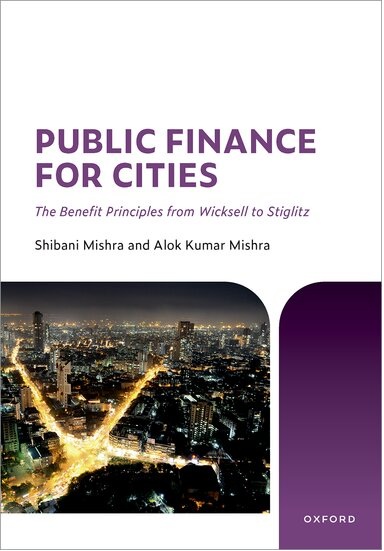
Brief Overview of the Book:
Public Finance for Cities: The Benefit Principles from Wicksell to Stiglitz addresses one of the most significant yet unresolved issues facing India’s development trajectory: how to finance the rapid expansion of cities in a manner that is safe, sustainable, inclusive, resilient, climate-smart, and humane. Even as Indian cities are engines of economic growth, their municipal governments are nevertheless financially constrained, fundamentally reliant on transfers, and ill-prepared to meet the growing demand for civic services and infrastructure. This book argues that a fundamental redesign of urban financing is necessary for sustainable urban growth rather than relying solely on intergovernmental transfers and ad hoc handouts. The book connects local taxes with service delivery, fiscal accountability, and democratic approval by cantering municipal finance around the benefit principle of taxation. It provides a strong foundation for changing urban finance by drawing on both classical and contemporary public finance theories from Joseph Stiglitz to Knut Wicksell. The book examines property taxes, land-based finance, user fees, beneficiary fees, and new urban revenue systems by fusing theory with global data and case studies of Indian municipalities. It evaluates international best practices, proposes a new framework for benefit-based urban financing, and provides valuable insights for India and other emerging nations. For academics studying public finance, urban economics, policymakers, municipal leaders, and advanced students seeking practical solutions to the financial challenges facing rapidly expanding urban areas, this volume is an essential resource.
The book is organised into a sequence of chapters that first lay out the theoretical evolution of the benefit principle — from Wicksell’s original formulation of just taxation and Lindahl’s voluntary-exchange model, through Musgrave’s synthesis and Stiglitz’s theory of local public goods, before turning to its practical application in the urban context. Subsequent chapters examine property taxation, land value capture, tax-increment financing, user charges and betterment levies, intergovernmental fiscal transfers to municipalities, and the financing of urban infrastructure and transport, illustrated throughout with case studies and empirical evidence from Indian cities and comparative international experience.
At a time when Indian cities are grappling with widening gaps between infrastructure needs and municipal revenues, this book is a timely and much-needed contribution. It is set to serve as a valuable reference for social scientists, scholars of urban studies and urban economics, policy analysts, policymakers, and municipal administrators seeking evidence-based approaches to financing India’s rapidly growing cities.
About the Authors

Dr. Shibani Mishra
Dr Shibani Mishra is an Assistant Professor of Economics at Binayak Acharya College, Berhampur, Odisha. She earned her PhD in Economics from the University of Hyderabad in 2022, under the supervision of Prof. Alok Kumar Mishra. Her areas of research include public finance, urban economics, transport economics, and housing economics. She has published in journals such as the Journal of Public Affairs and the International Journal of Transport Economics, and contributed chapters to edited volumes including the Routledge Handbook of Decentralised Governance and Development in India.

Prof. Alok Kumar Mishra
Prof. Alok Kumar Mishra is Professor of Economics at the School of Economics, University of Hyderabad. Before joining academia, he held senior positions in the financial services industry, including at the Bank of New York Mellon, Shinsei Bank (Tokyo), and Evalueserve. He holds an MA, MPhil, and Ph.D. in Economics from the University of Hyderabad, and has received the Baden-Württemberg Fellowship (Heidelberg University, 2014), the University’s Chancellor’s Award (2016), and the Young Economist Award (Odisha Economic Association, 2023). He has authored more than sixty peer-reviewed papers and several books on urban and public finance, financial economics, and risk management.
This is Prof. Mishra’s second book in a row. His first book, Smart Cities and the Poor: Towards an Agenda for Inclusive Urbanisation in India, was published by Routledge in 2023.
The university extends its warmest congratulations to both authors on this significant academic milestone.
Read here: https://academic.oup.com/book/63304