
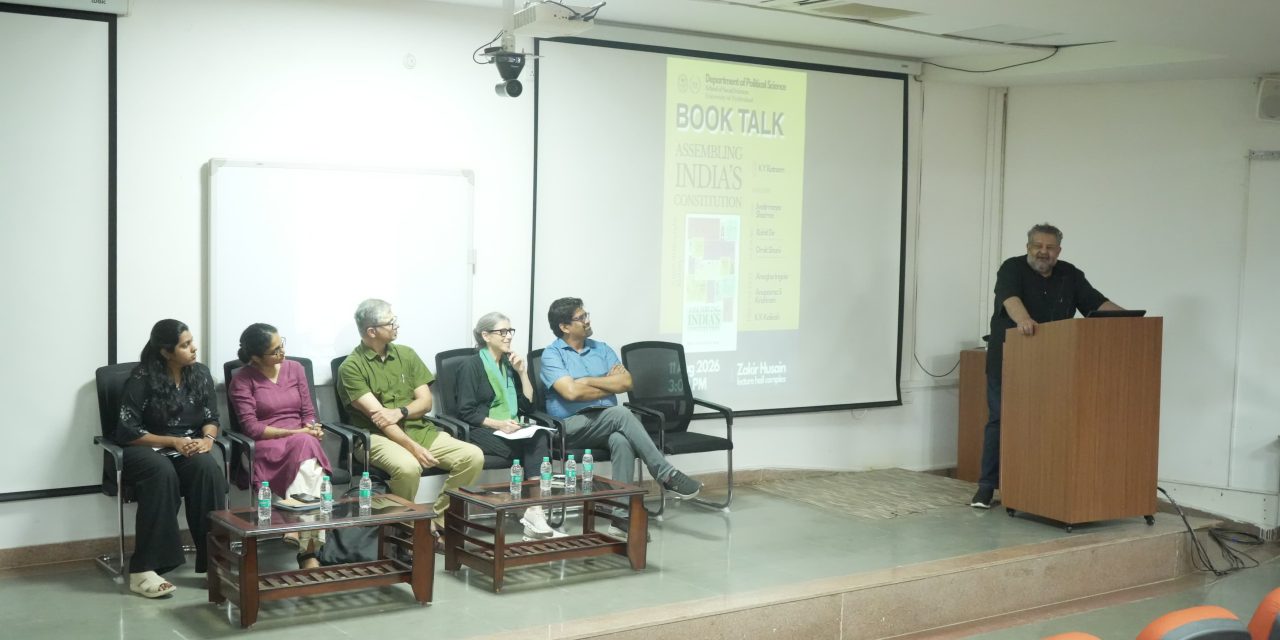
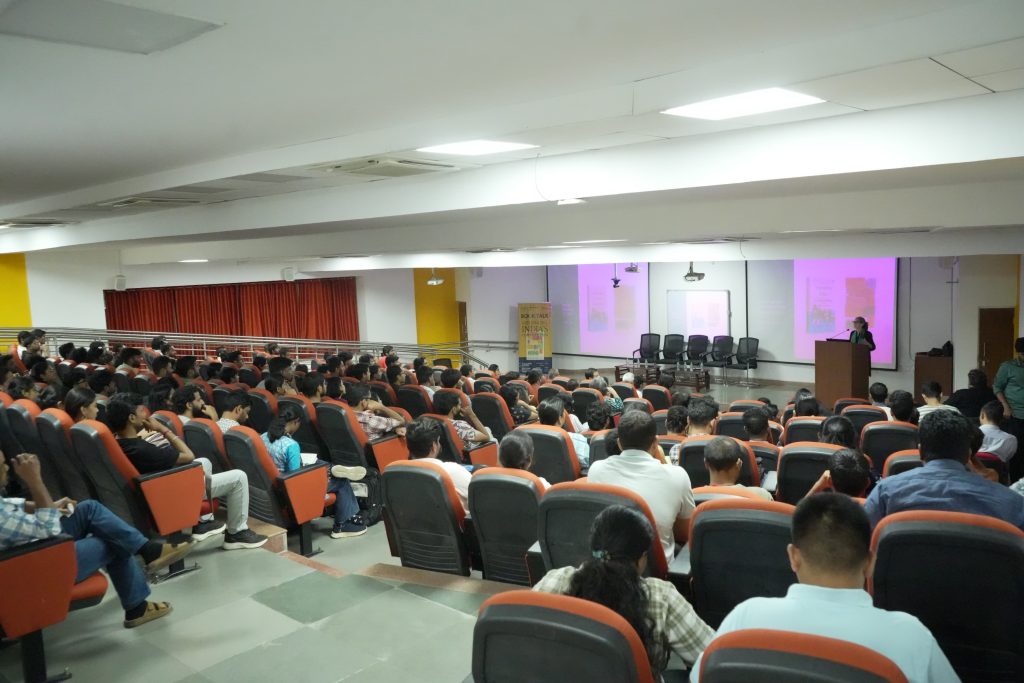
The Department of Political Science, University of Hyderabad, organised a book talk on Assembling India’s Constitution: A New Democratic History, authored by Professors Rohit De and Ornit Shani, on 11 August 2026 at the Dr. Zakir Husain Lecture Hall Complex. The event brought together students, faculty, and research scholars from across the University as well as from other academic institutions in the city.
Professor K.Y. Ratnam, Head of the Department, delivered the head address and welcomed the distinguished guests. Prem Sandeep (CIS) introduced the authors and panellists. Professor Jyotirmaya Sharma chaired the session and set the tone with his opening remarks. He observed that the Indian state, its people, and its Constitution represent the dreams of those who love India’s many ideas with passion and devotion.
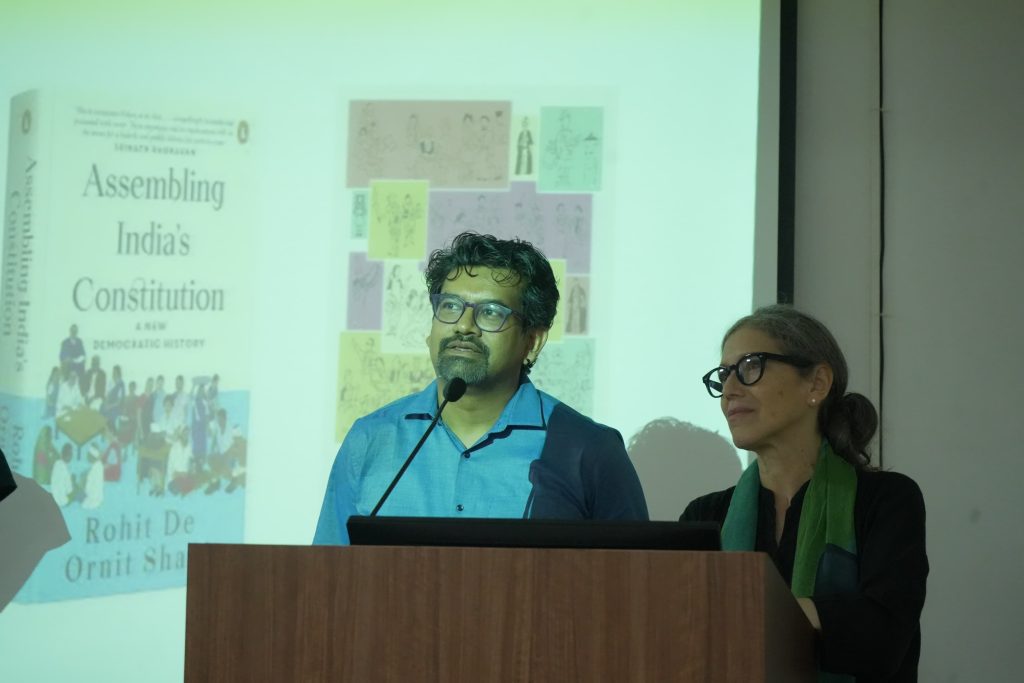
Professor Rohit De teaches history at Yale University and the author of A People’s Constitution: The Everyday Life of Law in the Indian Republic. Professor Ornit Shani teaches Modern Indian History at the University of Haifa and is the author of How India Became Democratic: Citizenship and the Making of the Universal Franchise.
The session featured three discussants: Anupama S. Krishnan, a research scholar; Dr Anagha Ingole, and Prof K.K. Kailash. Their comments explored questions of public participation, constitutional discretion, and the limits of legal frameworks. The discussion proceeded with the discussants sharing their observations, followed by a question-and-answer session where the authors responded to audience questions.
The authors made a case that the making of the Indian Constitution went well beyond the Constituent Assembly. They drew on petitions, memoranda, provincial debates, and letters from ordinary citizens to show how the public was deeply involved in shaping the constitutional process. The book moves the reader beyond the Assembly to provinces, princely states, and other regions that had a hand in the Constitution but have largely been overlooked in standard accounts.
The Constituent Assembly received thousands of petitions reflecting competing visions of rights and citizenship. Even when groups made demands specific to their communities, they often framed their claims in the language of public reasoning. This challenges the assumption that colonial constructions of identity simply carried over into the nation’s political vocabulary.
A key question raised during the discussion was the extent to which public participation influenced the final constitutional outcome. The authors acknowledged that the archive also contains pressures from below to contain or redirect democratic transformation. Discussants observed that the Constitution did not fully uphold commitments to economic rights, minority protections, or constitutional pluralism, with many safeguards relegated to the Directive Principles of State Policy.
The authors responded to questions on federalism, the Northeast, and the distinction between “the people” and “the public.” They explained that the term “public” better captures the diversity of actors involved—one could speak of a Khasi public or a public in a particular district. On federalism, they elaborated on how Indian federalism emerged through competing constitutional politics in princely states, with parts of princely state constitutions entering the final text adopted in November 1949.
Professor Sharma delivered the vote of thanks and brought the programme to a close. The discussion touched upon important questions about how the Constitution was made and why public participation still matters.
Report prepared by: RK Vanlalruata and Rajib K Panda