

The Department of Plant Sciences, University of Hyderabad, congratulates Dr. Madhuprakash, Assistant Professor, on his contributions to three recent publications in Science Advances that advance our understanding of plant immunity and pathogen infection strategies.
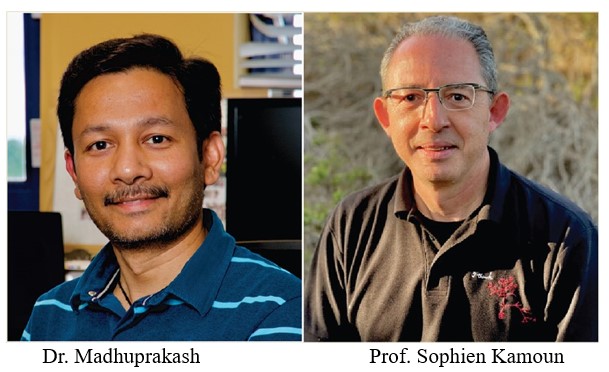
During his study leave from the University of Hyderabad, Dr. Madhuprakash worked in the laboratory of Prof. Sophien Kamoun at The Sainsbury Laboratory (TSL), Norwich, UK, one of the world’s leading centres for research on plant–microbe interactions. There, he became involved in cutting-edge research aimed at understanding how plants recognize and defend themselves against invading pathogens.
Plants rely on specialized intracellular immune receptors, known as NLRs (Nucleotide-binding Leucine-rich Repeat receptors), to detect pathogen invasion and activate defence responses. Through a series of studies published in Science Advances, Dr. Madhuprakash and colleagues uncovered important insights into how these immune receptors function and how pathogens attempt to disable them.
In one study, the team revealed how the helper immune receptor NRC2 assembles into a higher-order activated hexameric complex upon pathogen recognition, providing new insights into the molecular mechanisms that trigger immune signalling in plants. In two subsequent studies, the researchers investigated AVRcap1b, an effector protein produced by Phytophthora infestans, the pathogen responsible for potato late blight, the disease that caused the Great Irish Famine. Their work demonstrated how AVRcap1b suppresses immune responses mediated by the helper NLRs NRC2 and NRC3 by targeting key host cellular components required for immune activation.
Together, these studies provide a deeper understanding of the molecular arms race between plants and pathogens. Beyond their fundamental scientific significance, these findings contribute to ongoing efforts to develop crops with improved and durable disease resistance.
Dr. Madhuprakash gratefully acknowledges Prof. Sophien Kamoun at The Sainsbury Laboratory for providing the opportunity and an exceptional scientific environment that enabled him to gain expertise and contribute to plant intracellular immunity, NLR biology, and pathogen effector mechanisms. He also sincerely thanks the University of Hyderabad for granting study leave, which made this valuable international research experience possible.
Building on this experience, Dr. Madhuprakash has returned to the University of Hyderabad and is establishing plant NLR (immune receptor) biology as a new area of research within the Department of Plant Sciences. This emerging research program brings internationally recognized expertise in plant intracellular immunity to the University and strengthens its research portfolio in contemporary plant biology. Through continued collaboration with Prof. Kamoun and colleagues at The Sainsbury Laboratory, Norwich, UK, Dr. Madhuprakash aims to foster international research partnerships, provide advanced training opportunities for students, and contribute to establishing India as an active participant in the rapidly evolving field of plant immune receptor biology.
Science Advances Publications:
- NRC2 Hexamer paper: DOI: 10.1126/sciadv.adr2594
- AVRcap1b–NbTOL9a study: DOI: 10.1126/sciadv.aea4500
- SlNRC3–AVRcap1b study: DOI: 10.1126/sciadv.aeb1931